
Markets & Economy
Liquidity engineering, IPO mechanics, valuations, trade, and the economics beneath the security story.
Iran's defection from GPS to China's BeiDou, a stalked Finnish satellite over Ukraine, and a NATO assessment of an orbital shrapnel weapon are three signals of one shift: positioning, navigation, and timing has stopped being a neutral utility and become a contested chokepoint — and the law, the insurance market, and every GPS-dependent economy have no answer for it yet. Part I of two.
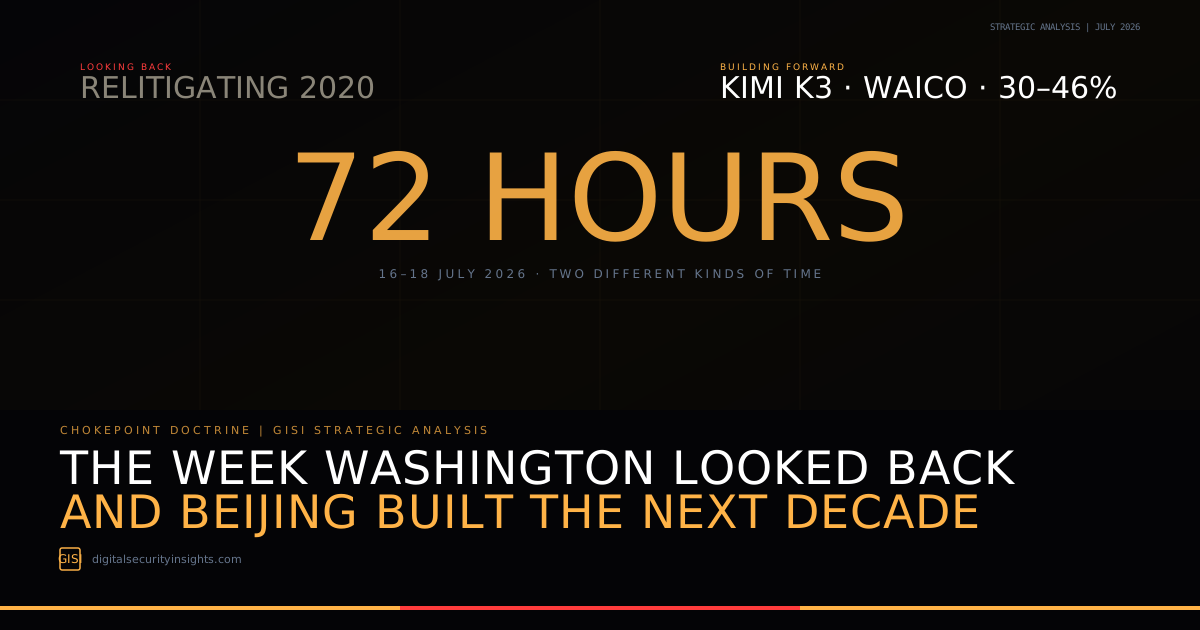
In one seventy-two-hour window in July 2026, four things happened — and only one country spent it building. Washington used primetime to relitigate the 2020 election. Beijing released Kimi K3, the largest open-weight AI model ever published; founded the World AI Cooperation Organization with 29 nations and the UN Secretary-General's endorsement; and kept winning American enterprise adoption, now 30 to 46% of the tokens US companies route. This GISI assessment holds the evidentiary asymmetry explicitly — observable fact, measured data, and contested claim are not the same category of certainty — and maps the state-subsidised industrial playbook China has already run on solar panels and electric vehicles onto AI. Twenty-three-to-one US capital bought a benchmark lead of 2.7 points. Both governments spent the week doing something legitimate. Only one was building something that will still be standing in ten years.
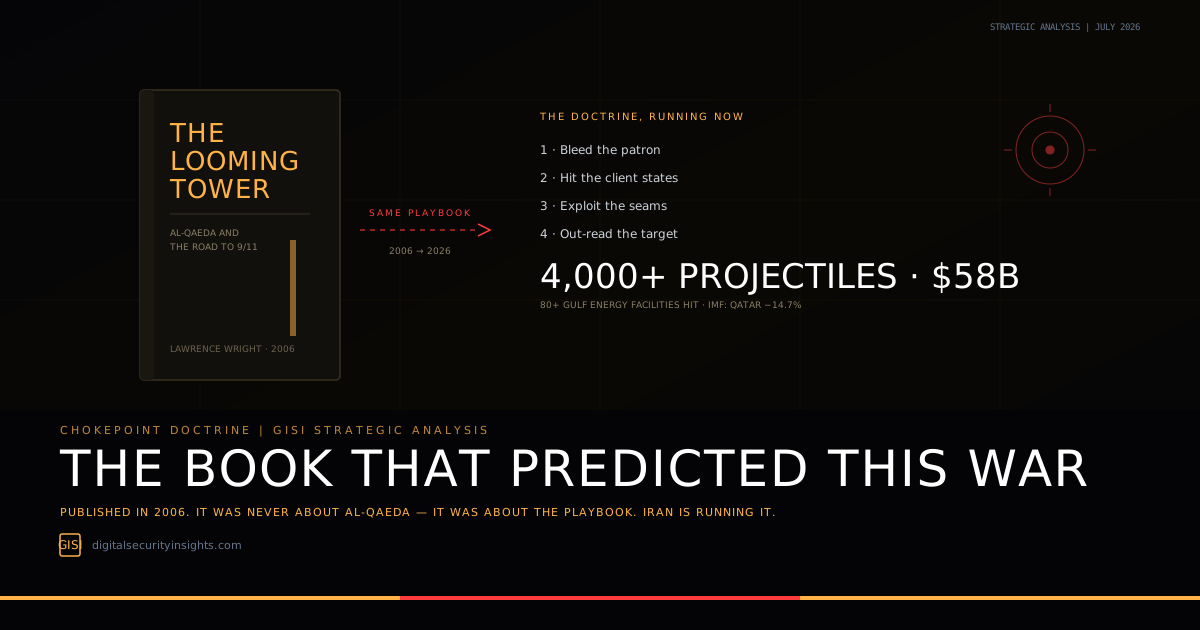
On 13 July 2026, the IRGC declared "the time for restraint is over" and struck US forces across the Gulf — the fifth month of an infrastructure war that has thrown 4,000-plus projectiles at GCC states, damaged 80-plus energy facilities, and pushed the IMF to project Qatar's economy contracting 14.7%. None of it should surprise anyone who has read Lawrence Wright's The Looming Tower. The Pulitzer-winning 2006 account of al-Qaeda was never really about al-Qaeda — it documented a playbook: bleed the patron by making its presence too expensive; hit the client states that host its power; exploit the seams between institutions that will not cooperate; and trust that your read of the superpower's tolerance is more accurate than its own. This GISI assessment maps all four components onto Iran's Gulf campaign in real time — not as moral equivalence, but as strategic logic. The war will not end for the same reason 9/11 was not prevented: not missing information, but institutions unable to assemble what they separately know into the single picture the adversary has already built.

Your voiceprint is not a password. A password can be changed; your voice cannot. In January 2021 Walmart settled for $10M over palm scans of 22,000 Illinois employees; by July it was sued over warehouse-headset voiceprints, then over uploading shoppers' faces to a Clearview AI database - three biometric systems, one company, all under Illinois's Biometric Information Privacy Act, the only US law that lets individuals sue. McDonald's, Chipotle, Verizon, Microsoft Teams face the same claims; 107 BIPA class actions were filed in Illinois in 2025 alone. In 47 of 50 states, collecting your fingerprint, face, or voiceprint needs no consent, no disclosure, and carries no consequence. Under GDPR Article 9 it is special-category data requiring explicit consent, with fines to EUR 20M or 4% of turnover - and the EU AI Act bans workplace emotion inference from 2 August 2026. My assessment: this is not a regulatory gap but a policy choice, applied to the one category of data that is permanent. If the database holding your voiceprint is breached, the credential is compromised for life - and in 47 states no one is obliged to tell you.

Flying back from Ayatollah Khamenei's state funeral in Tehran, Russia's Dmitry Medvedev said the Strait of Hormuz has become a weapon 'no weaker than a nuclear weapon' for Iran - and that Iran holds 'a thermonuclear weapon in reserve, the Bab el-Mandeb Strait.' Medvedev does not speak carelessly. This piece puts his claim under scrutiny: Hormuz carries a fifth of world oil and works as a deterrent whose power derives from the threat, not the use; Bab el-Mandeb carries roughly a tenth of global trade by volume and, as the Houthi campaign proved, can be disrupted by a non-state actor without physical control. The nuclear analogy names the energy market; the thermonuclear analogy names the entire container-shipping architecture. Delivered at a funeral no Western government attended, as France and the UK signal naval deployment to Hormuz and Iran answers with a sovereignty claim, the statement reframes the series' four-month chokepoint map: what this series read as vulnerabilities, Moscow is naming as weapons. The thermonuclear weapon has not been used - which is the most important fact in the statement, and the reason he said it out loud.

Is there an industry ShinyHunters has not breached lately? Food distribution, healthcare, higher education, entertainment, telecoms, finance, the Council of Europe. Sysco: 61 million Salesforce records claimed on 16 June, published after the 18 June deadline, 2,691,852 confirmed on HaveIBeenPwned by 28 June. The question is not who they target. It is whether sector, size, and security budget are all secondary to one variable: whether an unrevoked OAuth token is sitting in your Salesforce connected apps or a 2023 code commit. My assessment: ShinyHunters is not a group you arrest but a brand and a playbook that outlive their operators — one industrialised technique (voice-phish an employee or scan GitHub for forgotten tokens, both bypassing passwords; enumerate the CRM; loop and exfiltrate; extort). The reason the industry keeps being surprised is not sophistication. It is that the monitoring is pointed at the boxes, and the attack happens in the space between them. Every box is governed — identity, exposure, data, software, AI, supply chain, governance. The space between is no one's job. That argument is now a book: The Wrong Map, reading cybersecurity as political economy across Susan Strange's four structures. Contributors welcome — especially the dissenters.

On 2 July 2026, the FBI and IRS Criminal Investigation seized NetNut, a residential proxy service run by the NASDAQ-listed Israeli company Alarum Technologies, after Google and partners degraded the Popa botnet — roughly two million consumer devices, including the Android TV box and smart television under millions of ordinary homes, enrolled with little or no consent. A residential proxy routes criminal traffic through real home connections, so when a target checks the source it sees your ISP and your city, not a data centre. In one week of June 2026, Google's Threat Intelligence Group counted 316 distinct threat clusters — criminal and nation-state — using NetNut exit nodes; a comparable network, IPIDEA, carried APT28, Sandworm, and Volt Typhoon. My assessment: the FBI's advice to avoid cheap streaming boxes is correct and insufficient, and this is not a botnet you kill but a market you would have to close, resilient because the same infrastructure serves legitimate ad-verification and nation-state espionage alike. The connected device is the permanent weak point: the risk rides an access path you never chose to open. What to do today: segment your smart devices onto a separate network, and ask what the box under your television does when the television is off.

From a conference stage, Claus Balslev, head of digitalisation at Denmark's STAR labour-market agency, said the sentence everyone hedges around: if you put data in a US cloud, you share it directly with the US intelligence service. Then he acted on it, migrating STAR's systems off Microsoft and onto European cloud in roughly nine months, and saving money doing it. My assessment: the statement is not rhetoric, it is the precise legal architecture. The CLOUD Act attaches jurisdiction to the US entity, not the data; FISA 702 authorises bulk collection from US providers with no warrant and a gag order; RISAA (2024) extends reach toward the silicon itself; and the 12 June 2026 Fable/Mythos AI suspension proved Washington can switch off the capability globally by letter. Asked under oath before the French Senate in 2025 whether Microsoft could guarantee EU data is never sent to US authorities, Microsoft France's legal-affairs director answered: no. This is not a governance gap but a governance collision, two irreconcilable legal systems applied to the same data, which is why Safe Harbor, Privacy Shield, and soon the current framework all fall. Residency is where the bits sit; sovereignty is who controls access. STAR removed the last excuse, and the AI layer is the next Schrems ruling.

Breaking update. Between 2 and 3am on 28 June 2026, Iran's IRGC launched ballistic missiles and drones at two US military facilities at once - the Ali Al Salem Air Base in Kuwait and the Fifth Fleet headquarters at Salman Port in Bahrain - claiming eight installations destroyed, after a second wave of US strikes on Iran. It is the end of a 48-hour collapse: the drone strike on the container ship Ever Lovely and the IMO's paused evacuation of 11,000 sailors on 25 June, a US strike on the 27th, Iran's drone hit on the tanker Kiku carrying 2 million barrels of crude, a second US strike, and Israel's approval of continued operations in southern Lebanon two days after a ceasefire. The Versailles MOU of 17 June is functionally dead. A week ago, in 'The War That Cannot End,' my assessment was that the MOU was as valid as its weakest enforcement node, and that the node was in Jerusalem. Four written judgments - the Lebanon tripwire, Netanyahu's electoral calendar, Iran's temporal asymmetry, and the resumption of tanker attacks - have now been confirmed in 48 hours. This is a fight over a shipping lane, and Iran is enforcing a claimed sovereignty over Hormuz with ballistic missiles. The MOU was the pause, not the settlement.

In June 2024, Paradigm Initiative proved the largest data leak in Nigerian history by buying it: for 100 naira a record, rogue sites were selling the NIN, BVN, passport, and phone number of 104 million Nigerians from NIMC's database, including the slips of the digital-economy minister and the national data regulator. On 27 June 2026, President Tinubu signed the NIMC Act 2026, replacing a 19-year-old law, and named that same commission the Root Certification Authority for Nigeria's national PKI. My assessment: the Act hardens the cryptography, but the 2024 breach was never cryptographic. It leaked through custody and access, third-party agents with legitimate credentials, the exact layer a certificate hierarchy does not fix. The new 14-agency board (INEC, DSS, EFCC, CBN, the population commission, the national security adviser) concentrates the state's coercive machinery around one dataset. For every Nigerian fintech, identity verification now chains to a single sovereign root you cannot switch away from, held by a custodian with a demonstrated breach history. The law is overdue and much of it is sound. But a root of trust is the one credential that cannot be reissued, and it now sits on the custody layer that already failed once, at the scale of a nation. What to watch: the secondary regulations, the data regulator's enforcement teeth, the access-governance layer, and whether any redress ever reaches the 104 million.

In March 2026, FulcrumSec found an Azure Container Registry token in a public JavaScript bundle on a Novo Nordisk subdomain. Two months later it had walked out with 1.3 terabytes: 41,000 drug compounds, 30 trained AI models, and a marketed drug's manufacturing recipe. The pharmaceutical industry's credential problem, mapped globally.

Why the Strait of Hormuz keeps closing, why the salt caves have a floor, and why Netanyahu's calendar is the variable that no peace deal can govern. Four thousand feet below Louisiana and Texas, the US strategic petroleum reserve sits in salt caverns with a hard physical floor: below roughly 150-250 million barrels of its 714-million capacity, the caves begin to collapse and the oil is lost, not depleted but structurally destroyed. That floor is the clock behind the 17 June Versailles MOU between Trump and Pezeshkian, and behind Trump's urgency for peace. But the deal has a structural flaw visible before the ink dried: its first clause requires a ceasefire on all fronts, and the enforcer on the Lebanese front is a state that never signed it. By 21 June Iran had re-closed Hormuz over continued Israeli strikes in Lebanon; the Switzerland talks then collapsed, JD Vance left without an agreement or a handshake. My assessment: Netanyahu's Lebanon strikes are not a survival calculation but a compulsion, and rational-actor theory cannot model a compulsion. Iran does not need to win; it needs to outlast, and it can absorb punishment that would end any Western government. The MOU is as valid as its weakest enforcement node. That node is in Jerusalem.

Since the 2026 Iran war opened on 28 February, Iran has pushed at least 11.7 million barrels of crude through the Strait of Hormuz it declared closed — every barrel to China, and on 4 March it made the arrangement explicit: only Chinese vessels may pass. The strait was never closed. It was reserved. Western coverage of the 20 June closure reads the map upside down. Hormuz carries ~20 million barrels a day, close to a third of seaborne crude, and almost 90% sails east — China 5.4 mb/d, India, Japan, and South Korea another slice each. The hostage is not the empire; it is the Global South that buys from the Gulf, led by Iran's own creditor. The weapon points home: ~90% of Iranian crude leaves via Kharg and must transit Hormuz, so a blockade of the strait is mechanically a blockade of Iran — which is why Tehran is quietly loading at Jask, beyond the chokepoint. And the leverage belongs to the buyer: China pre-stocked its reserves, kept Brent near $80 when analysts forecast $200, and now sets the price of any closure. Iran holds the geography. Beijing holds the economy of the geography. This is conditional sovereignty in the energy age — the inherited chokepoint exercisable only on terms set elsewhere. Part II of two; Part I is 'The Architecture Beneath the Signature.'

The United States and Iran are the ones signing the deal that ended the 2026 Iran war. Qatar and the UAE are the ones who actually made it possible. The UAE has unlocked $10B for Iran with $3B+ already delivered, in exchange for halted attacks and economic-intelligence cooperation. Qatar holds $6–12B in Iranian frozen assets under custody — the $6B from the September 2023 South Korea transfer, restricted to humanitarian use, never released after October 7. Tehran cannot access any of it without Doha. This is the first major US–Iran deal in fifty years not architected by the United States. The Full Threat Surface framework applied to the deal across four dimensions — physical geography (Hormuz, Al Udeid, the dual-track positioning), logical architecture (the three-layer financial mechanism), governance architecture (the ad-hoc enforcement coalition with no precedent), and adversarial intent (Iranian pragmatists vs hardliners, UAE $500B self-preservation, Qatar's strategic positioning, Trump's narrative needs, Israel's disruption vector). The predictive intelligence layer: four probability-banded scenarios across the oil path from current $80s through December 2027, mapped against Gulf fiscal break-evens (KSA $80, UAE $60, Qatar $45, Kuwait $70). The deeper question the diplomatic coverage is not asking: whether the Gulf states can sustain the mediation through the recession their own success helped to create.

In the early 1990s, exporting strong cryptography from the United States was, legally, exporting a weapon. A T-shirt with RSA source code was a controlled export. Phil Zimmermann spent three years under US Customs investigation for publishing PGP. It took most of a decade — and Executive Order 13026 in November 1996 — to dismantle the regime. The signal, WhatsApp, Telegram, TLS, and every banking app on every phone exist in their current globally-available form because that restriction was eventually lifted. On Friday 12 June 2026, at 5:21pm ET, the same structural argument returned in a sharper form. A letter from the US government to Anthropic. Fable 5 and Mythos 5 suspended for any foreign national worldwide. The artefact has changed — from published math to hosted frontier model. The mechanism has changed — from court enforcement to a configuration flag at a single provider. The argument has not. The market consequence will not either. Whoever fills the gap during the restricted years keeps the customers after liberalisation. The companion historical-precedent piece to “The Export Control That Reached Inside the Model.”

China was first. The EU is third. Singapore governs what neither directly reaches. China’s CAC Measures + GB 45438-2025 took effect 1 September 2025, with audits since October and enforcement actions from January 2026. Singapore’s IMDA Agentic AI framework launched at Davos on 22 January 2026 — non-binding in form, procurement-binding in practice. EU AI Act Article 50 activates 2 August 2026; existing GenAI systems get until 2 December for the marking requirement specifically. California’s SB 942 / AB 853 has been binding for two years. Three different enforcement postures. One convergent architectural requirement: AI-generated content and AI agent actions need to carry a verifiable, machine-readable record of their provenance. The strategic read for builders shipping into global markets, and the architecture that satisfies all four regimes when built once correctly.

How the SpaceX IPO closes the loop on Twitter’s $44 billion loss. The route from a Twitter share purchased October 2022 to a SpaceX share trading on Nasdaq June 12 2026 runs through three sequential all-stock mergers, two paper-valuation revisions, and one record-setting public offering at a $1.75 trillion valuation — without cash changing hands at any intervening step. The Twitter investors who would otherwise be down 80 percent now exit at 2.5x to 3x their original investment. The valuation multiples that justify the IPO — 109x revenue, 265x EBITDA — do not have a clear historical precedent at this scale. This is the first piece in the new GISI Market Economy series and names the technique by its discipline: liquidity engineering.

Smart-TV ACR (Automatic Content Recognition) fingerprints the screen every 500 milliseconds, captures every HDMI input — work laptops, consoles, paired phones — ties the fingerprint to the household IP, and sells. Samsung admitted the architecture out loud in 2015 (in writing, in its privacy policy, transmitting plaintext audio to a third party). The Vizio FTC settlement was 2017. The Texas Attorney General sued five manufacturers in December 2025; Samsung settled on 26 February 2026; Sony, LG, Hisense and TCL are still fighting. The European Union has GDPR and the ePrivacy Directive and has not enforced. This is the fourth node of the DSI commercial-surveillance mosaic after adtech, connected vehicle, and the Handala OSINT convergence. Orwell got the architecture right and the operator wrong: the modern telescreen works for whoever pays.

On 27 April 2026 the Iranian MOIS cover group Handala (Storm-0842) sent personalised WhatsApp messages to US service members at Naval Support Activity Bahrain naming them by rank, unit, and personal phone number, and the next day published the claimed details of 2,379 named US Marines — home address, family, daily commute, shopping habits, nightly leisure. The data was not stolen. It was bought. This convergence article ties the DSI adtech surveillance piece, the connected vehicle piece, and the Handala profile from the Stryker article into a single argument: three commercial data streams, one mosaic, one targeting package, no breach.

USCENTCOM has confirmed it: US forces in active war zones have been targeted using commercial location data bought from adtech brokers. No exploit. No malware. No insider. Just a credit card and a dataset. The Pentagon was first warned in 2016, when contractor Mike Yeagley tracked JSOC personnel from Fort Liberty to a covert facility inside a Lafarge cement factory in Syria using advertising data. A decade later the institutional response has remained a guidance document telling soldiers to review their privacy settings. This DSI piece maps the chain, the reverse pattern of life tradecraft, the carrier layer nobody is regulating, and what adequate protection actually requires.

Two Doctrines, One Coastline named the coalition chokepoint. This piece names what the United Arab Emirates is actually doing inside that coalition. The federation flew Israeli targeting packages out of Al Dhafra against Iranian targets it has held a constitutional grievance with since 1971. The Abu Dhabi capital base has been welded into the American artificial intelligence stack at the chip, model, and platform level — through MGX, OpenAI, Anthropic, the Stargate project, BlackRock, and Microsoft — in commitments that cannot be unwound without vaporising approximately eighty billion dollars of Emirati positioning. The federation will survive the war structurally. The brand promise the survival depended on will not.

The AI cost crisis, the permission problem, and the workforce destruction that is already being reversed. The AI replacement doctrine rested on three assumptions that 2026 has tested to destruction simultaneously: that costs would stay at pilot-phase pricing as deployment scaled, that AI could replicate the human contribution adequately enough to make replacement economically rational, and that AI agents could be granted full access without creating governance obligations the security architecture needed to be built to address. All three assumptions are failing at once, the data confirming each is now unambiguous, and the organisations that built genuine AI governance have a structural advantage over the ones that bought a subscription, fired their people, and are now rehiring them six months later at higher cost.

In April 2026, Riyadh sent Washington a list of named Iranian energy facilities and asked the United States to stop the United Arab Emirates from hitting them. The list was framed as oil-price diplomacy. The complete reading requires reckoning with what Riyadh has been building under its own mountains since 1987: six underground bases, Chinese ballistic missiles, and a four-decade deterrent stack that does not require American greenlight. The Gulf monarchies no longer share a single doctrine. They share a single coastline, and one of them has been running an Iranian-style asymmetric deterrence model in silence since Reagan’s second term.

Hormuz has been closed for weeks. The headlines describe the visible failure — oil. The cascade beneath the headline runs through sulfur, sulfuric acid, copper, and the electrical grids that semiconductor fabs cannot survive without. Part 1 of a five-part GISI series on the physical layer of civilisation — the balance sheet most analysts have never modelled.

Part 1 of The Collective Veto, a three-part GISI series on the political economy of the AI transition. The historical record contains multiple episodes of organised political authority treating specific human populations as disposable inputs to civilisational projects — imperial Chinese Corvée labour across two millennia, the Bengal famine of 1770 under East India Company governance (seven to ten million dead, a quarter to a third of the regional population), and the Aktion T4 euthanasia programme of Nazi Germany (200,000 to 350,000 victims). The post-1945 institutional architecture that constructed against this pattern is, on the historical scale, a brief and atypical interruption. The interruption was sustained not by the Enlightenment vocabulary of natural rights but by the specific structural conditions that made human labour, military service, consumer demand, and political participation irreplaceable inputs to organised production and governance. The artificial intelligence transition is the systematic substitution of artificial systems for those inputs. The coercive instruments through which rights were extracted across the historical record retain their formal legitimacy. They are losing their structural force.

An industry post circulating this week articulated an accurate diagnosis: the subsea cable sector is being asked to deliver 2030 capacity with a 2005 procurement model. The diagnosis is correct. The prescription is incomplete. The three-to-five-year MOU-to-RFS gap is not a market efficiency problem awaiting a market solution. It is a strategic vulnerability that adversaries have already mapped, exploited in active conflict, and that a state actor is systematically addressing through state-subsidised construction priced twenty to thirty percent below Western competitors. HMN Technologies (formerly Huawei Marine Networks) went from 11% market share in 2021 to 18% of global cables laid in the next four years. The Digital Silk Road's stated ambition is 60%. The private build trend the industry post celebrates as innovation is, in documented cases, going to HMN because Western alternatives cannot deliver on timeline or price. ZTT commenced construction of a new cable-laying vessel in August 2025. The 2030 cable infrastructure landscape will be the operational expression of choices being made over the next thirty-six months.

On or around 30 April 2026, a leaked internal Meta all-hands recording articulated, in language attributed to Mark Zuckerberg and not substantively contested by the company, a doctrinal position on AI training data sourcing that the leak's juxtaposition with imminent layoffs made operationally legible. The doctrine has a three-stage operational structure: AI replaces the contractor, the employee trains the AI, the AI replaces the employee. This piece names the doctrine, locates it in the documented record of the past month, identifies the structural verification problem the 'strip-out' assurance produces, examines the strategic-secrecy framing that revealed the firm's true governance posture, traces the compounding economics that make the doctrine irresistible without governance discipline, and proposes the augmentation alternative — opt-in compensated training data contribution, shared productivity gains, verifiable disclosure, explicit board-level doctrinal commitment — that workforce-productive AI architecture actually requires. AI should make organisations productive, not redundant. The claim is a doctrinal position with operational, legal, and competitive consequences. The choice is on every board's desk.

Every large organisation buying AI is having a meeting this quarter about tool selection. Beneath that meeting, a doctrinal question is being answered by default: should intelligence inside the organisation become more centralised or more decentralised as AI is deployed across the operating model? Centralised AI doctrine fits portfolio management, capital allocation, and algorithmic operations. Decentralised AI doctrine fits broker operations, advisory firms, network platforms, and specialty businesses. The commercial pull of the AI vendor ecosystem favours centralisation regardless of which doctrine the customer actually needs. The Ukrainian battlefield has already proven what happens when centralised doctrine meets an adversary that has adopted the decentralised one. The doctrinal question is the highest-order AI risk most boards are not asking — and the next twelve months will reveal which boards have answered it deliberately versus by default.

On 16 May 2026, a joint US-Nigerian precision strike in Mitile killed Abu-Bilal al-Minuki, the second-in-command of the Islamic State. The same year, Nigeria recorded the highest Belt and Road Initiative construction volume on earth — $24.6 billion in Chinese contracts, up from $1.8 billion the year before. Tinubu's government is splitting its great-power dependencies by domain: the United States for intelligence and counterterrorism; China for railways, telecoms, and oil. The arrangement is being studied as the multipolar playbook for the Global South. The complication: the ghost the Eagle is hunting in Lake Chad is one the Eagle helped to birth — through CPA Order 2 in 2003, Camp Bucca, and the August 2012 DIA memo that predicted exactly the outcome it became.

The UAE has exited OPEC after sixty years. This is not a production story. It is the dismantling of the governance architecture that managed the world's most strategic commodity -- and the four scenarios that follow will define oil prices, inflation, and geopolitical stability for the next six months.

China blocks Meta's $2B acquisition of Manus AI and exit-bans its founders, establishing that technological nationality follows people, not incorporation documents. The AI control stack now extends from rare earths through chips and models to the human layer -- the one you cannot replicate.

Brent crude at $101. Urea at $858 per ton. The IEA calls it the biggest energy security threat in history. None of these numbers mean anything until they arrive at the grocery line. And they are arriving now.

On December 30, 2025, a Chinese entity filed for 193,428 satellites. Washington called it spectrum hoarding. Three weeks later, SpaceX filed for one million. The orbital commons is being enclosed by every power that has the launch capacity to participate. The only question is who wrote the filing system.

Three institutions in three weeks. The Corporate Affairs Commission, Remita Payment Services, and Sterling Bank — a systematic campaign against Nigeria's digital infrastructure is draining the trust that a digital economy cannot function without.

The adversary did not build the vulnerability. The adversary found it. How thirty years of privatisation, market logic, and institutional hollowing created the infrastructure crisis the West now blames on Russia, China, and Iran — while simultaneously cutting the agency responsible for defending against them.

In 2012, Iran hit 46 US banks with 140 Gbps DDoS attacks in response to SWIFT sanctions. In March 2026, the IRGC publicly named US and Israeli-linked banks as military targets. Citi, Goldman, Standard Chartered, and HSBC evacuated Gulf offices. Sixty hacktivist groups are active. Handala deploys wiper malware that permanently destroys data. The Bangladesh Bank precedent shows 32 days to restore SWIFT access. AI-generated deepfakes target the human authentication layer above every technical control. The financial chokepoint is where a successful attack disrupts the trust architecture the entire global economy depends on.

Larry Fink controls $14 trillion. He told the world the Iran war ends in one of two extremes: $40 oil and growth, or $150 oil and global recession. Both outcomes end with BlackRock building the tokenised financial system. The Strait of Hormuz is now a toll booth charging in yuan and crypto. The fertiliser chain is collapsing toward a food crisis affecting 363 million people. The welfare loss in Zambia is 20 times larger than in the United States. And the man who prices the war just bought both ends of the Panama Canal. This is predictive intelligence on chokepoint economics, de-dollarisation, and who profits when the world burns.

Sixteen gigawatts of data centre capacity is scheduled to come online this year. Only five gigawatts is under construction. The transformer shortage, grid interconnection queues stretching to seven years, and a bipartisan revolt across American towns have created a bottleneck that no amount of capital can force open. The AI infrastructure buildout has hit the physical limits of the electrical grid — and the security implications of concentrated compute are already being tested by Iranian drones.

The US spent $2 billion a day for the first six days of a war it started. Iran spent $35,000 on a drone. The interceptor missile cost $4 million. The drone destroyed a $485 million radar. The national debt crossed $39 trillion. The interest payments now exceed the defence budget. And the empire just drew a line at the equator and declared half of Africa its security perimeter. Part 3 of The Empire Looks South.

Professor David Gibbs told Sovereign Media that when you create a military this enormous, you have to use it periodically. He is right. The United States spends $997 billion a year on defence, maintains 750 bases across 80 countries, and has fought five wars in two decades. The machine does not respond to threats. It manufactures them. From Eisenhower’s warning to the One Per Cent Doctrine to the bombing of Iran on the eve of a diplomatic breakthrough — this is the anatomy of a system that cannot stop.

The most-cited energy analyst in the world told you the global economy could collapse by May if Hormuz stays closed. He is right about the timeline. He is wrong about why. The crisis is not barrels — it is that every barrel now moves through infrastructure that is simultaneously physical and digital, kinetic and networked. And the invisible half is under attack.

The EU AI Act demands conformity assessments. Nigeria's AI bill requires mandatory registration. Kenya just forced Worldcoin to delete all biometric data. India chose no risk classification at all. For organisations deploying AI across African markets, the regulatory fracture is not a governance challenge — it is a barrier to existence.

"Ohun ti a ba gbin la o ka a" — what one plants is what one reaps. Iran presented five conditions for peace. One of them was a bill. Through a 21-mile strait, a $2M yuan toll, and reparations demanded in non-dollar currencies, a financially isolated nation used every weapon except the ones America expected.

The twelve-day war consumed up to 25% of America's THAAD stockpile. Restocking takes 3-8 years. Iran replenishes in months. A Shahed drone costs $20K. The interceptor that destroys it costs $4.2M. The mathematics of this conflict favour the attacker by 200 to 1 — and the factories cannot close the gap.

Iran's unprecedented demand for $100 billion in war reparations from the United States, backed by the Strait of Hormuz and payable in non-dollar currencies, may matter more to the future of American power than anything that happened on the battlefield.

A $20K Shahed drone versus a $4.2M Patriot interceptor. A 200:1 cost ratio in the attacker's favour. US interceptor stocks at 25% of required levels, with no new THAAD deliveries until 2027. The defence economics of the Iran war are rewriting the strategic calculus from the Gulf to the Taiwan Strait.

Third-party vendor networks are the most compromised vector in Western defence. This briefing maps two decades of state-sponsored intrusions through the supply chain — from the F-35 theft to today's access broker markets — and explains why CMMC cannot fix a problem this structural.

How a twelve-day conflict is quietly rewriting the terms of global order — and why common sense was the first casualty. The actuaries moved before the generals did, and insurance markets are now pricing in a reality that diplomats refuse to acknowledge.

A cartoon about a mad scientist's car explains neocolonialism better than a thousand academic papers. 'That just sounds like slavery with extra steps.' And right now, in 2026, the battery is realizing what it is.

January 3, 2026 established a new doctrine: existing indictments plus presidential authority equals legal permission to bomb capitals and extract heads of state. No congressional debate. No UN authorization. Just Article II and Delta Force.

Germany's transformation from Europe's industrial powerhouse to a cautionary tale about energy security was a carefully constructed suicide note, written in renewable energy pledges and geopolitical virtue signaling.

Washington's 'India will replace China' strategy represents a fundamental misunderstanding of how economies, capabilities, and strategic relationships actually work. Trump's 48-hour humiliation campaign was the public acknowledgment of a decade-long strategic failure.

Western powers deploy economic pressure assuming their targets will submit to isolation, yet consistently witness the opposite: accelerated innovation, deeper cooperation among sanctioned states, and the rapid construction of alternative systems.