

The Renewable Crop
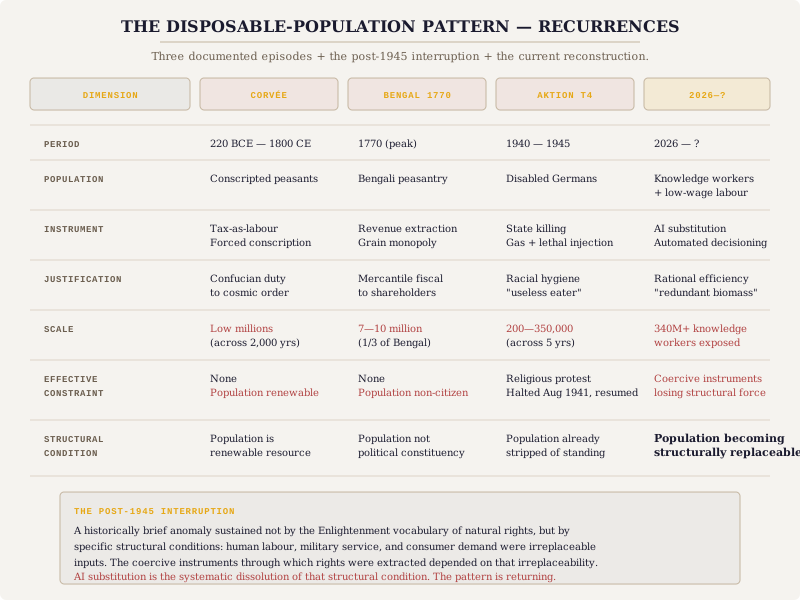
Part 1 of The Collective Veto, a three-part GISI series on the political economy of the AI transition. The historical record contains multiple episodes of organised political authority treating specific human populations as disposable inputs to civilisational projects — imperial Chinese Corvée labour across two millennia, the Bengal famine of 1770 under East India Company governance (seven to ten million dead, a quarter to a third of the regional population), and the Aktion T4 euthanasia programme of Nazi Germany (200,000 to 350,000 victims). The post-1945 institutional architecture that constructed against this pattern is, on the historical scale, a brief and atypical interruption. The interruption was sustained not by the Enlightenment vocabulary of natural rights but by the specific structural conditions that made human labour, military service, consumer demand, and political participation irreplaceable inputs to organised production and governance. The artificial intelligence transition is the systematic substitution of artificial systems for those inputs. The coercive instruments through which rights were extracted across the historical record retain their formal legitimacy. They are losing their structural force.
This is Part 1 of The Collective Veto, a three-part GISI series on the political economy of the AI transition. Part 1 establishes the historical pattern of civilisations that organised around populations they could afford to waste. Part 2 will map the over-determining forces locking in a maximally-automated economy in the absence of deliberate intervention. Part 3 will examine the coercive leverage that retains effective force, and what is required to apply it. The series is grounded in the analytical proposition that the Enlightenment-era language of natural rights is a post-hoc rationalisation of rights that were extracted through coercive force, and that the conditions which made the extraction effective are being reconstructed in directions that the Enlightenment vocabulary is structurally unable to describe.
The Crop That Came Up Every Year
The Qin emperor who built the first unified Great Wall of China did not, by any contemporaneous account that survives, regard the deaths of his conscripted labourers as a meaningful constraint on the project. The labourers were drawn from the fertile river valleys of the Yellow and Yangtze basins, regions whose agricultural productivity produced a population surplus that imperial planning could deploy against the construction objectives of the dynasty without disturbing the underlying economic base. The labourers worked under the Corvée system — forced unpaid labour conscripted from peasant households as a tax obligation owed to the imperial state — in conditions whose mortality rates were not a hidden cost of construction but an expected operating parameter. Hundreds of thousands of Corvée labourers died during the Qin Great Wall construction. The Han, Sui, Tang, Yuan, Ming, and Qing dynasties continued the system across two thousand years of imperial governance, applying it to canals, mausoleums, river-control infrastructure, and the recurring reconstruction of the Wall itself. The total number of Corvée deaths across the system’s operational lifetime cannot be calculated with precision, but the order of magnitude is in the low millions across the dynastic period.
The Corvée system worked because the population that supplied it was, in the operational frame of imperial planning, a renewable resource. The crop came up every year. The labourers who died at the Wall were replaced by the next cohort of conscripted peasants the following season. The structural condition was the productivity of the river-valley agriculture combined with the demographic patterns it sustained. The imperial state did not need to economise on the lives of the labourers because the lives were, in the relevant accounting, free at the margin and continuously replenished.
This piece is not a history of imperial China. It is the opening of an analytical sequence whose proposition is that the structural condition that made Corvée operationally viable — the treatment of a human population as a renewable resource that the central authority could afford to waste — is the structural condition that the contemporary AI transition is reconstructing in ways that the post-1945 rights regime is not equipped to describe, much less prevent. The historical record contains multiple episodes of this pattern. The post-1945 interruption that suspended the pattern across the wealthier zones of the global economy is, on inspection, the anomaly rather than the norm. The conditions that made the pattern previously possible are being assembled again. The Enlightenment-era vocabulary of natural rights, dignified individuality, and inalienable human worth is the vocabulary that emerged to describe the brief interruption, and the vocabulary is not load-bearing against the conditions now returning.
Three Episodes That Should Not Be Forgotten
The historical record is dense with episodes in which organised political authority treated specific human populations as disposable inputs to civilisational projects. Three episodes are worth engaging in detail because the structural mechanics across them are sufficiently similar to constitute a pattern, and because the pattern’s recurrence under different ideological framings — Confucian imperial, mercantile colonial, racial-totalitarian — demonstrates that the pattern is not an artefact of any particular political ideology. The pattern is what civilisations produce when the structural conditions for it are present and the institutional constraints against it are absent.
Imperial Chinese Corvée
The Corvée labour system in imperial China was the operational instrument through which the Qin, Han, and successor dynasties executed the construction projects that historians retrospectively classify as the foundational infrastructure of Chinese civilisation. The Grand Canal, completed under the Sui dynasty in the seventh century CE and extended subsequently, required the conscription of approximately five million labourers across its principal construction phase, with mortality rates that contemporary Tang and later sources describe as devastating to the conscripted communities. The Great Wall’s Qin-era construction, between approximately 220 and 206 BCE, conscripted an estimated 300,000 to 500,000 labourers depending on the source, with mortality estimates in the hundreds of thousands. The Ming-era reconstructions of the Wall, executed across the fifteenth and sixteenth centuries CE, conscripted at similar scale across multi-decade construction campaigns. The Qing emperors continued the system into the eighteenth century.
The justification structure was Confucian and dynastic. The labourer’s obligation to the imperial centre was articulated as a moral duty owed to the cosmic order of which the emperor was the earthly expression. The labourer’s death in the execution of that duty was assimilated to the broader framework of obligation that defined the labourer’s social being. The death was not denied; it was metabolised by a governance framework that did not classify the death as a cost requiring justification. The crop came up every year.
Bengal Under the East India Company, 1770
The Bengal famine of 1770 was the operational consequence of a governance configuration that did not require a particular ideological commitment to disposable populations. It required only the absence of institutional constraint against the consequences of revenue extraction conducted against the agricultural base of a population the extracting authority did not regard as its political constituency. The British East India Company had obtained the diwani — the right to collect revenue — in Bengal in 1765 through the Treaty of Allahabad with the Mughal emperor. The Company collected revenue at maximum extractive rates across the subsequent five years, including across the crop failure of autumn 1768 and the broader agricultural collapse of summer 1769. The Company purchased substantial portions of remaining rice production for its army. The Company’s private servants and their Indian agents established local grain monopolies that drove prices beyond the reach of the agricultural population that had grown the grain in the first place.
This analysis is published. Your decision isn't.
We run the same cross-domain, scenario-based foresight on the decision in front of you — a deal, a market entry, a supplier dependency. Board-ready in five days, with a foresight indicator watchlist.