

The Doctrine Question
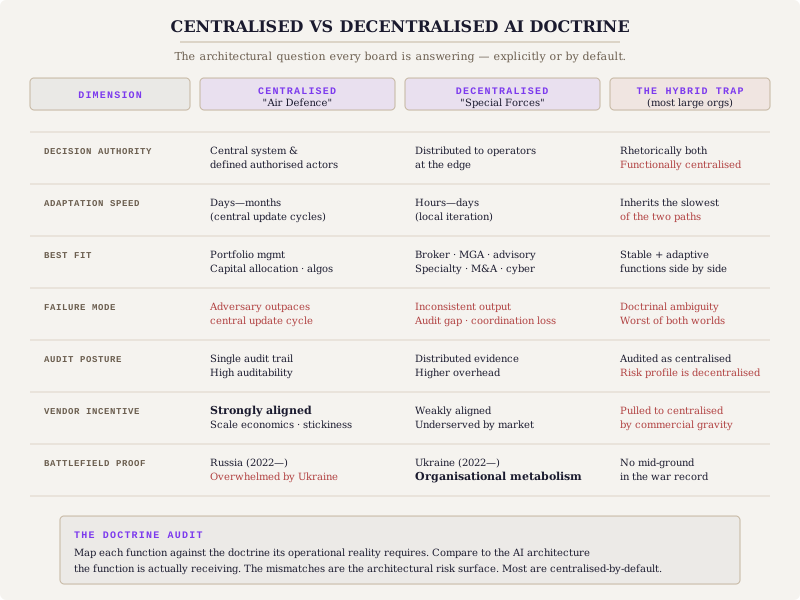
Every large organisation buying AI is having a meeting this quarter about tool selection. Beneath that meeting, a doctrinal question is being answered by default: should intelligence inside the organisation become more centralised or more decentralised as AI is deployed across the operating model? Centralised AI doctrine fits portfolio management, capital allocation, and algorithmic operations. Decentralised AI doctrine fits broker operations, advisory firms, network platforms, and specialty businesses. The commercial pull of the AI vendor ecosystem favours centralisation regardless of which doctrine the customer actually needs. The Ukrainian battlefield has already proven what happens when centralised doctrine meets an adversary that has adopted the decentralised one. The doctrinal question is the highest-order AI risk most boards are not asking — and the next twelve months will reveal which boards have answered it deliberately versus by default.
This briefing names the question every board is answering by default while debating the question it thinks it is answering. AI tool selection is the visible meeting. AI architectural doctrine is the meeting beneath it. The doctrine choice is the risk decision. Most organisations are not making it deliberately.
The Meeting Beneath the Meeting
There is a meeting happening this quarter in every large organisation that is buying AI. The meeting is ostensibly about tool selection. Which platform. Which vendor. Which integration layer. Which pilot programme. Which model family. Which deployment posture. The participants are the chief information officer, the chief data officer, the head of risk, the chief operating officer, occasionally a board member with technology in their brief. The questions on the agenda are the questions the market trains organisations to ask. Cost per query. Model governance. Training data residency. Integration with existing systems. Time to deployment. The procurement signals are clear, the comparison matrices are constructed, the pilot budgets are approved.
The question that is not on the agenda is the question that determines whether the deployment will produce strategic value or strategic vulnerability. That question is not a tooling question. It is a doctrinal question. And the organisations that are not asking it are answering it by default — usually in favour of a doctrine that does not match the operational reality in which the organisation is actually competing.
The doctrinal question runs as follows. Should intelligence inside the organisation become more centralised or more decentralised as artificial intelligence is deployed across the operating model? Should the AI architecture concentrate situational awareness, decision support, and machine-speed response at a coordinating centre, or should it distribute initiative, judgement, and adaptive capability to operators at the edge of the organisation? The two options are not merely technical configurations. They are operational doctrines. They determine where human judgement remains decisive, where machine output is permitted to act, and where the institutional risk surface is concentrated when the system encounters conditions it was not designed for.
This briefing names the doctrinal question, traces the commercial forces that are biasing the default answer, locates the documented battlefield case in which the doctrinal choice has already been operationally tested, and proposes the doctrine audit that board risk committees should be running before the next AI investment cycle commits the organisation to an architectural posture it has not deliberately chosen.
Two AI Doctrines
The doctrines are not new categories invented for the AI question. They are the long-standing categories that military doctrine has used to describe the trade-off between integrated command and distributed initiative. The AI revolution has imported the trade-off into the operational design of every large civilian organisation, and the categories that the military discourse has been refining for a century now apply, with minor adaptations, to the architectural choices that civilian boards are quietly making.
The centralised AI doctrine corresponds, in military terms, to the architecture of integrated air defence. Sensors across the operational environment feed data into a central processing capability. The central capability constructs a unified operational picture. Coordinated decision support is provided to authorised actors. Response is calibrated to the shared situational awareness. Ambiguity is minimised through integration. The doctrine excels at problems where the operating environment is observable, where the threat set is enumerable, where the decision rules are stateable, and where the value of consistency exceeds the value of locally varied response. Portfolio management functions in financial services operate this way. Enterprise risk aggregation operates this way. Algorithmic trading operates this way. Personal lines insurance underwriting operates this way. Air traffic control operates this way. The doctrine is appropriate, defensible, and increasingly well-supported by the AI vendor ecosystem that has emerged to serve it.
The decentralised AI doctrine corresponds, in military terms, to the architecture of special operations forces. Decision authority is distributed to operators with deep local knowledge. Initiative is rewarded. Coordination is loose, networked, and dependent on shared mission intent rather than centralised command. The operating environment is treated as fundamentally uncertain, the threat set as adaptive, the decision rules as situationally dependent, and the value of speed-of-local-judgement as exceeding the value of integrated consistency. Specialty insurance broker operations function this way. Investment banking advisory work functions this way. Elite professional services firm engagements function this way. Distributed cyber defence functions this way. The doctrine is appropriate, defensible, and structurally underserved by the AI vendor ecosystem that has organised itself around the centralised model.
The complication that determines the doctrinal question for most boards is that most large organisations are operationally both. They contain portfolio functions that run on centralised doctrine and advisory functions that run on decentralised doctrine. They contain platform businesses whose architecture is centralised by design and network businesses whose architecture is decentralised by necessity. They contain standardised products that require consistency and bespoke engagements that require initiative. The doctrinal question is not which doctrine the organisation should adopt wholesale. The doctrinal question is which doctrine should govern which dimension of the operating model, and whether the AI architecture currently being procured is being matched to the doctrinal requirements of each dimension or is being applied uniformly across dimensions that require different architectures.
The Commercial Pull Toward Centralisation
The default that most organisations are converging toward is centralisation. The convergence is not a function of analytical deliberation. It is a function of commercial gravity in the AI vendor ecosystem, and the gravity deserves to be named precisely because the gravity is exerting force regardless of whether the organisation is conscious of being moved by it.
The economic logic of large AI infrastructure vendors favours centralised deployment for reasons that have nothing to do with the operational appropriateness of centralisation for any particular customer. Centralised AI architectures generate higher per-deployment revenues because the integration scope is larger. Centralised architectures produce stickier customer relationships because the cost of switching from one centralised platform to another is substantial. Centralised architectures generate the operational data that improves the vendor&rsqu
This analysis is published. Your decision isn't.
We run the same cross-domain, scenario-based foresight on the decision in front of you — a deal, a market entry, a supplier dependency. Board-ready in five days, with a foresight indicator watchlist.