

The Cable Gap
An industry post circulating this week articulated an accurate diagnosis: the subsea cable sector is being asked to deliver 2030 capacity with a 2005 procurement model. The diagnosis is correct. The prescription is incomplete. The three-to-five-year MOU-to-RFS gap is not a market efficiency problem awaiting a market solution. It is a strategic vulnerability that adversaries have already mapped, exploited in active conflict, and that a state actor is systematically addressing through state-subsidised construction priced twenty to thirty percent below Western competitors. HMN Technologies (formerly Huawei Marine Networks) went from 11% market share in 2021 to 18% of global cables laid in the next four years. The Digital Silk Road's stated ambition is 60%. The private build trend the industry post celebrates as innovation is, in documented cases, going to HMN because Western alternatives cannot deliver on timeline or price. ZTT commenced construction of a new cable-laying vessel in August 2025. The 2030 cable infrastructure landscape will be the operational expression of choices being made over the next thirty-six months.
This briefing extends an accurate industry-side diagnosis — that the subsea cable sector is being asked to deliver 2030 capacity with a 2005 procurement model — to the strategic conclusion the industry-side discussion stops short of. The Chokepoint Doctrine series has documented the cable repair-fleet gap, the Iranian cable toll demand, and the LEO dependency layer that sits underneath both. This piece maps what the procurement gap is producing where the Western consortium model cannot deliver on the timeline or price the market requires: a market share trajectory that the Digital Silk Road has stated, in its own planning documents, that it intends to terminate at sixty percent of the global fibre-optic cable market.
The Diagnosis Is Correct. The Prescription Is Incomplete.
A post circulating in the subsea cable industry this week articulated an observation that is accurate, important, and widely shared among practitioners. The subsea cable industry is being asked to deliver 2030 capacity with a 2005 procurement model. Hyperscaler demand, AI traffic growth, and end-of-life replacement cycles are stacking up against a Western consortium architecture in which a typical cable still takes three to five years from memorandum of understanding to ready-for-service. Cableships take years to build. Skilled jointers take years to train. The market does not have those years remaining in the supply pipeline that the procurement model assumes is available.
The post is right about the diagnosis. Where it stops is precisely where the strategic analysis most urgently needs to continue.
The three-to-five-year procurement gap is not merely a market efficiency problem waiting for a market solution. It is a strategic vulnerability that has already been mapped by adversaries, exploited in active conflict, and is being systematically addressed by a state actor whose solution to the Western procurement speed problem is not a better consortium model. The solution is state-subsidised construction, priced twenty to thirty percent below Western competitors, delivered faster, embedded in a geopolitical strategy whose explicit ambition is sixty percent of the global fibre-optic cable market.
The private build trend that the original post correctly identifies as a market innovation is real. What the post does not state, and what the strategic record has now made undeniable, is that in a growing share of cases across Asia, Africa, the Middle East, and the Pacific, the private build going fastest and cheapest is the one delivered by HMN Technologies — formerly Huawei Marine Networks, now operating under Hengtong Group ownership, still the world’s fastest-growing subsea cable builder, still carrying the strategic objectives of China’s Digital Silk Road whether or not the corporate rebranding obscures the connection.
This piece extends the post’s diagnosis to its strategic conclusion.
The Four Companies and What the Market Share Actually Means
The subsea cable manufacturing and installation market is one of the most concentrated sectors in global infrastructure. Approximately ninety-eight percent of the world’s undersea cables are manufactured and installed by four private firms: SubCom in the United States, Alcatel Submarine Networks in France, Nippon Electric Company in Japan, and HMN Technologies in China. In 2021, the United States, French, and Japanese firms collectively held an eighty-seven percent market share, with HMN Technologies holding the remaining eleven percent.
The eleven percent figure is the 2021 baseline. The trajectory since then is the analytically important number. HMN Technologies has become the fastest-growing subsea cable builder over the past decade, laying eighteen percent of the world’s subsea cables in the most recent four-year window. From eleven percent market share to eighteen percent of global cables laid in four years — a trajectory that, if sustained, reaches the Digital Silk Road’s stated ambition of sixty percent market capture on a timeline that the Western procurement model cannot respond to adequately.
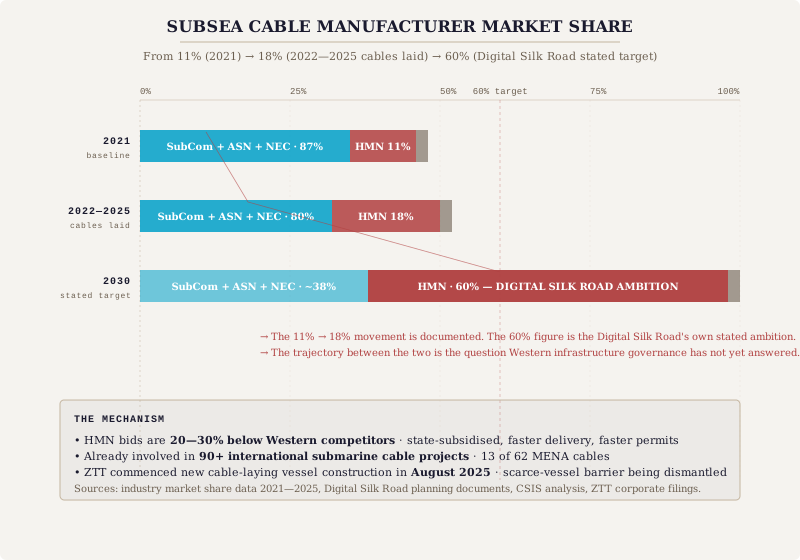
HMN Technologies’ bids on undersea cable projects are priced twenty to thirty percent below those of its rivals, which has helped China secure increasing deal volume across the past decade. Even where HMN Technologies is still perceived as offering lower-quality technology than its Western competitors, it can offer dramatically cheaper contracts than Western firms are able to match without operating at structural losses that their commercial governance does not permit.
The price differential is the mechanism through which the procurement gap is being resolved in practice — not by fixing the Western consortium model, but by routing around it. An emerging market government or a hyperscaler operating under a delivery timeline that the Western three-to-five-year MOU-to-RFS cycle cannot meet faces a binary choice: wait for the Western consortium, or accept the Chinese alternative that can deliver faster and cheaper. In a documented and growing number of cases, the choice is the Chinese alternative.
HMN Technologies’ involvement in over ninety international submarine cable projects is the operational scale that the market share trajectory implies. Chinese state-backed cable companies operate as both commercial entities and instruments of state strategy, with the boundary between enterprise and geopolitics deliberately blurred by the governance architecture of the Chinese industrial-policy state. Unlike Western firms which remain largely beholden to market incentives, Chinese telecommunications operators must align with national priorities that include the Digital Silk Road and the Belt and Road Initiative, both of which treat cable infrastructure as strategic assets rather than as neutral commercial products.
The private build that bypasses traditional consortium dynamics — which the LinkedIn post identifies as a market innovation — is, in the cases where HMN is the selected vendor, not a rejection of state involvement in cable infrastructure. It is the replacement of Western-consortium state adjacency with Chinese-state directionality. The governance framework that is bypassed by the private build is the one that embedded national security review, allied-nation consultation, and landing rights assessment into the procurement process. What replaces it is faster delivery, lower cost, and a vendor whose strategic objectives are documented in Chinese national planning documents that have been publicly available for the better part of a decade.
The Geography That the Procurement Gap Has Already Ceded
The procurement model failure has not produced an even degradation of Western cable market position across all geographies. It has produced a specific geographic pattern, and the pattern maps almost precisely onto the regions where cable infrastructure is most strategically important.
Assessing supply chain or infrastructure risk for a decision ahead?
DSI Advisory Services helps boards, business leaders, defence institutions, and security leaders understand threats before they reach the horizon — where cyber, geopolitics, and business risk converge.