

You Didn't Hire a Replacement. You Bought a Subscription That Is Billing You Into a Corner.
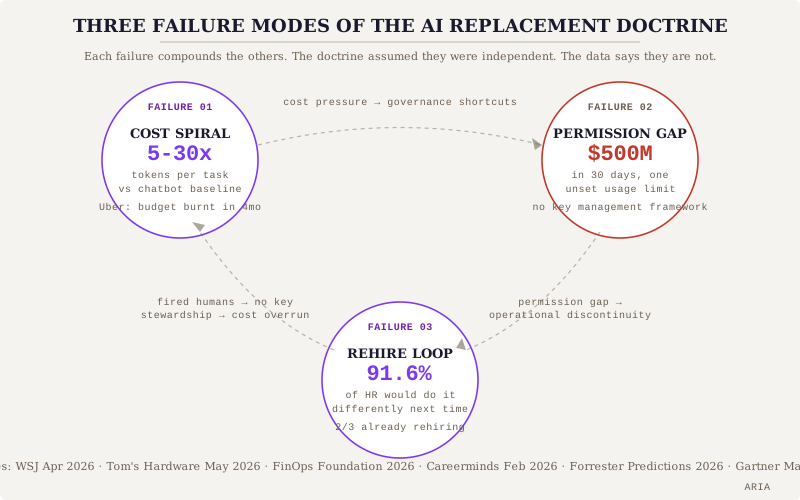
The AI cost crisis, the permission problem, and the workforce destruction that is already being reversed. The AI replacement doctrine rested on three assumptions that 2026 has tested to destruction simultaneously: that costs would stay at pilot-phase pricing as deployment scaled, that AI could replicate the human contribution adequately enough to make replacement economically rational, and that AI agents could be granted full access without creating governance obligations the security architecture needed to be built to address. All three assumptions are failing at once, the data confirming each is now unambiguous, and the organisations that built genuine AI governance have a structural advantage over the ones that bought a subscription, fired their people, and are now rehiring them six months later at higher cost.
The AI replacement doctrine rested on three assumptions that 2026 has tested to destruction simultaneously. This is the ARIA reading of all three failure modes converging at the same time: the token cost crisis, the permission architecture problem, and the workforce destruction that is already being reversed.
The Reckoning That Was Always Coming
There is a moment in every technology hype cycle when the gap between the promise and the invoice becomes impossible to ignore. For enterprise AI in 2026, that moment has arrived — not quietly, not gradually, but in the specific and spectacular form of a company that spent half a billion dollars on Claude in a single month because nobody remembered to set a usage limit on employee licences.
The Tom’s Hardware report that broke the story attributed the revelation to an AI consultant speaking to Axios. The scale of the overspend — $500 million in thirty days — narrows the candidate pool to only the very largest corporations on earth. The identity of the company is less important than what the incident confirms: the AI procurement model that most enterprises have adopted in 2025 and 2026 was designed for a threat environment that did not include their own employees.
In April 2026, Deloitte published a comprehensive CFO guide specifically on AI token economics — a topic that did not exist on finance radar 18 months ago. Finance leaders across industries are watching AI spend spiral past forecasts, past budgets, and past any recognisable pattern from traditional software procurement.
The Wall Street Journal reported what practitioners already knew: enterprises that were quick to embrace AI spending are now hitting their annual budgets in three months, watching AI spending bills double and triple, and scrambling to ration use, steer workers toward cheaper tools, and figure out whether the investment is delivering anything that justifies the invoice. Uber’s CTO confirmed to The Information that the company burned through its entire 2026 AI budget in four months — driven by Claude Code adoption that jumped from 32% to 84% of its 5,000-engineer organisation, with monthly API costs per engineer ranging from $500 to $2,000. The company is, in the CTO’s own words, "back to the drawing board" on budgeting.
The FinOps Foundation’s 2026 State of FinOps report found that 73% of enterprises reported their AI costs exceeded original projections. Price and invoice are moving in opposite directions.
73% of enterprises. Not a minority of poorly managed deployments. Nearly three quarters of the organisations that deployed enterprise AI at scale are now discovering that the cost model they agreed to was not the cost model that materialised in production. The gap between the projection and the invoice is not a budgeting failure. It is an architectural one — and understanding why requires understanding what changed between the pilot and the production deployment.
The Agentic Multiplier Nobody Modelled
The AI budget crisis has a specific technical cause that most executive briefings on the topic have not adequately explained to the people making the budget decisions.
Enterprise AI deployments in 2024 and early 2025 were predominantly chatbot-model deployments. An employee asks a question, the model responds, the interaction ends. The token consumption per interaction is bounded, predictable, and roughly proportional to the length of the question and the answer. The cost models that justified most enterprise AI business cases were built on this assumption.
Gartner’s March 2026 analysis confirms that agentic AI models require 5 to 30 times more tokens per task than standard chatbots. Enterprises that piloted AI with single-query chatbots and then deployed multi-step agentic workflows at scale experienced cost multiplications they had not modelled. The ROI calculations that justified the agentic deployment often assumed chatbot-level token consumption per workflow — the real numbers were an order of magnitude higher.
An agentic workflow does not ask one question and receive one answer. It breaks a task into steps, executes each step, evaluates the result, decides whether to proceed or adjust, executes the next step, and maintains context across the entire sequence. Every step consumes tokens. Every evaluation consumes tokens. Every adjustment consumes tokens. The context maintained across the sequence — the memory of what has been done, what the goal is, what constraints apply — consumes tokens for every subsequent step. A single agentic task that a human analyst would complete in thirty minutes can consume 10 to 50 times the tokens of a basic prompt-response exchange.
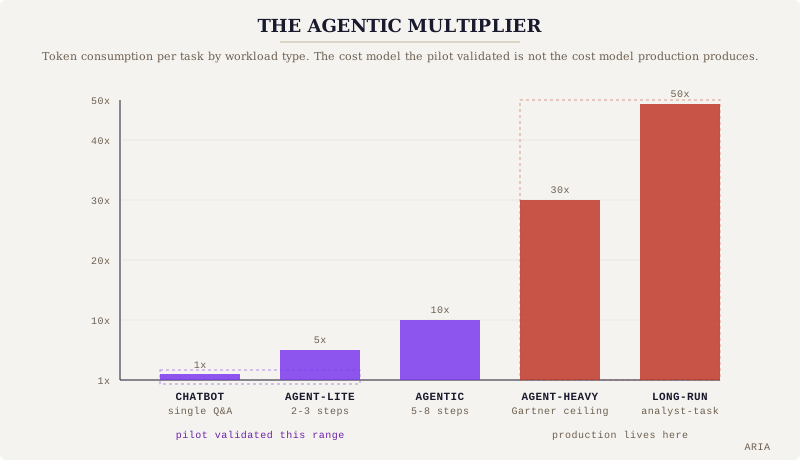
A single agent task can use 10 to 50 times the tokens of a basic prompt-response exchange. With a 4,500 times pricing spread between cheapest and most expensive models, using premium models for simple tasks burns budgets 10 to 100 times faster than necessary.
The employee who uses Claude to check the weather — documented in the WSJ and Axios reporting as a real phenomenon inside major enterprises — is not burning meaningful budget. The employee who uses a frontier model to execute an agentic workflow for a task that a budget-tier model could have handled adequately is burning budget at a rate that was not included in the business case that justified the deployment. And the employee who uses an agentic AI system to automate a dreary task they do not want to do — rather than a valuable task that justifies the compute cost — is the pattern that Amazon’s internal AI usage leaderboard was inadvertently incentivising before Amazon scrapped it.
Microsoft’s Experiences and Devices division, which covers Windows, Microsoft 365, Outlook, Teams, and Surface, is winding down most Claude Code usage by June 30, 2026. The timing aligns with the end of Microsoft’s fiscal year, and financial considerations influenced the decision. Microsoft — a company whose Azure infrastructure is the compute substrate on which much of the AI industry runs — is pulling back on Claude Code usage because the cost does not justify the return. That is not a small signal. That is the largest enterprise software company on earth announcing that the AI product it was deploying at scale is not delivering the value that the cost requires.
The Permission Problem Nobody Wants to Talk About
The social-media post that circulated alongside these stories named something that the corporate AI procurement conversation has been systematically avoiding: to do its job, the AI agent needs access. Full access. Your systems, your patents, your contracts, your future plans. Everything you spent years building, handed to a process that has no loyalty, no discretion, and no skin in the game.
Need intelligence like this on a decision you're facing?
DSI Advisory Services helps boards, business leaders, defence institutions, and security leaders understand threats before they reach the horizon — where cyber, geopolitics, and business risk converge.