
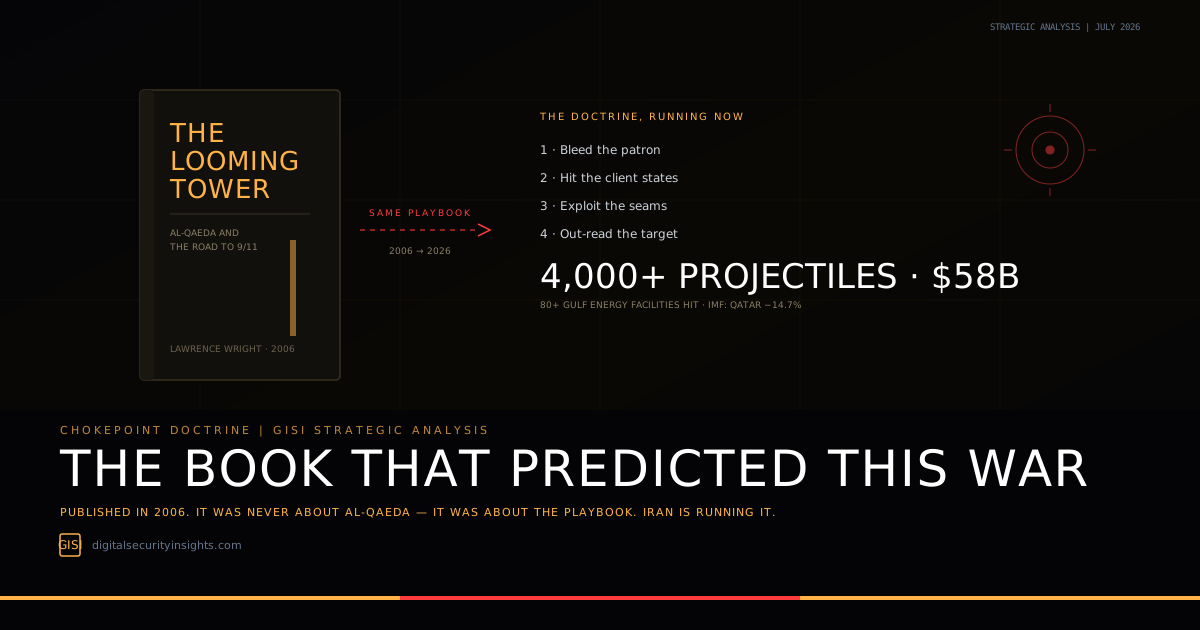
The Book That Predicted This War Was Published in 2006
On 13 July 2026, the IRGC declared "the time for restraint is over" and struck US forces across the Gulf — the fifth month of an infrastructure war that has thrown 4,000-plus projectiles at GCC states, damaged 80-plus energy facilities, and pushed the IMF to project Qatar's economy contracting 14.7%. None of it should surprise anyone who has read Lawrence Wright's The Looming Tower. The Pulitzer-winning 2006 account of al-Qaeda was never really about al-Qaeda — it documented a playbook: bleed the patron by making its presence too expensive; hit the client states that host its power; exploit the seams between institutions that will not cooperate; and trust that your read of the superpower's tolerance is more accurate than its own. This GISI assessment maps all four components onto Iran's Gulf campaign in real time — not as moral equivalence, but as strategic logic. The war will not end for the same reason 9/11 was not prevented: not missing information, but institutions unable to assemble what they separately know into the single picture the adversary has already built.
A Warning From July 13, 2026
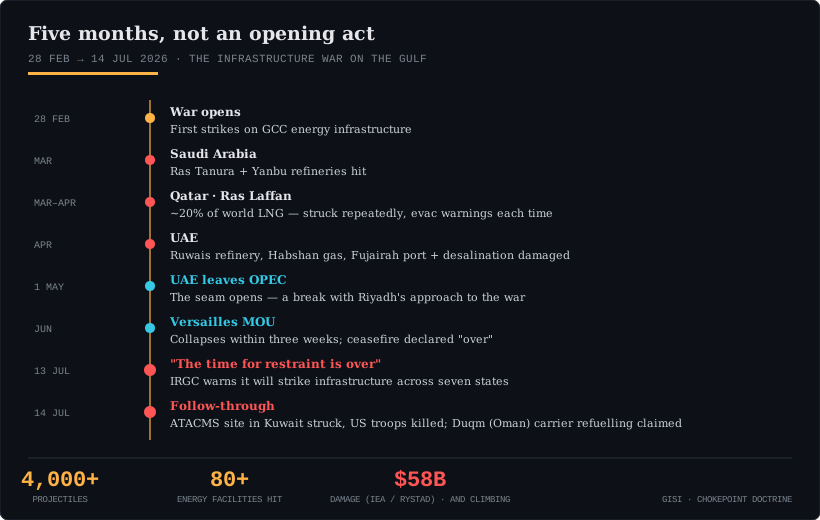
At 4:00pm on Sunday, July 13, 2026, IRGC spokesman Brigadier General Hossein Mohebbi delivered a statement carried by Iranian state media that deserves to be read in full, because every clause in it is doing strategic work. "The time for restraint is over." Iran would now target the infrastructure belonging to American-Israeli forces in the UAE, Saudi Arabia, Kuwait, Bahrain, Jordan, Qatar, and all their partners. The attacks would be devastating and could deprive the US and its allies of the region's oil and gas supplies and revenues for years to come. "You have been warned. No excuses left. We will strike."
Within a day, the IRGC followed through. Iranian forces conducted a strike on American ATACMS ground-to-ground missile systems in Kuwait, killing US servicemen. Iran claimed a second strike on refuelling platforms used by US aircraft carriers at the Port of Duqm in Oman — an attack that, if accurately reported, represents a crippling setback for US naval logistics in the theatre.
This is not the war's opening act. It is its fifth month. Since February 28, Iran has launched more than 4,000 projectiles at Gulf Cooperation Council states. It has hit Saudi Arabia's Ras Tanura and Yanbu refineries. It has struck Qatar's Ras Laffan facility — responsible for roughly a fifth of the world's liquefied natural gas — not once but repeatedly, each time after issuing evacuation warnings to civilians that read like a hostage negotiator's countdown. It has damaged the UAE's Ruwais refinery, Habshan gas complex, and Fujairah port and desalination facilities. It has targeted Kuwait's Mina Al-Ahmadi and Mina Abdullah refineries, Bahrain's aluminium smelting operations, and Oman's transport and logistics infrastructure. The IEA and Rystad Energy estimate damage to more than 80 energy facilities across the Arab Gulf states at $58 billion and climbing. The IMF has revised its 2026 growth projections for the region into outright contraction — Qatar at negative 14.7%, Kuwait at negative 4.2%, Bahrain at negative 3.8%.
None of the Gulf states targeted are combatants in the conventional sense. None of them asked for this war. All of them are being systematically, patiently, and repeatedly punished for a geographic and political proximity to the United States that they did not choose and cannot easily escape.
I want to tell you why none of this should surprise anyone who has read a 600-page book published in 2006 about a war that supposedly ended in a different country, on a different continent, twenty-five years ago.
The Book on the Counter
The photograph that prompted this analysis shows a well-worn paperback copy of Lawrence Wright's The Looming Tower: Al-Qaeda and the Road to 9/11, sitting on a kitchen counter. The book won the Pulitzer Prize for General Nonfiction in 2007. It was named one of the New York Times' 100 Best Books of the 21st Century. It remains, nearly two decades after publication, the single most authoritative narrative account of how al-Qaeda formed, how it thought, and how it defeated an intelligence apparatus that possessed nearly every piece of information required to stop it and failed anyway.
Most readers remember The Looming Tower as a 9/11 book — a forensic account of the plot, the hijackers, the specific institutional failures at the FBI and CIA that let nineteen men board four aircraft. That is what the book is about on its surface. It is not what makes the book prophetic.
What Lawrence Wright actually documented, across five years of research and interviews conducted in Egypt, Saudi Arabia, Pakistan, Afghanistan, Sudan, and half a dozen European capitals, is a playbook. Not a plot. A strategic doctrine, developed by men who understood something about asymmetric warfare against a superpower that the superpower itself did not understand about itself. The doctrine has four components. Every one of them is currently being executed against the Gulf Cooperation Council states, in real time, by an adversary who has read the same history and drawn the same conclusions.
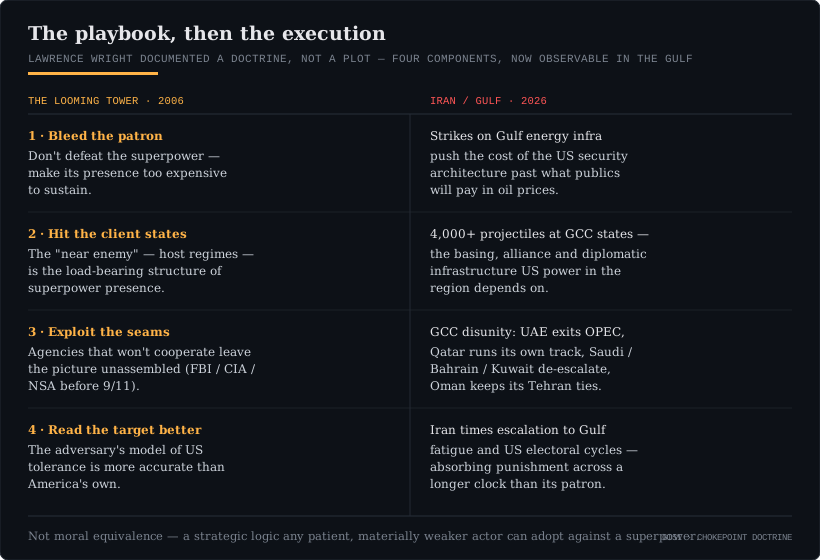
Component One: You Do Not Need to Defeat the Superpower. You Need to Make the Superpower's Presence Too Expensive to Sustain.
Osama bin Laden's core strategic insight — the one that Wright's book documents through interviews with people who sat in rooms with him as he articulated it — was not that al-Qaeda could militarily defeat the United States. Bin Laden understood, from his experience in Afghanistan against the Soviet Union, that a state actor's material superiority was not the decisive variable in an asymmetric conflict. The decisive variable was whether the cost of maintaining a military and economic presence in a contested region exceeded the domestic political tolerance for paying that cost indefinitely.
The 1998 East Africa embassy bombings and the 2000 USS Cole attack were not intended to destroy American military capability. They were demonstrations — proof of concept, delivered at relatively low cost, that American assets anywhere in the world could be reached, that the cost of protecting them everywhere was unsustainable, and that the political will required to remain in the region indefinitely would erode faster than al-Qaeda's own patience.
This analysis is published. Your decision isn't.
We run the same cross-domain, scenario-based foresight on the decision in front of you — a deal, a market entry, a supplier dependency. Board-ready in five days, with a foresight indicator watchlist.