
When the Sky Stopped Being Neutral
Iran's defection from GPS to China's BeiDou, a stalked Finnish satellite over Ukraine, and a NATO assessment of an orbital shrapnel weapon are three signals of one shift: positioning, navigation, and timing has stopped being a neutral utility and become a contested chokepoint — and the law, the insurance market, and every GPS-dependent economy have no answer for it yet. Part I of two.
For eighty years, every major military and every civilian economy on Earth has quietly depended on a single assumption: that the signal telling you where you are, and what time it is, comes from a source no one can turn off on you. That assumption died sometime in the summer of 2025, and almost nobody outside a small community of defence analysts and satellite trackers noticed it happen.
The evidence is now accumulating from at least four unrelated directions at once — a jammed Gulf war, a stalked Finnish satellite whose stalking has continued for months with no resolution, a NATO intelligence assessment about weaponised shrapnel, and a satellite insurance and international law regime that, on inspection, has no coherent answer for any of it — and each one is telling the same story from a different angle. Positioning, navigation, and timing infrastructure, the invisible utility that GPS has functioned as since the 1990s, is no longer a neutral layer sitting above the conflicts of nations. It is the chokepoint itself, and multiple states have started treating it that way, deliberately and at scale, in the last eighteen months.
The GPS defection nobody priced in
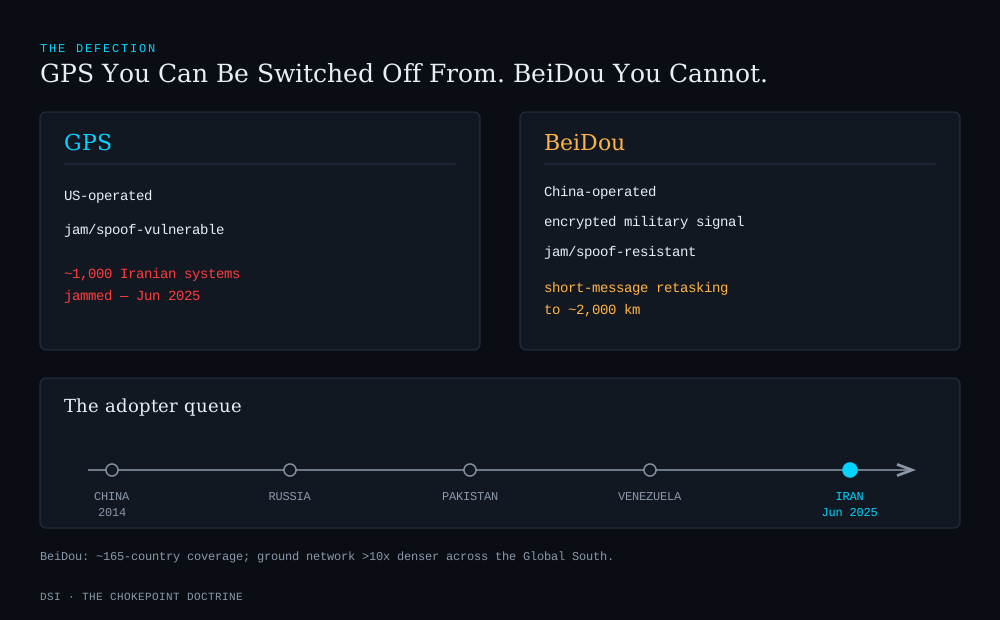
During the twelve-day Israel-Iran war in June 2025, Israeli electronic warfare did something that Western planners had assumed would be decisive for the next generation: it jammed and spoofed GPS-guided Iranian drones and missiles out of the sky. GPS jamming disrupted close to a thousand Iranian civilian and military systems in less than two weeks. The doctrine worked exactly as designed. Iran's precision-strike capability, built on a satellite navigation system the United States government ultimately controls and can degrade at will, collapsed under electronic attack.
Iran's response was not tactical. It was structural. On or around 23 June 2025, Iran switched off GPS across its military and — by its own government's account — nationwide, civilian use included, completing a wholesale transition to China's BeiDou Navigation Satellite System. The precise civilian reach is hard to verify from outside; the military decision is not in doubt, and it is the one that matters. This is not a workaround. It is a state deciding that dependency on infrastructure another government can unilaterally switch off is itself the vulnerability, and that the fix is not better jamming resistance within the existing system but exit from the system entirely.
What most coverage of Iran's defection has missed is that Iran was not the trailblazer here. China's own armed forces eliminated their reliance on US-controlled GPS years earlier, migrating fully to BeiDou specifically to remove the single point of failure that any American adversary could exploit in a future conflict — a decision analysts trace back to at least 2014, when China began integrating BeiDou directly into its precision-guided munitions programme. Iran is not an isolated case. It is the latest and most visible member of a list of states that includes Russia, Pakistan, and Venezuela, all of which have separately begun integrating BeiDou into their own military navigation systems for the identical reason: reducing US leverage over their armed forces and their exposure to sanctions-linked infrastructure denial. What looked, in June 2025, like an emergency wartime improvisation by a single besieged state has turned out to be Iran joining a queue that was already forming.
By March 2026, the operational consequence was unmistakable to the people watching the war unfold in real time. Iranian precision strikes began threading through the same class of advanced air defences that had neutralised them eight months earlier, with a former French intelligence chief among the Western analysts publicly attributing the shift to BeiDou integration. BeiDou's military signal is encrypted and engineered from inception to resist the jamming and spoofing techniques that defeated Iran's GPS-guided systems in 2025. Beyond raw resistance to interference, BeiDou's onboard messaging architecture reportedly allows real-time flight-path adjustments to munitions already in the air, at ranges up to 2,000 kilometres — meaning a controller who detects a Patriot battery or an intercepting aircraft mid-flight can retask the weapon before impact, an intelligent kill chain built entirely outside the Western technology stack GPS represents.
Al Jazeera, citing unnamed Pentagon officials, reported that several recent Iranian strikes hit targets whose coordinates do not appear on any public map — including a drone strike on a US facility in Kuwait that killed six American service members. The reporting is explicit that this pattern traces back to infrastructure China has spent years building into Iran's military: advanced radar exports, the GPS-to-BeiDou navigation transition, and satellite-based signals intelligence and terrain mapping support. That is a materially different and more defensible claim than "China is live-feeding coordinates for individual strikes" — it is closer to China having built and sold Iran the independent, jam-resistant nervous system that now makes those strikes possible without needing a human in Beijing watching each one unfold. The infrastructure is the intervention. It doesn't need to be operated in real time to be decisive.
One claim deserves to be stated with equal precision in the other direction. Reporting on the broader Russia-China-Iran technological alignment is explicit that there is no confirmed evidence Russia is providing real-time targeting support in this conflict, even as the same reporting describes growing cooperation between Russian space surveillance and the Iranian missile and drone programme as a real and emerging trend. Precision matters here specifically because overclaiming what one adversary is doing degrades the credibility of what can actually be documented about the other two.
The chokepoint doesn't need a war to matter
What Iran's GPS defection reveals is not really an Iran story. It is a demonstration, conducted at national scale and under live combat conditions, that global satellite positioning infrastructure is now explicitly understood by multiple governments as a chokepoint that can be denied, degraded, or exited — not a permanent, neutral utility layer sitting beneath geopolitics.
That reframing matters for reasons that have nothing to do with Iran, the Gulf, or GPS specifically. BeiDou today outperforms GPS in coverage and precision across roughly 165 countries — most of them outside North America and Western Europe — through a ground station network more than ten times denser than GPS's in the Global South, and through a deliberate Chinese strategy of bundling BeiDou access with Belt and Road infrastructure financing. The strategy is explicit in China's own academic and policy literature: subsidise the pricing, integrate it with Chinese-built ports, railways and telecoms already under construction across Africa, Southeast Asia, and Latin America, and let dependency compound over a generation of infrastructure contracts rather than a single procurement decision. Analysts at the Belfer Center have warned that the deeper danger of this strategy is not any single country's defection during wartime, but that it is far easier to build a rival system and give it away than to persuade the states that adopt it to give it back once it is embedded in their railways, their agriculture, and their emergency services.
This analysis is published. Your decision isn't.
We run the same cross-domain, scenario-based foresight on the decision in front of you — a deal, a market entry, a supplier dependency. Board-ready in five days, with a foresight indicator watchlist.