

The Cascade Below the Headlines: How One Closed Strait Becomes a Global Chip Shortage in Ninety Days
Hormuz has been closed for weeks. The headlines describe the visible failure — oil. The cascade beneath the headline runs through sulfur, sulfuric acid, copper, and the electrical grids that semiconductor fabs cannot survive without. Part 1 of a five-part GISI series on the physical layer of civilisation — the balance sheet most analysts have never modelled.
This Is Not a Hook
The global economy is breaking down. That sentence is not a hook. It is not a black-and-white rhetorical move designed to capture attention. It is the operational description of what is happening, in public, while the analytical apparatus that exists to model these events continues to describe them in categories that no longer match the system being described.
The closure of the Strait of Hormuz is a civilisational stress test, and the civilisation being tested is failing it in real time. The failure is not yet visible to most of the people who will be most affected by it, because the language of supply chains and physical layers has been ceded — for thirty years — to logistics consultants whose remit was efficiency and to commodity traders whose remit was the next quarter. Neither of those professional cultures was built to describe what happens when the layer below efficiency breaks.
This briefing maps what the layer looks like when it breaks. It is Part 1 of a five-part series called The Balance Sheet of Civilization — the physical, chemical, and metallic inventory that this civilisation runs on, and the cascade that follows when one of its chokepoints fails.
Part 1 traces the cascade that begins at Hormuz and ends — within approximately ninety days — at the chip fabs of Taiwan and the power grids of Europe and the United States. Parts 2 through 5 will trace the cascades that run through agriculture (fertiliser, food, the calorie supply), through pharmaceutical chemistry (active ingredients, vaccine cold chain, the molecules behind the medicines), through capital markets (the dollar drain, the credit freeze, the FX reserves that empty in weeks), and finally through politics — because the boundary between economic crisis and political crisis is not a wall. It is a doorway. People do not feel a supply chain breakdown through grand strategy. They feel it through unaffordable bread, empty pharmacies, and the silence on the other end of a service number.
Let us begin with one tanker that does not leave Kharg.
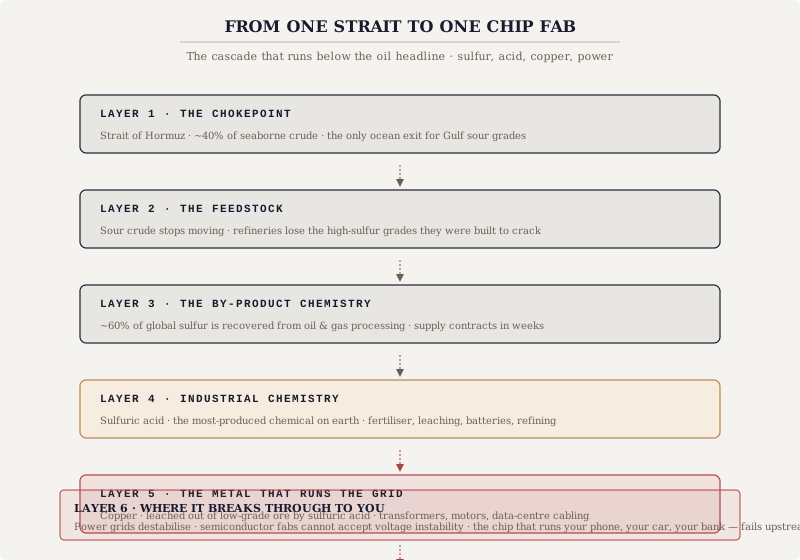
The Sulfur Chain
The Strait of Hormuz carries roughly forty percent of seaborne crude. That number is repeated in every commodity desk briefing of the past three weeks. The number that is not repeated is what kind of crude it carries. The Gulf produces predominantly sour grades — high-sulfur crude that requires specific refining capacity to crack into useful products. Refineries built to process sour grades have been engineered around the assumption that sour feedstock will be available. They cannot trivially be re-fed light sweet crude from Texas or the North Sea. The catalytic cracking units, the desulfurisation hardware, the sulfur recovery loop — all of it is calibrated to the feedstock the refinery was built for.
The first-order failure is the obvious one: refinery throughput drops as Gulf-sourced sour grades become unavailable. The second-order failure is less obvious and considerably more consequential: the sulfur that is recovered as a by-product of sour crude refining stops being produced at the volumes the global industrial chemistry sector has come to depend on.
Roughly sixty percent of global sulfur supply comes from oil and gas processing. The remainder comes from metallurgical operations and a small contribution from native sulfur mining, most of which has been priced out of competitiveness by the cheap by-product sulfur that refineries have produced for decades. The substitution capacity is not standing by. The lead time on new sulfur production at meaningful scale is measured in years, not weeks. When refinery throughput drops, sulfur recovery drops with it. Within weeks, the spot market for sulfur tightens in ways that the people downstream of sulfur — and there are many — begin to feel as a price they cannot pay.
Sulfur becomes sulfuric acid. Sulfuric acid is the single most-produced industrial chemical on the planet by volume — roughly 270 million tonnes per year across global production. Most of that sulfuric acid is consumed by the fertiliser industry, and that is the cascade we will trace in Part 2 of this series, when we ask what happens to the world's calorie supply when the chemistry behind nitrogen fixation contracts. But a significant fraction of global sulfuric acid is consumed by a different industry that is invisible in the consumer-facing economy: hydrometallurgy.
Hydrometallurgy is the process by which low-grade metal ores are leached — dissolved out of rock — by acid baths. Copper, cobalt, nickel, uranium, and rare earth elements are all extracted by hydrometallurgical processes that depend on sulfuric acid as the leachate. As the grade of mined ores has declined over the past three decades — because the high-grade deposits have already been worked — hydrometallurgy has become the dominant process for keeping the metal supply moving at industrial scale. The cheap by-product acid from sour crude refining made that economic. Take away the cheap acid, and the leaching operations cannot price their input. Copper output begins to slip. Cobalt and nickel follow. And the metals that this civilisation runs on stop arriving on the schedule the buyers have built their projects around.
The Metal That Runs the Grid
Copper is the metal that runs the grid. That sentence sounds rhetorical until it is unpacked. Copper is the conductor in the transformers that step voltage up and down across every electricity transmission and distribution network on earth. Copper is the winding in the motors that drive industrial machinery. Copper is the cabling that carries the current from the substation to the data centre to the rack to the chip. Copper is in the heat exchangers that keep that chip from frying. The grid is, in a chemical sense, an artefact of copper. Substitute aluminium where you can — and it is substituted in long-distance transmission where weight matters — but the precision applications cannot accept the conductivity penalty.
Copper supply has been tight for two years. Project pipelines have been sliding for longer than that. Major new mines take a decade to bring online from discovery; the projects that should have been delivering 2026 copper were sanctioned in 2018, and most of them did not run on time. The world has been buffered from the consequences of that pipeline lag by Chinese strategic stockpiles, by efficiency improvements in copper use per unit of output, and by recycled copper from end-of-life infrastructure. The acid cascade strips out the marginal supply that was holding the system together.
Within weeks of Hormuz closure, the price of refined copper begins to disconnect from its usual cycle. Within months, large grid-build projects — the transformer order books that utilities placed two and three years ago — begin to renegotiate delivery schedules. Within six months, the build-out of data centre capacity that has been hailed as the infrastructure backbone of the AI economy starts to encounter the physical reality that data centre racks need transformers and that transformers need copper. The story that has dominated technology coverage for two years — that the constraint on AI is GPUs — quietly becomes a story about copper instead. The market discovers what investors who have been positioned in the physical layer already knew: the bottleneck below the bottleneck is always the metal.
This analysis is published. Your decision isn't.
We run the same cross-domain, scenario-based foresight on the decision in front of you — a deal, a market entry, a supplier dependency. Board-ready in five days, with a foresight indicator watchlist.