

Two Doctrines, One Coastline
In April 2026, Riyadh sent Washington a list of named Iranian energy facilities and asked the United States to stop the United Arab Emirates from hitting them. The list was framed as oil-price diplomacy. The complete reading requires reckoning with what Riyadh has been building under its own mountains since 1987: six underground bases, Chinese ballistic missiles, and a four-decade deterrent stack that does not require American greenlight. The Gulf monarchies no longer share a single doctrine. They share a single coastline, and one of them has been running an Iranian-style asymmetric deterrence model in silence since Reagan’s second term.
The Chokepoint Doctrine series has mapped the cable floor, the helium supply chain, the port OT environment, the financial authentication layer, the GPS spoofing campaign, the EUDI Wallet security gap, the industrial robot dependency, the regulatory architecture beneath European digital governance, and the Low Earth Orbit layer above all of them. Each piece named a layer of physical or digital infrastructure whose failure cascades downstream. This piece names a different kind of chokepoint — the political chokepoint inside an alliance that everyone assumed was solid until a country with a clandestine forty-year missile network stopped wanting the war.
The List Riyadh Sent to Washington
In April 2026, while Donald Trump’s envoys were drafting the framework for a tentative US-Iran ceasefire, the Royal Court in Riyadh was preparing a different document. It was not a peace plan. It was a target list. The targets were not Iranian. They were the facilities Iran owned that the Saudis wanted Washington to forbid the Emiratis from hitting again. Qeshm Island. Abu Musa. Bandar Abbas. The Lavan Island refinery. The Asaluyeh petrochemical complex. Each one a node in Iran’s energy export spine. Each one already smoking from coordinated US-Israeli-Emirati air operations the Wall Street Journal would expose on the twenty-ninth of May.
The list was the first time in living memory that one Gulf monarchy formally asked a superpower to disarm another Gulf monarchy. It is the most important diplomatic document of the war and the press is still catching up to its meaning. The story that broke on May twenty-ninth was framed as an Emirati participation scandal — the secret bombing campaign that Abu Dhabi had denied for two months. The real story is older and harder. The Saudis went to Washington because they had concluded that their own strategic survival no longer depended on either American air superiority or Emirati kinetic enthusiasm. The Saudis went to Washington because they have a deterrent stack of their own, buried under their own mountains, that the analytical establishment has spent forty years declining to take seriously.
The Doctrine Beneath the Sand
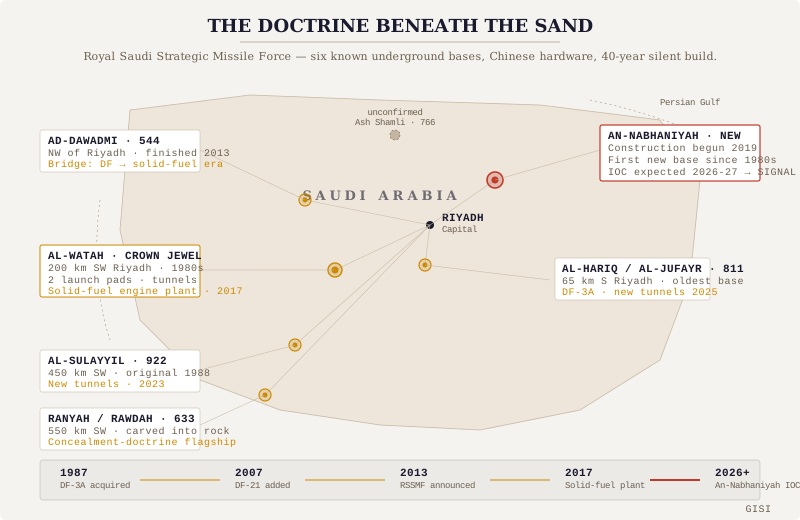
Begin with the part of the picture that is not currently in any of the Western coverage. In 1987, Saudi Arabia secretly acquired Chinese DF-3A liquid-fuelled ballistic missiles — a system designed for nuclear delivery, with a range of approximately five thousand kilometres, sufficient to reach every capital from Cairo to Mumbai. The deal was kept quiet for more than a year before Western intelligence detected it. When detected, the missiles stayed. The kingdom acquired them with conventional payloads, but the platform was nuclear-capable, the supplier was the People’s Republic of China, and the entire arrangement was opaque to Saudi’s American security guarantor. The Reagan administration was furious. The Saudis kept the missiles.
In 2007, a second Chinese system arrived — the DF-21, shorter-range but substantially more accurate, marking the kingdom’s graduation from area-denial missiles to precision-strike platforms. In 2013, Riyadh formally announced the existence of the Royal Saudi Strategic Missile Force as a distinct service branch alongside the Royal Saudi Air Force and the Royal Saudi Land Forces. The announcement disclosed less than it appeared to: by the time the service was named, the infrastructure had been under construction for a quarter of a century.
That infrastructure now consists of six known underground missile bases distributed across the kingdom’s interior, plus one unconfirmed site. Al-Watah, two hundred kilometres south-west of Riyadh, is the crown jewel — built in the late 1980s with Chinese assistance, equipped with two large launch pads, underground storage tunnels, mobile launch areas, and, since 2017, a solid-fuel missile engine production facility that closes the supply-chain dependency Riyadh had on Chinese factories for the previous three decades. Al-Sulayyil (base designation 922), four hundred and fifty kilometres south-west of Riyadh, is one of the original Chinese-built sites; satellite imagery analysed by the International Institute for Strategic Studies in 2023 documented a new multi-entrance underground complex completed at the same time. Al-Hariq (also known as Al-Jufayr, base 811), sixty-five kilometres south of Riyadh, is among the oldest installations in the network, still operational, with a new complex under construction as of 2025. Ranyah (base 633), five hundred and fifty kilometres south-west of the capital, is carved directly into rock formations. Ad-Dawadmi (base 544), completed in 2013, is the link between the legacy Chinese-platform infrastructure and the solid-fuel domestic production at Al-Watah. And An-Nabhaniyah — the newest base, construction begun in 2019, near-complete by early 2024 — is the first entirely new missile installation built from scratch since the 1980s. A seventh site, Ash Shamli (base 766), remains unconfirmed but appears in IISS satellite catalogues.
The strategic philosophy that unites these sites is articulated cleanly in one sentence the analytical community has spent four decades looking past: if your missiles cannot be found, they cannot be destroyed; and if they cannot be destroyed, they deter. This is not Reagan-era extended deterrence. It is not Washington-supplied area defence. It is the Iranian doctrine of mass and concealment, executed by the country that Washington has been told for forty years is the anchor of the Western security order in the region. Saudi Arabia did not abandon American security. It built a parallel system, in silence, under its own mountains, with Chinese hardware, while pretending the Patriot battery was sufficient.
What Actually Happened in the Air War
The popular framing — that the United Arab Emirates absorbed thousands of Iranian rockets and quietly hit back alone — is close to the truth but wrong in the way that matters. The real shape is uglier.
Iran fired four hundred and thirty-eight ballistic missiles, two thousand and twelve drones, and nineteen cruise missiles into the Emirates between late February and early April 2026, according to UAE Ministry of Defence figures. Ruwais burned. Jebel Ali burned. Dubai International Airport was hit three times. An Amazon Web Services data centre and an Oracle data centre went dark for hours. Six civilians died in the first fortnight, one hundred and thirty-one were wounded. Most projectiles were intercepted at an eighty-nine percent success rate, but the debris from interception is itself a weapon when it falls on a residential tower in Sharjah at three in the morning.
This analysis is published. Your decision isn't.
We run the same cross-domain, scenario-based foresight on the decision in front of you — a deal, a market entry, a supplier dependency. Board-ready in five days, with a foresight indicator watchlist.