

The Ghost in Lake Chad
On 16 May 2026, a joint US-Nigerian precision strike in Mitile killed Abu-Bilal al-Minuki, the second-in-command of the Islamic State. The same year, Nigeria recorded the highest Belt and Road Initiative construction volume on earth — $24.6 billion in Chinese contracts, up from $1.8 billion the year before. Tinubu's government is splitting its great-power dependencies by domain: the United States for intelligence and counterterrorism; China for railways, telecoms, and oil. The arrangement is being studied as the multipolar playbook for the Global South. The complication: the ghost the Eagle is hunting in Lake Chad is one the Eagle helped to birth — through CPA Order 2 in 2003, Camp Bucca, and the August 2012 DIA memo that predicted exactly the outcome it became.
At roughly 23:00 GMT on Saturday, 16 May 2026, a precision air-land operation in Mitile — a Borno State village in the Lake Chad Basin that almost no atlas marks — killed Abu-Bilal al-Minuki, the second-in-command of the Islamic State and the senior figure responsible for ISIL operations across West Africa and the Sahel. Donald Trump announced it on social media before the strike’s coordinates had cooled. President Bola Tinubu’s office followed with a statement crediting joint Nigerian-US intelligence sharing. Zero Nigerian casualties. Zero assets lost. The official Nigerian framing was that this is what counterterrorism cooperation looks like when the partner nation insists on leading inside its own borders.
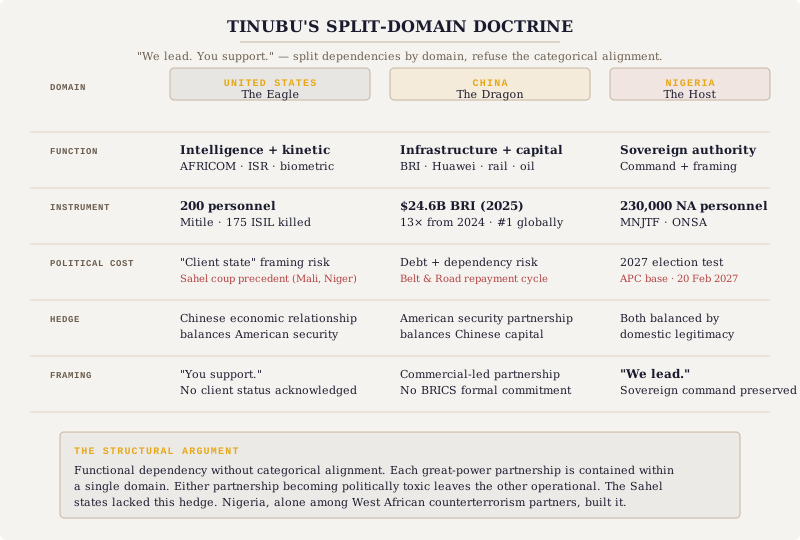
Four days later, on 20 May, the Nigerian Defence Headquarters announced that follow-on operations conducted with United States Africa Command had killed 175 ISIL fighters across the northeast and destroyed checkpoints, weapons caches, logistics hubs, and the financing networks that had sustained Islamic State West Africa Province since its 2015 declaration. The Eagle had returned to Africa, the kill chain was operational, and the Nigerian state was carefully framing the relationship in language no previous African counterterrorism partner had quite used: the United States supports, Nigeria leads.
That careful framing is the strategic centre of a much larger story. While American intelligence officers operate in Maiduguri and AC-130 gunships range the Lake Chad Basin, Chinese contractors are signing the largest year-on-year Belt and Road Initiative volume on earth. In 2025, Nigeria recorded $24.6 billion in BRI construction contracts, up from $1.8 billion the year before — the highest single-country surge in the initiative’s history. Huawei runs the country’s 4G and 5G backbone. China Civil Engineering Construction Corporation is building the railways that will eventually connect Lagos to Calabar along an $11 billion coastal corridor. China’s spending on Nigerian oil and gas reached an all-time high the same year, anchored by a $20 billion processing facility under construction.
The Eagle is conducting counterterrorism. The Dragon is laying track. And Abuja is doing something that almost no African capital has managed to do since the Cold War ended: split its great-power dependencies by domain rather than by alignment. The United States gets the security file. China gets the infrastructure file. Nigeria leads both.
This piece maps what that strategy looks like in operational detail, why it is significantly riskier than its architects acknowledge, and the awkward genealogy that makes the entire arrangement structurally unstable: the ghost the Eagle is hunting in Lake Chad is one the Eagle helped to birth.
The Eagle Returns to Africa
The strike that killed al-Minuki on 16 May 2026 was not the beginning of American counterterrorism re-engagement in Nigeria. It was the latest event in a sequence that has unfolded methodically over the preceding five months, and that sequence reveals more about American strategy in West Africa than any single Trump tweet or Tinubu statement.
The first acknowledged American combat action inside Nigerian territory occurred on Christmas Day, 25 December 2025, when US air assets struck Islamic State West Africa Province positions in Sokoto State. The strike was officially announced and politically owned in Washington and Abuja simultaneously, breaking with a decades-old American practice of conducting kinetic operations in African counterterrorism partner states under various degrees of strategic ambiguity. The Christmas Day strike was framed as a partnership operation, not a unilateral American action. The framing was the message.
In mid-February 2026, approximately 200 United States military personnel arrived in Nigeria to provide counterterrorism training, intelligence support, and technical assistance to Nigerian forces operating across the northeast. The number is small by historical standards — the United States deployed over 1,000 personnel to Niger before the 2023 coup ended that posture — but the political symbolism was substantial. American forces had not been operationally present in Nigeria in this configuration since the Boko Haram emergency of 2014. Their return signalled that Washington had concluded the Lake Chad Basin was strategically significant enough to require physical American presence, despite an administration whose general posture toward African security commitments had been one of disengagement.
The May 16 strike on Mitile was the demonstration that the political infrastructure built since Christmas Day was operationally functional. Trump announced it because the political value of the kill required announcement. Tinubu confirmed it because the domestic political value of demonstrating partnership with American capability while preserving Nigerian command authority was equally substantial. The 175-fighter follow-on operations announced on May 20 were the demonstration that the partnership was not a single-event arrangement but an ongoing operational tempo.
The strategic logic on the American side is not difficult to reconstruct. The Islamic State’s West Africa Province has, by the metrics that matter to American counterterrorism analysts, become the most active and lethal of all Islamic State regional “provinces” worldwide. Between July 2024 and July 2025, ISWAP claimed 445 attacks resulting in 1,552 casualties, more than any other Islamic State affiliate globally. The Lake Chad Basin recorded 4,779 fatalities from militant Islamist activity in the same period, a 28 percent increase year-on-year and the deadliest annual figure since 2015. Approximately 90 percent of Islamic State activity worldwide is now concentrated in sub-Saharan Africa. The numerical reality is that the Lake Chad Basin is the central theatre of contemporary global jihadism, and that fact has not registered fully in Western policy discourse precisely because it does not align with the geographic priors that shaped the post-2001 counterterrorism architecture.
The American return to Nigeria is, at one level, the recognition that the post-2001 architecture was looking in the wrong place. The Afghan theatre closed in 2021. The Iraqi theatre transitioned to embassy protection. The Syrian theatre stabilised at a low-level deployment. The Sahel theatre — where France had carried the operational load through Operation Barkhane — collapsed after the 2021-2023 wave of military coups in Mali, Burkina Faso, and Niger pushed French and US forces out. Nigeria was the only large-population, oil-producing, English-speaking, relatively stable Atlantic-facing partner Washington had left in West Africa with both the political will and the territorial integrity to host a sustained counterterrorism partnership. The Eagle returned to Africa because Nigeria was the only door still open.
This analysis is published. Your decision isn't.
We run the same cross-domain, scenario-based foresight on the decision in front of you — a deal, a market entry, a supplier dependency. Board-ready in five days, with a foresight indicator watchlist.