
Combat-Ineffective
The war you cannot leave. Part III of the Iran-war series: America's Gulf war can be neither won at the near edge, escalated cleanly, nor left — because its forward bases have been rendered combat-ineffective and the decisive chokepoint has moved to the sensor, feeding every front at once. Deliberately neutral.
The War You Cannot Leave — Part III of the Iran-war series.
Part I argued that both capitals sell a story the structure doesn't support. Part II argued that force cannot reach the thing the war is actually about — that you cannot bomb a question. This part takes the argument one step further down, to the hardware: what happens when the force itself becomes unusable at the near edge, and the war stops being one war at all.
The bases are still there. An American planner will tell you that, and it is true, and it is beside the point. The runways in the Gulf that the United States spent forty years building — close enough to Iran to mass force and project it from right next door — can no longer do the one thing they were built for. Not destroyed. Combat-ineffective. The distinction is the whole story, because a destroyed base is a headline and a combat-ineffective one is a strategy quietly running out of road.
Two claims are competing to explain this moment. One holds that Iran is crippling America's war machine in the Gulf. The other holds that American firepower, once it decides to climb the escalation ladder, still ends this on its own terms. An analyst's first duty, as in the two parts before this one, is to decline both. The first is triumphalism — the same voice that narrated the 557-missile epic of Al-Udeid, now narrating the ruin of American basing with the same appetite. The second is the assumption that produced the position America now occupies. What survives when you set both down is a machine with a logic of its own, and the logic says the most powerful military on Earth has arrived at a war it can neither win at the near edge, escalate cleanly, nor leave.
The base that stands but cannot fight
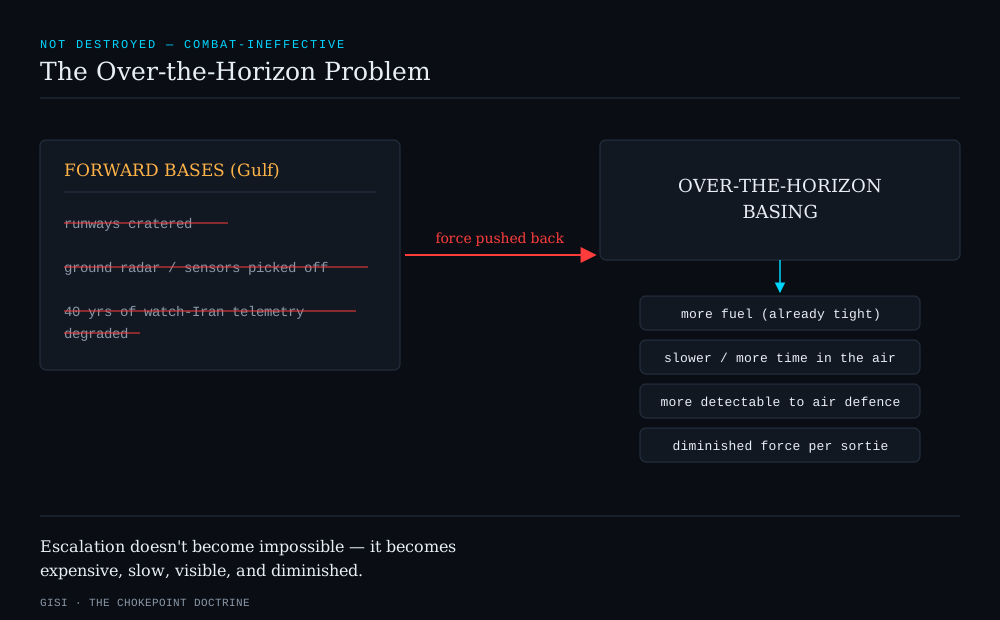
Start with the physics, because the physics is neutral and the rhetoric is not. Forward basing is a bet: that putting runways, radar, and fuel within a few hundred miles of your adversary lets you mass force and project it faster than he can respond. The bet paid for forty years because the adversary could not reach the bases. That is the condition that has changed. In the account of the commentators tracking this war most closely, Iranian fire has not levelled the Gulf installations — it has methodically stripped them of function: cratering runways so aircraft cannot launch, and picking off the ground-based radar and sensor telemetry the United States spent four decades installing specifically to watch Iran. A base that cannot launch aircraft and cannot see is not a base. It is real estate.
I cannot verify the tactical specifics from here, and I will not pretend the sourcing is anything better than partisan commentary. But the structural claim underneath does not depend on the specifics, because it is a property of the era rather than of this war: a forward base is only an asset while the sensor-and-missile reach of the adversary stops short of it, and that reach has been getting longer, cheaper, and more precise for two decades. What is being described in the Gulf is not a uniquely Iranian achievement. It is what happens to any fixed forward position once a determined adversary can range it — the same lesson the same commentators would have to apply, in reverse, to any Iranian position the United States could range.
The consequence is the part worth sitting with. If the near bases are combat-ineffective, force has to come from over the horizon — from farther away, which means more fuel for every sortie, at a moment when, by these same accounts, aviation fuel in theatre is already tight; more time in the air, which means more exposure to the air defences waiting for it; and more cost per unit of force delivered, at exactly the range where each unit is least survivable. Escalation, in other words, does not become impossible. It becomes expensive, slow, visible, and diminished — which for a superpower is a subtler and more dangerous condition than impossibility, because it invites the attempt while removing the margin.
The invasion that does not close
Part II of this series laid out the arithmetic of taking ground against a prepared defender on his own soil, using a former Navy SEAL's Iwo Jima math. The current commentary supplies the specific scenario that arithmetic was always pointing at, and it is worth walking through precisely because it is presented, even by its own describers, as something close to insane.
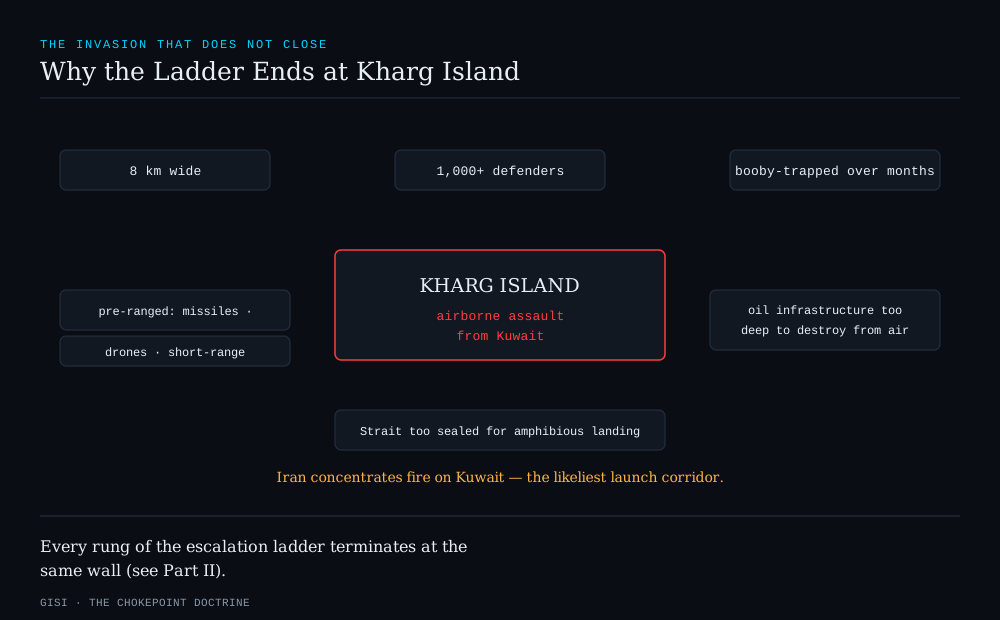
The scenario is an airborne assault on Kharg Island — Iran's principal oil-export terminal — flown in from Kuwait, because the Strait itself is judged too sealed for an amphibious landing. One retired missile-defence official, cited second-hand by a war commentator, floats it as the kind of thing a cornered administration might reach for. Set the sourcing aside and look at the board it describes. Kharg is eight kilometres wide. It is held, on this account, by at least a thousand defenders. It has been booby-trapped over months and pre-ranged by the missiles, drones, and shorter-range systems that Iran has in depth, and the production infrastructure that would be the prize is too far underground to destroy from the air. An airborne assault into that is not the amphibious operation where you first take the water around the objective. It is dropping light infantry into a prepared kill-box and hoping the plan survives contact.
The point is not whether any such operation is actually contemplated — I have no way to know, and neither, credibly, do the commentators. The point is structural and it closes the loop from Part II: every rung of the escalation ladder the near-edge force could climb terminates in the same place. The precision strike is blunted by the loss of the sensors that make precision possible. The invasion runs into geography and a defender who has spent months preparing exactly the corridor the attacker would have to use — which is why, on these accounts, Iran has concentrated its fire on the Kuwait facilities in the first place: not at random, but at the single likeliest launch point for the assault it is preparing to defeat. Force at every scale reaches the same wall it reached in Part II. What is new here is that the wall now stands at the near edge too, where the whole logic of forward basing was supposed to have removed it.
The chokepoint moved to the sensor
Here the two series this analysis has been running — the Iran war and the war in orbit — become one argument, and it is the most important move in this piece.
This analysis is published. Your decision isn't.
We run the same cross-domain, scenario-based foresight on the decision in front of you — a deal, a market entry, a supplier dependency. Board-ready in five days, with a foresight indicator watchlist.