
Two Stories, One Battlefield
The Iran war has resumed. Washington sells salvation; Tehran sells resistance. Neither story explains why a war both sides keep pausing keeps coming back. The structure does — and the bill radiates to the Global South. Part I of a two-part, deliberately neutral assessment.
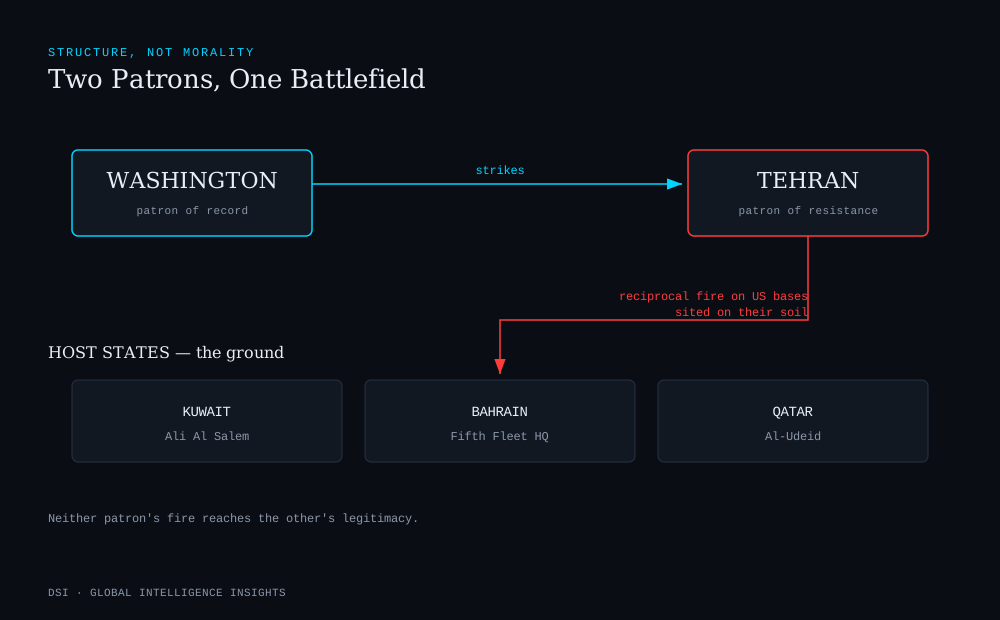
The war is back. The June ceasefire — the Versailles understanding — was meant to end it “on all fronts.” Within weeks the strikes resumed: the United States hitting Iran, Iran answering against American installations that sit on Kuwaiti, Bahraini, and Qatari soil, the host states absorbing a war they did not declare and cannot leave. We wrote in June that the understanding would not hold. It did not. I take no satisfaction in a forecast confirmed by a return to killing.
But the resumption is not only news. It is the cleanest evidence we have that the question everyone is asking about this war is the wrong one. The question is not who is winning. It is why a war that both sides keep pausing keeps coming back — and who pays for the interval.
Both capitals sell a story. Washington sells salvation: stability, security, the responsible power restoring order. Tehran sells resistance: sovereignty, defiance, the refusal to kneel. An analyst’s first duty is to decline both business cards. The stabiliser has presided over serial instability; the resister is firing on the territory of the neighbours it claims to speak for. Neither self-portrait survives contact with the map. What survives is the architecture beneath both — and the architecture, not the morality, decides how this ends.
The four questions
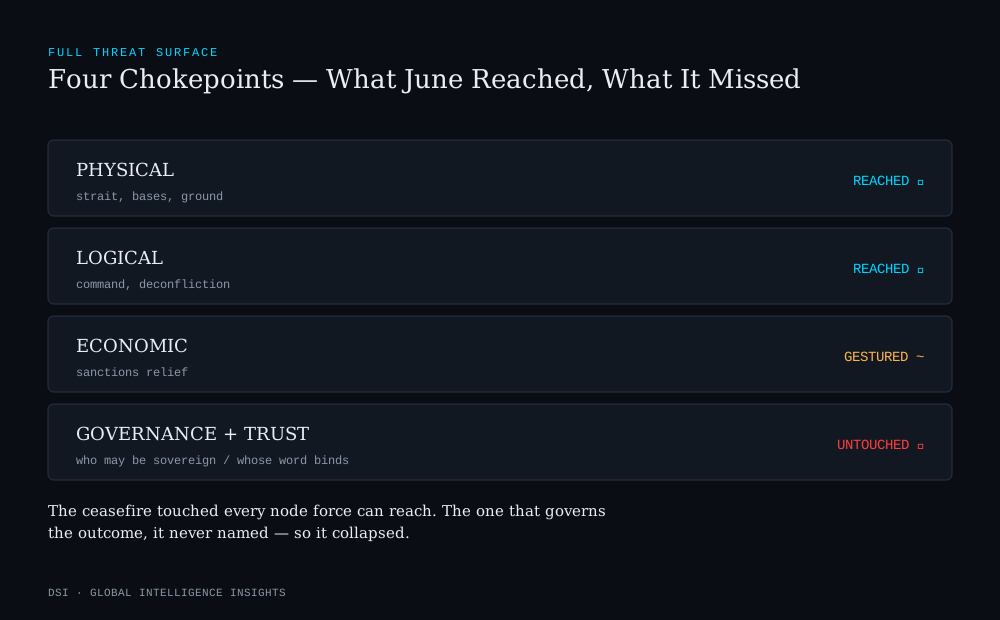
Our method is to ask four questions of one system at once. Where is the physical chokepoint — the geography, the hardware, the ground? Where is the logical chokepoint — the command, the connective tissue? Where is the governance chokepoint — who is legitimately permitted to decide, and whose word is trusted enough to bind? And what do the actors actually intend? Most analysis stops at the first two, because the first two have coordinates you can put a warhead on. The discipline is to ask all four of the same object and see which one is being ignored.
Do that here, and the chaos becomes legible. Look at what the June ceasefire actually touched. It touched the physical chokepoint — lines on a map, Hormuz reopening to traffic, bases un-targeted. It touched the logical chokepoint — deconfliction channels, who calls whom before firing. It gestured at the economic one — the sanctions relief the Gulf promised would flow. What it did not touch, could not touch, was the governance chokepoint: who is permitted to be sovereign in that region, on whose sufferance, and enforced by whose word. So it held for exactly as long as a bandage holds over an artery. The war came back because the settlement reached every control point except the one that governs the outcome.
The photograph that breaks both stories
Consider the image at the center of this month’s fighting, because it exposes that node better than any map. Iran struck the American bases; the host Gulf states, days later, sent delegations to mourn Iran’s dead Supreme Leader. Under the salvation frame — stability against terror — that is incoherent. Under the resistance frame — a united front against empire — it is equally incoherent, because Iran’s missiles had just landed on those same states’ soil. Both stories break on the photograph. Only the structural reading holds it: a capital can resent the power that strikes it and still register that the power answers to no patron, in a neighbourhood where almost every government answers to one. Those are not opposite reactions. In a region of conditional sovereignty, they are the same reaction.
Independent, but not sovereign
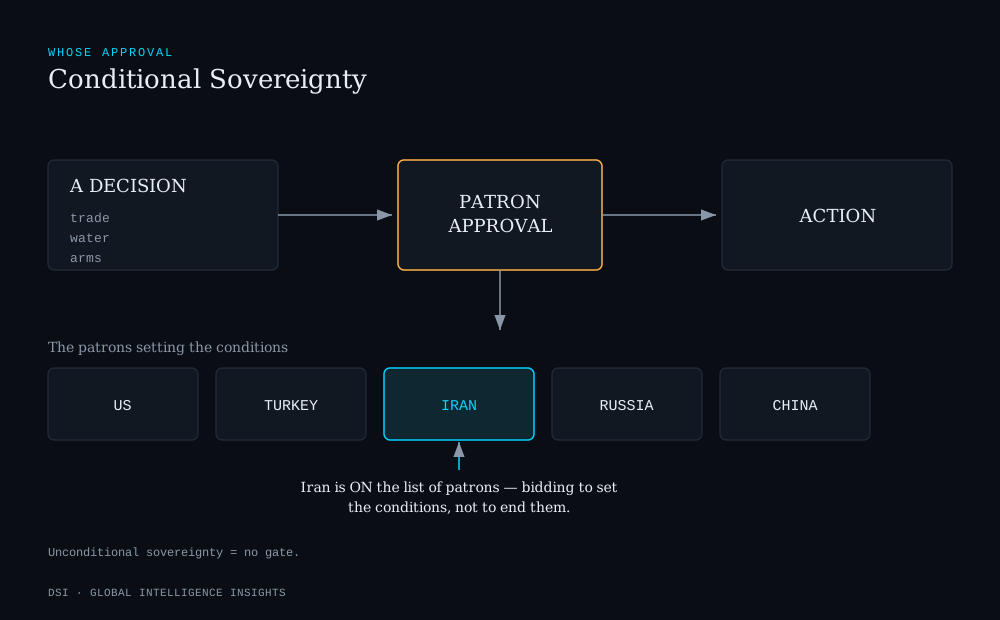
And conditionality is the fact underneath everything. One voice carried in this month’s coverage put it bluntly: the Arab states are independent but not sovereign — no consequential decision, on trade or water or arms, made without a patron’s approval. It was London and Paris; now it is Washington, with Ankara, Tehran, occasionally Moscow and Beijing bidding for the role. Set aside the same voice’s claim that some eighty percent of the region backs Iran; that is rhetoric, not data, and we treat it as such. But note what the sentence quietly concedes: Iran is named among the patrons. It is not standing outside the system of conditional sovereignty demanding its end. It is one of the powers bidding to set the conditions. This is not empire versus liberation. It is a contest over whose conditions prevail — and the ground it is fought on belongs to neither contestant.
That is the precise, unglamorous truth about “Iran bombing its neighbours.” Iran is largely striking US installations — the Fifth Fleet’s pier at Salman Port, the air-operations center at Al-Udeid, the base at Ali Al Salem — in reciprocal answer to American strikes on Iran. But Kuwait does not get to experience that as an American problem. It experiences it as war on its own ground. That is the condition of the host state in any war between larger powers: sovereign on paper, garrisoned by one, struck by another, consulted by neither. It is not an indictment of Tehran or of Washington specifically. It is what happens to whoever becomes the territory on which a war neither side will end gets conducted.
A lesson that is not partisan
There is an old lesson here, and it is not partisan. Force can destroy a capacity but cannot manufacture a consent. France learned it in Algeria — where it called the colony three departments of the Republic, poured in schools and administrators while it tortured in the Casbah, won nearly every battle across eight years, and left anyway in 1962, because the one thing all that force could not produce was the agreement of people who had decided they would rather govern themselves. America is relearning the lesson now against Iran. And Iran, if it imagines its missiles will bend the Gulf toward Tehran rather than away from it, is on course to learn it too. The instrument is the same in every hand. It reaches the target and misses the point.
The mantle these powers are fighting over has changed shoulders before, and how it changed tells you what it is. In 1956, Britain and France — the old civilisers — tried to seize the Suez Canal by force. Washington, not Moscow, ended the adventure, pulling the floor from under the pound and ordering its allies home. That was the day the patron’s role passed to America — not because America was gentler, but because it had learned to run the arrangement without the embarrassment of the map: through the dollar, the base, the guarantee, and the quiet veto over what a nominally sovereign state may decide. The colony became the client. And the client relationship rests on one thing above all: that the patron’s word can be trusted.
This analysis is published. Your decision isn't.
We run the same cross-domain, scenario-based foresight on the decision in front of you — a deal, a market entry, a supplier dependency. Board-ready in five days, with a foresight indicator watchlist.