
The First War Nobody Has Fought Yet
Washington, Beijing, and Moscow are each building for a war in orbit none of them can currently win cleanly — and Europe, in its own commissioned analysis, has conceded it cannot be a serious combatant before 2040. Four powers, four clocks, four speeds, toward a domain no binding law constrains. Part II of two.
Part I of this piece, published on DSI, established the infrastructure-level evidence: Iran's wartime defection from GPS to China's BeiDou navigation system, Russia's months-long shadowing of a Finnish reconnaissance satellite supplying Ukraine, and a NATO intelligence assessment describing a Russian weapon engineered to disable an entire orbital shell at once. This piece asks the strategic question those three developments raise together — what they reveal about the balance of power among the three states capable of fighting a war in orbit, and why the fourth major power in this story, Europe, has already conceded it cannot be one of them for at least another decade.
For as long as satellites have existed, the states that built them have operated under an assumption too convenient to examine closely: that whatever else happened on Earth, the machinery in orbit would remain, functionally, off-limits. No nation has ever destroyed another country's satellite in anger. Every anti-satellite weapon test on record — American, Russian, Chinese, Indian — has been conducted against the testing nation's own defunct hardware, a demonstration aimed at deterrence rather than an act of war. That restraint has held for as long as it has not because any treaty enforced it, but because no state had yet concluded the value of breaking it exceeded the cost.
Three governments are now building, simultaneously and at accelerating pace, for the scenario in which that calculation changes. None of them can say with confidence they would win the resulting fight cleanly. A fourth power, the European Union, has effectively conceded it will not be a serious combatant in that fight for at least another decade and a half — a concession made not in a moment of crisis but in a carefully worded strategic assessment that deserves to be read as one of the more consequential admissions of the current period.
Washington's doctrine has a name now, and an admission attached to it
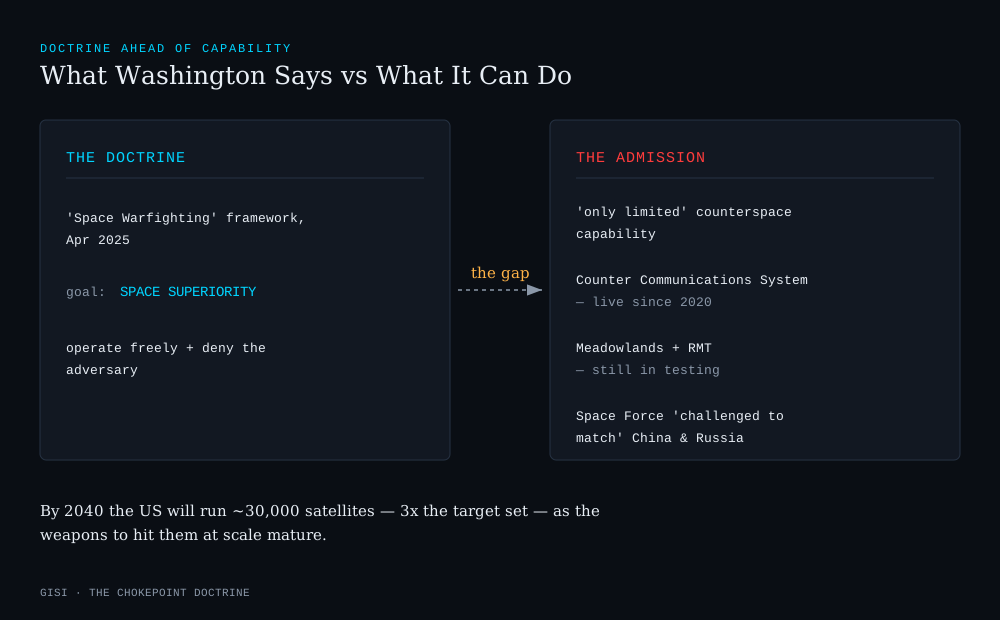
For most of the Space Force's existence since 2019, the United States avoided saying plainly what it was building toward. That changed in April 2025, when the service released "Space Warfighting: A Framework for Planners" — the first comprehensive public articulation of how the newest branch of the American military actually conceptualises combat in, from, and to orbit. The framework is built around a concept it calls space superiority, defined as the ability of military forces in every domain to operate at a time and place of their choosing without prohibitive interference from space or counterspace threats, while denying the same freedom to an adversary. It describes this superiority across both spatial and temporal dimensions, borrowing the vocabulary of air and naval warfighting doctrine and applying it, for the first time in an unclassified document, explicitly to orbit.
The doctrine's public language is confident. The Space Force's own senior leadership, describing the actual state of American capability to match it, is considerably less so. General B. Chance Saltzman, Chief of Space Operations, has said the service will continue investing in a full range of counterspace capabilities to deter conflict and win decisively if called upon — but reporting on the specifics of that investment describes a force racing to catch up rather than one that has already arrived. The Counter Communications System, an electronic jammer capable of disrupting Chinese and Russian satellite communications, has been operational since 2020; two additional systems, the Meadowlands and the Remote Modular Terminal, are still in late-stage training and live-fire testing as of this year. At this point, the newest branch of the American military has only limited operational counterspace capability, and the Space Force will be challenged to match the systems its two principal rivals already field.
The Space Force's own long-range planning document, projecting the operating environment out to 2040, does not soften this picture for the years ahead. It anticipates Russia will not attempt to match American and Chinese space power directly, choosing instead to pursue asymmetric counterspace capabilities that level the playing field cheaply — explicitly including the possibility of a nuclear anti-satellite weapon, on the stated grounds that Russia has the lowest declared threshold for nuclear weapons use of any major power, and that the planners see increasing indications Moscow is developing exactly such a capability despite the fact that no version of Russian doctrine has yet said so outright. By the same year, the document projects, American government and commercial operators combined will have roughly 30,000 satellites in orbit, up from about 12,000 today — a threefold expansion of the exact asset base any adversary would be targeting, arriving at precisely the moment the weapons capable of targeting it at scale are reaching maturity.
China's growth curve is the fact that reorganises the other two countries' planning
If American doctrine is candid about the gap between ambition and current capability, the American intelligence assessment of China's trajectory is candid about why closing that gap has become urgent. The US-China Economic and Security Review Commission's most recent annual assessment states plainly that China is aggressively positioning itself as a global leader in space technology, seeking not merely to compete but to reshape the international governance of the domain, influence its technical standards, and displace the United States as the world's premier space power. The commission's own figures describe the scale of that positioning in stark terms: China's operational satellite fleet exceeded 1,060 spacecraft by mid-2025, with hundreds dedicated specifically to intelligence, surveillance, and reconnaissance — a fleet that has grown by roughly 560 percent since 2015, a decade-long compounding expansion that has occurred largely in parallel with, rather than in direct reaction to, American planning cycles.
The Secure World Foundation's 2026 Global Counterspace Capabilities Report — the most comprehensive open-source annual assessment of the domain, now covering thirteen countries across co-orbital, direct-ascent, electronic warfare, directed energy, and cyber capability categories — documents China conducting what it describes as a likely on-orbit refuelling experiment for most of the second half of 2025, alongside continued reporting that Beijing may now possess a new direct-ascent anti-satellite interceptor. The report's editor, Victoria Samson — the same analyst who characterised the Russian shadowing of ICEYE-X36 as an escalation from prior patterns in Part I of this analysis — notes that while research and development into counterspace weapons is proliferating rapidly across all thirteen countries studied, only non-destructive capabilities have actually been employed in live conflicts to date. That distinction — proliferating capability, restrained employment — is the fragile equilibrium the entire domain currently rests on, and it is precisely the equilibrium that a Russian shrapnel weapon engineered for indiscriminate effect, or a first confirmed destruction of another state's satellite, would end.
This analysis is published. Your decision isn't.
We run the same cross-domain, scenario-based foresight on the decision in front of you — a deal, a market entry, a supplier dependency. Board-ready in five days, with a foresight indicator watchlist.