
You Cannot Bomb a Question
American force fails against the decisive chokepoint at every scale — and so would Iranian force against the Gulf. Why the war keeps returning to limbo instead of ending, who prefers it that way, and who is handed the bill. Part II of a two-part, deliberately neutral assessment.
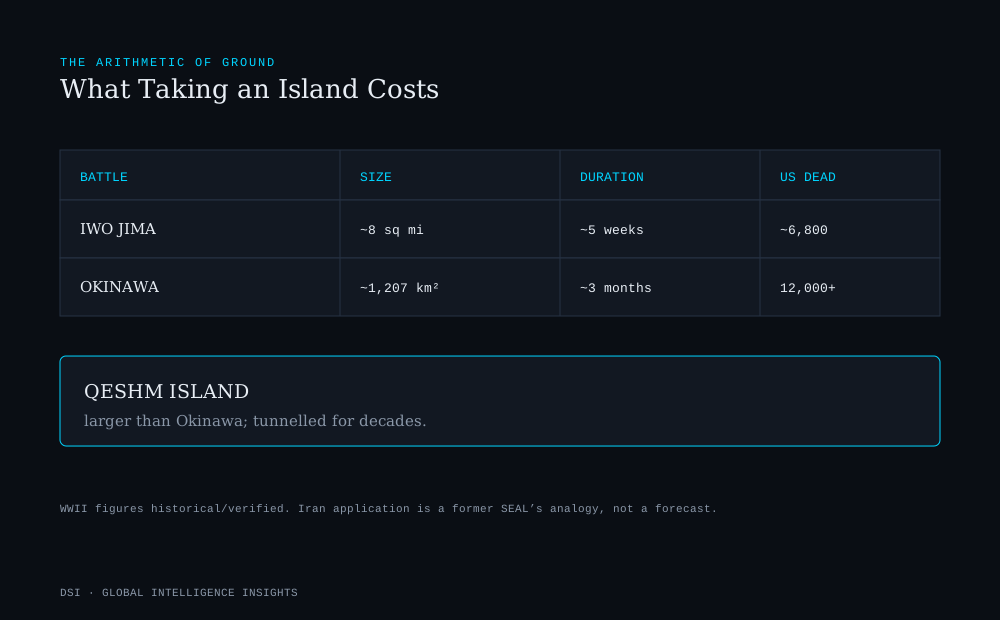
There is a number that ends most serious arguments about invading Iran, and a former Navy SEAL named Matt Bracken reached for it this month. Iwo Jima was eight square miles of volcanic rock. The United States shelled it from battleships for weeks, landed seventy thousand Marines, and still buried nearly seven thousand of them and carried nineteen thousand off wounded — in about five weeks, on an island you could cross on foot in an afternoon. Okinawa took three months and more than twelve thousand American dead. Now look at the Iranian coast: Qeshm is larger than Okinawa, its islands tunnelled for decades by people who studied exactly how America fights. “If we went into Iran,” Bracken said, “I think we will lose everybody we send in. The more we send in, the more we lose. And the Iranians have been very open about saying: come on in, we welcome you.”
Hold that welcome. It is not, in the neutral reading, an act of courage or of righteousness. It is a capability assessment offered by the defender himself — and it happens to be correct.
In Part I, I argued that the June ceasefire collapsed because it reached every chokepoint except the governance one, and that this node — legitimacy plus trust — has no coordinates. The obvious objection is that this is a soft point, true in the seminar and irrelevant at the target list. So here is the hard version, in the currency the Pentagon respects: casualties and capability. My assessment is that American force fails against the governance chokepoint at every scale it can be applied — and, crucially, so would Iranian force against the Gulf. The failure is structural, not moral, which is why it binds every hand that reaches for the weapon.
The two poles, the same rock
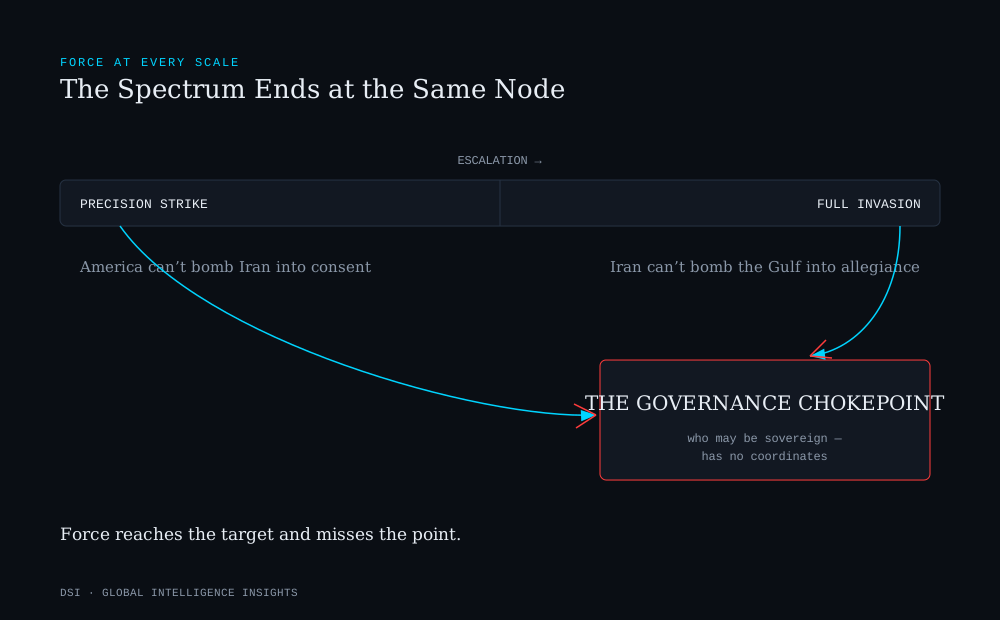
Take the two poles of American power. At one end, the precision strike — the surgical proof that you can reach anything, anywhere, without risking a boot. At the other, the invasion — boots, armour, the will to hold ground. These are meant to be a spectrum: if the light touch fails, escalate toward the heavy one. Iran has spent forty years making sure both ends terminate in the same place.
The precision end: a myth that works
At the precision end, watch the story of Al-Udeid form in real time. In the material now circulating, Iran’s strike on America’s regional air command has already become an epic — five hundred and fifty-seven missiles, four waves, five vectors, hypersonic warheads through twelve metres of earth, the whole cathedral of American command blinded in eighty-five seconds. Be precise: those numbers are almost certainly fiction — machine-translated, unsourced, physically extravagant — and no serious analyst repeats them as fact. But the accuracy of the myth is irrelevant to its function. The poem’s only load-bearing claim needs no five hundred missiles to be true: America’s war brain can be reached. Once that belief is loose, the warhead count is a footnote. The strike’s purpose was never the crater. It was the story of the crater.
That mechanism is neutral — it has served every asymmetric combatant of the last seventy years, and it implies nothing about who is right. The weak do not need to win the battle; they need to survive it and tell it. Hezbollah did not defeat the Israeli army in 2006; it withstood it for thirty-four days and turned survival into legend. Tet was a military catastrophe for the Vietnamese and a strategic turning point in their favour, because the story outweighed the ground. The Al-Udeid myth is the same instrument. Its numbers are propaganda; its function is real; and a power that scores the exchange in intercepted missiles while its adversary scores it in narrative has agreed to fight on a battlefield it cannot win.
The invasion end: the arithmetic of ground
At the invasion end you get Bracken’s arithmetic, honest where the myth is not. The Iwo Jima numbers are real history. The tunnelling is real. The missiles that can reach every deck in the Gulf are real. And the welcome inverts the logic of deterrence: a normal adversary raises the cost of attacking him high enough that you don’t; Iran offers the attack, because the attack is the one thing that converts its weakness into strength. The occupier’s presence recruits the resistance for free. This is not irrationality — Bracken calls it rationality out the window, but it is better described as a different arithmetic, in which the willingness to endure loss is the decisive weapon. It is the one weapon a wealthier, safer, more casualty-averse power can never purchase. That, too, is neutral: it is a property of the defender on his own ground, not a virtue of this defender.
The question has no coordinates
So the governance chokepoint sits at the center of the system, and no scale of force reaches it. Flatten the reactor and the question remains. Hold Qeshm at the cost of twelve thousand dead and the question walks into the hills with the survivors. And — the point our neutrality requires — the same wall stands in the other direction. Iran cannot bomb Bahrain or Kuwait into choosing Tehran; every missile that lands on a host state’s soil pushes it further under the American umbrella, not out from it. Force cannot confer legitimacy in any hand. America cannot strike Iran into consent. Iran cannot strike the Gulf into allegiance. Everyone is firing at a node that absorbs fire and yields nothing.
Why they keep fighting: the limbo
Which raises the question your leaders will not ask aloud. If force cannot reach the decisive chokepoint, why does everyone keep fighting? Here is the uncomfortable answer, and it is the reason the war returns to limbo rather than ending: the limbo is not a failure of strategy. It is what stands in for one, and it suits the combatants better than a settlement would.
Israel has a name for the posture: mowing the grass — its own doctrinal term for periodic degradation of an enemy it has decided cannot be defeated, only trimmed, forever. It is not a plan to win. It is an admission, in operational language, that there is nothing here to win, dressed as patience. Washington runs the quieter version: degrade, reopen the strait, restore deterrence, go home, return in six months. Tehran runs its own: absorb the blow, fire the reciprocal volley, harvest the legend, wait. None of the three aims at an end-state, because for each of them the end-state is worse than the limbo. Clausewitz said war is politics by other means; strip out the political objective — the theory of how it ends — and the violence stops being a means to anything. It becomes the condition itself.
This analysis is published. Your decision isn't.
We run the same cross-domain, scenario-based foresight on the decision in front of you — a deal, a market entry, a supplier dependency. Board-ready in five days, with a foresight indicator watchlist.