
AI Risk & Governance
Model and agentic risk, non-human identity, shadow AI, deepfakes, and the EU AI Act's enforcement edge.
Every major incident looks like its own story - AI governance one week, an enterprise authentication bypass the next, then a banking malware campaign, a cloud migration, a nation-state compromise, a national blackout. Read enough of them and the same thing keeps surfacing underneath. The breach is rarely the beginning of the story; the beginning is almost always an assumption that had never been tested. Storm-0558 exposed the assumption that a consumer signing key could never authenticate an enterprise account. ServiceNow, that the platform holding the map of every system deserved less scrutiny than the systems. Kimi K3, that self-hosting a model resolves the trust question. The Iberian blackout, that transparency and operational security are the same objective. FASTCash, that banks on shared payment rails carry risk independently. The subject of the analysis is not the technology - it is the widening distance between what organisations believe about their systems and how those systems actually behave under pressure, which may be one of the most important attack surfaces in modern security.
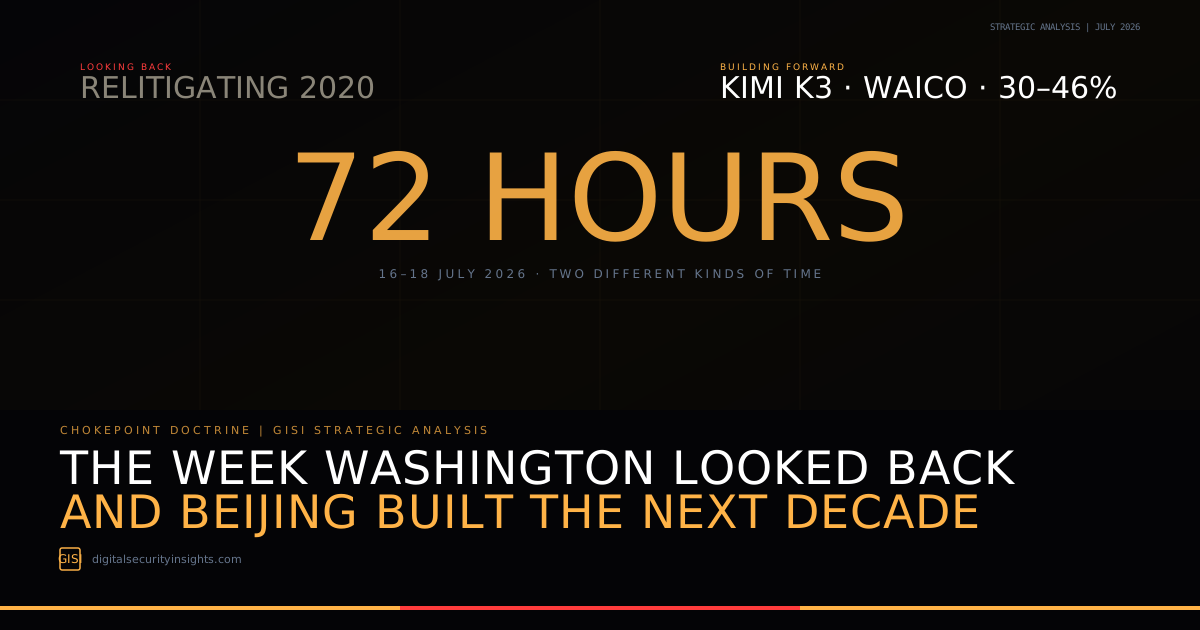
In one seventy-two-hour window in July 2026, four things happened — and only one country spent it building. Washington used primetime to relitigate the 2020 election. Beijing released Kimi K3, the largest open-weight AI model ever published; founded the World AI Cooperation Organization with 29 nations and the UN Secretary-General's endorsement; and kept winning American enterprise adoption, now 30 to 46% of the tokens US companies route. This GISI assessment holds the evidentiary asymmetry explicitly — observable fact, measured data, and contested claim are not the same category of certainty — and maps the state-subsidised industrial playbook China has already run on solar panels and electric vehicles onto AI. Twenty-three-to-one US capital bought a benchmark lead of 2.7 points. Both governments spent the week doing something legitimate. Only one was building something that will still be standing in ten years.
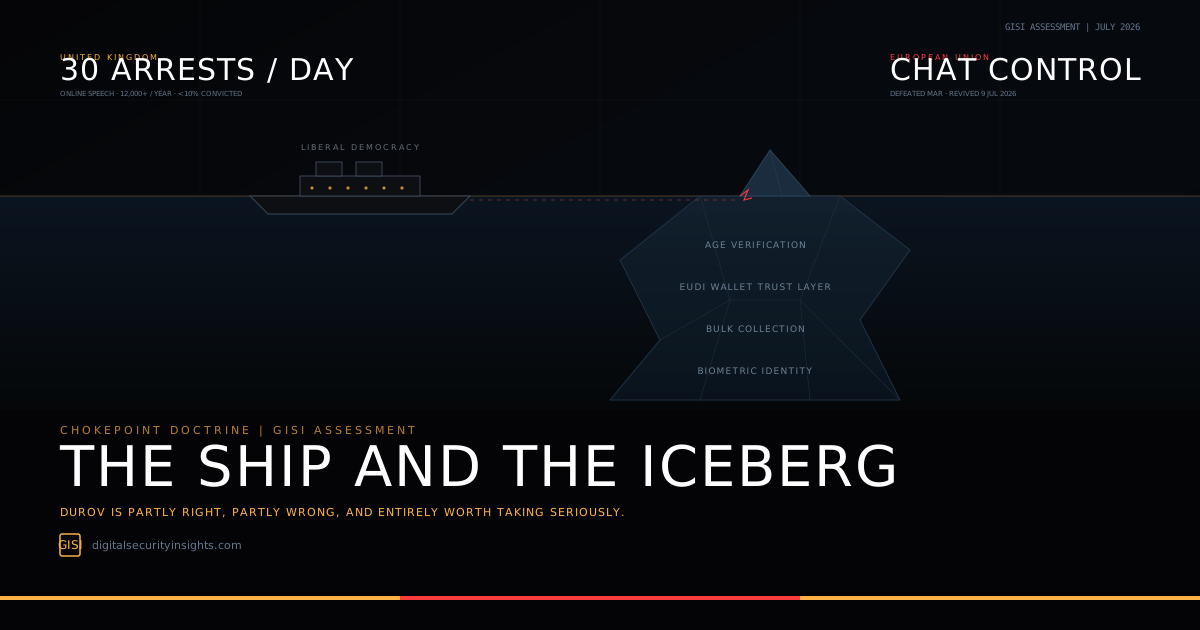
Pavel Durov says the ship of our personal freedoms has hit the iceberg and is sinking without us realising it. He is partly right, partly wrong, and entirely worth taking seriously. This GISI assessment evaluates his argument against the evidence: the UK's 30 online-speech arrests a day, Germany's platform-fining model, France's crypto-kidnapping wave, the EU's Chat Control revival on 9 July 2026, and the online-safety regimes of Australia and New Zealand. What is accurate survives scrutiny. What is exaggerated — the collapse of the distinction between Western democracies and Russia, China, and Iran — does not. The right question is not whether the West is becoming authoritarian. It is whether the architecture being built in the name of safety — age verification, identity wallets, bulk collection, biometric mandates — creates the conditions under which essential liberty becomes, in practice, optional, regardless of who governs it. The series has been asking that question. The answer, so far, is not consistently yes.

Your voiceprint is not a password. A password can be changed; your voice cannot. In January 2021 Walmart settled for $10M over palm scans of 22,000 Illinois employees; by July it was sued over warehouse-headset voiceprints, then over uploading shoppers' faces to a Clearview AI database - three biometric systems, one company, all under Illinois's Biometric Information Privacy Act, the only US law that lets individuals sue. McDonald's, Chipotle, Verizon, Microsoft Teams face the same claims; 107 BIPA class actions were filed in Illinois in 2025 alone. In 47 of 50 states, collecting your fingerprint, face, or voiceprint needs no consent, no disclosure, and carries no consequence. Under GDPR Article 9 it is special-category data requiring explicit consent, with fines to EUR 20M or 4% of turnover - and the EU AI Act bans workplace emotion inference from 2 August 2026. My assessment: this is not a regulatory gap but a policy choice, applied to the one category of data that is permanent. If the database holding your voiceprint is breached, the credential is compromised for life - and in 47 states no one is obliged to tell you.

Is there an industry ShinyHunters has not breached lately? Food distribution, healthcare, higher education, entertainment, telecoms, finance, the Council of Europe. Sysco: 61 million Salesforce records claimed on 16 June, published after the 18 June deadline, 2,691,852 confirmed on HaveIBeenPwned by 28 June. The question is not who they target. It is whether sector, size, and security budget are all secondary to one variable: whether an unrevoked OAuth token is sitting in your Salesforce connected apps or a 2023 code commit. My assessment: ShinyHunters is not a group you arrest but a brand and a playbook that outlive their operators — one industrialised technique (voice-phish an employee or scan GitHub for forgotten tokens, both bypassing passwords; enumerate the CRM; loop and exfiltrate; extort). The reason the industry keeps being surprised is not sophistication. It is that the monitoring is pointed at the boxes, and the attack happens in the space between them. Every box is governed — identity, exposure, data, software, AI, supply chain, governance. The space between is no one's job. That argument is now a book: The Wrong Map, reading cybersecurity as political economy across Susan Strange's four structures. Contributors welcome — especially the dissenters.

In March 2026, FulcrumSec found an Azure Container Registry token in a public JavaScript bundle on a Novo Nordisk subdomain. Two months later it had walked out with 1.3 terabytes: 41,000 drug compounds, 30 trained AI models, and a marketed drug's manufacturing recipe. The pharmaceutical industry's credential problem, mapped globally.

Why the Strait of Hormuz keeps closing, why the salt caves have a floor, and why Netanyahu's calendar is the variable that no peace deal can govern. Four thousand feet below Louisiana and Texas, the US strategic petroleum reserve sits in salt caverns with a hard physical floor: below roughly 150-250 million barrels of its 714-million capacity, the caves begin to collapse and the oil is lost, not depleted but structurally destroyed. That floor is the clock behind the 17 June Versailles MOU between Trump and Pezeshkian, and behind Trump's urgency for peace. But the deal has a structural flaw visible before the ink dried: its first clause requires a ceasefire on all fronts, and the enforcer on the Lebanese front is a state that never signed it. By 21 June Iran had re-closed Hormuz over continued Israeli strikes in Lebanon; the Switzerland talks then collapsed, JD Vance left without an agreement or a handshake. My assessment: Netanyahu's Lebanon strikes are not a survival calculation but a compulsion, and rational-actor theory cannot model a compulsion. Iran does not need to win; it needs to outlast, and it can absorb punishment that would end any Western government. The MOU is as valid as its weakest enforcement node. That node is in Jerusalem.

After the October 2023 Okta compromise, Cloudflare rotated more than five thousand credentials. On Thanksgiving Day a nation-state actor walked into its Atlassian environment anyway — through the four machine identities the rotation missed: a Moveworks service token, a Smartsheet account with admin rights to Jira, a Bitbucket account reaching source code, an AWS credential. Every one a non-human identity nobody believed was theirs. This is Part II of the cross-cutting threat analysis: a vulnerability is a property of a component, a threat is a property of the system, and the actors crossing your organisation are now overwhelmingly not human. Machine identities outnumber people by as much as eighty to one, nearly half hold privileged access, and OWASP now publishes a separate Top Ten for them. A service account is a seam with permissions — connective tissue that spans the boundaries human silos are built around, held by an account no team owns. And the seam has begun to act: AI agents are non-human identities that reason, hold credentials across every silo at once, and can be redirected by a planted instruction at machine speed. The fix is the same operating model from Part I, extended to actors that are not people: every machine identity and every agent needs a named owner, a defined scope, an expiry, and a decommissioning trigger. Run the removal test this afternoon — pick any service account or agent and ask who owns it, what it can do, and when it expires.

On 12 January 2024, a Russian state actor read the email of Microsoft's senior leadership. Not through a zero-day — through a forgotten legacy test tenant with no MFA, an over-permissioned OAuth app, and an elevated consent grant nobody owned. The path crossed four domains; not one team owned the route. Every control was green. Storm-0558 was the same shape: a consumer signing key accepted as valid for enterprise mailboxes — a seam between two identity planes. This is the failure the industry refuses to name. A vulnerability is a property of a component; a threat is a property of the system. We have spent two decades building frameworks that make each silo defensible in isolation and almost no time building the thing that lets a defender reason across them the way an attacker already does. The fix is not another framework. It is an operating model — decision rights, intake, prioritisation, governance, delivery engagement — the connective tissue that owns the seams. Run the removal test: if your security function vanished tomorrow, would any business decision change? Part I of two. Part II continues on ARIA.

The United States and Iran are the ones signing the deal that ended the 2026 Iran war. Qatar and the UAE are the ones who actually made it possible. The UAE has unlocked $10B for Iran with $3B+ already delivered, in exchange for halted attacks and economic-intelligence cooperation. Qatar holds $6–12B in Iranian frozen assets under custody — the $6B from the September 2023 South Korea transfer, restricted to humanitarian use, never released after October 7. Tehran cannot access any of it without Doha. This is the first major US–Iran deal in fifty years not architected by the United States. The Full Threat Surface framework applied to the deal across four dimensions — physical geography (Hormuz, Al Udeid, the dual-track positioning), logical architecture (the three-layer financial mechanism), governance architecture (the ad-hoc enforcement coalition with no precedent), and adversarial intent (Iranian pragmatists vs hardliners, UAE $500B self-preservation, Qatar's strategic positioning, Trump's narrative needs, Israel's disruption vector). The predictive intelligence layer: four probability-banded scenarios across the oil path from current $80s through December 2027, mapped against Gulf fiscal break-evens (KSA $80, UAE $60, Qatar $45, Kuwait $70). The deeper question the diplomatic coverage is not asking: whether the Gulf states can sustain the mediation through the recession their own success helped to create.

In the early 1990s, exporting strong cryptography from the United States was, legally, exporting a weapon. A T-shirt with RSA source code was a controlled export. Phil Zimmermann spent three years under US Customs investigation for publishing PGP. It took most of a decade — and Executive Order 13026 in November 1996 — to dismantle the regime. The signal, WhatsApp, Telegram, TLS, and every banking app on every phone exist in their current globally-available form because that restriction was eventually lifted. On Friday 12 June 2026, at 5:21pm ET, the same structural argument returned in a sharper form. A letter from the US government to Anthropic. Fable 5 and Mythos 5 suspended for any foreign national worldwide. The artefact has changed — from published math to hosted frontier model. The mechanism has changed — from court enforcement to a configuration flag at a single provider. The argument has not. The market consequence will not either. Whoever fills the gap during the restricted years keeps the customers after liberalisation. The companion historical-precedent piece to “The Export Control That Reached Inside the Model.”

The operational lesson of the Fable 5 and Mythos 5 suspension is not about whether the directive was justified. It is about what it demonstrated: every non-US enterprise running production AI workloads on a US-headquartered frontier model is, structurally, one letter away from an outage that no contract, no regional setting, and no sovereign cloud reseller can prevent. Anthropic had to “abruptly disable” both models for all customers globally to comply — within hours of receiving the 5:21pm ET letter. Three categories of exposure: hard-coded production dependencies, research collaborations with non-US personnel, and government / regulated-industry partnerships (TCS-50K-users-across-56-countries, DXC-banking, all in scope). The full threat surface framework now treats provider home jurisdiction as a primary variable. Single-provider risk is single-sovereign risk. The failover architecture that survives the next 5:21pm letter, with five cross-cutting controls (contract, cache, drill, audit, board), the sovereignty risk matrix across seven provider categories, and the action list for the next four working days under DORA, NIS2, the EU AI Act, and the Tech Sovereignty Package.

At 5:21pm ET on Friday 12 June 2026, a US government letter directed Anthropic to suspend Fable 5 and Mythos 5 for any foreign national, anywhere in the world, including its own non-US employees. Anthropic complied within hours, in full, worldwide — while publicly dissenting from the action and stating that the underlying capability is freely available from competing models without restriction. Sixteen days earlier, the European Commission had published the Tech Sovereignty Package built for exactly this scenario. The letter is the first operational use of Export Control Classification Number 4E091, finalised in the BIS Framework for AI Diffusion on 15 January 2025 to cover frontier model weights trained on more than 10^26 computational operations. The pattern it completes — CLOUD Act 2018, Schrems II 2020, the chip rules 2022, the AI weight rule 2025, the ICC sanctions, the Solvinity block, the EU package, now this — is the ladder of US extraterritorial reach this series has been mapping. The new layer is cognition itself. With the eight-rung extraterritoriality timeline, the seven-region cognitive-dependency map, and the strategic read for EU, UK, India, China, Japan, Korea, Middle East, and Africa.

China was first. The EU is third. Singapore governs what neither directly reaches. China’s CAC Measures + GB 45438-2025 took effect 1 September 2025, with audits since October and enforcement actions from January 2026. Singapore’s IMDA Agentic AI framework launched at Davos on 22 January 2026 — non-binding in form, procurement-binding in practice. EU AI Act Article 50 activates 2 August 2026; existing GenAI systems get until 2 December for the marking requirement specifically. California’s SB 942 / AB 853 has been binding for two years. Three different enforcement postures. One convergent architectural requirement: AI-generated content and AI agent actions need to carry a verifiable, machine-readable record of their provenance. The strategic read for builders shipping into global markets, and the architecture that satisfies all four regimes when built once correctly.

Part II of the Governance Gap trilogy. The operational requirement that follows from the strategic finding: every security architecture is built against the threat model that the current architecture was already adequate to detect — which means the threat operating in the governance gap is, by definition, the one your architecture cannot see. The four wrong questions enterprise security is organised to answer (compliance, breach, supply chain, incident response) and the right ones (adversarial view, inference, shared infrastructure, intersection) that the full threat surface framework requires. France Titres, Snowflake, Trellix, the NIS2 / NiS2 chemical-plant scenario — each as evidence the gap is operational, not theoretical.

Part I of the Governance Gap trilogy. The Chokepoint Doctrine series’ central finding, stated as its central thesis for the first time: no institution has the mandate, the expertise, and the authority to govern the full threat surface of any critical system simultaneously, and the adversary’s operational architecture is specifically designed to exploit the space between the institutions that cannot coordinate fast enough. The three wrong questions Western institutions are asking — What is the adversary doing? Which institution is responsible? How do we deter the adversary? — and the right questions that should replace them. The governance gap is the chokepoint. Everything the series has documented is a symptom.

Two Doctrines, One Coastline named the coalition chokepoint. This piece names what the United Arab Emirates is actually doing inside that coalition. The federation flew Israeli targeting packages out of Al Dhafra against Iranian targets it has held a constitutional grievance with since 1971. The Abu Dhabi capital base has been welded into the American artificial intelligence stack at the chip, model, and platform level — through MGX, OpenAI, Anthropic, the Stargate project, BlackRock, and Microsoft — in commitments that cannot be unwound without vaporising approximately eighty billion dollars of Emirati positioning. The federation will survive the war structurally. The brand promise the survival depended on will not.

The AI cost crisis, the permission problem, and the workforce destruction that is already being reversed. The AI replacement doctrine rested on three assumptions that 2026 has tested to destruction simultaneously: that costs would stay at pilot-phase pricing as deployment scaled, that AI could replicate the human contribution adequately enough to make replacement economically rational, and that AI agents could be granted full access without creating governance obligations the security architecture needed to be built to address. All three assumptions are failing at once, the data confirming each is now unambiguous, and the organisations that built genuine AI governance have a structural advantage over the ones that bought a subscription, fired their people, and are now rehiring them six months later at higher cost.

Part 1 of The Collective Veto, a three-part GISI series on the political economy of the AI transition. The historical record contains multiple episodes of organised political authority treating specific human populations as disposable inputs to civilisational projects — imperial Chinese Corvée labour across two millennia, the Bengal famine of 1770 under East India Company governance (seven to ten million dead, a quarter to a third of the regional population), and the Aktion T4 euthanasia programme of Nazi Germany (200,000 to 350,000 victims). The post-1945 institutional architecture that constructed against this pattern is, on the historical scale, a brief and atypical interruption. The interruption was sustained not by the Enlightenment vocabulary of natural rights but by the specific structural conditions that made human labour, military service, consumer demand, and political participation irreplaceable inputs to organised production and governance. The artificial intelligence transition is the systematic substitution of artificial systems for those inputs. The coercive instruments through which rights were extracted across the historical record retain their formal legitimacy. They are losing their structural force.

On or around 30 April 2026, a leaked internal Meta all-hands recording articulated, in language attributed to Mark Zuckerberg and not substantively contested by the company, a doctrinal position on AI training data sourcing that the leak's juxtaposition with imminent layoffs made operationally legible. The doctrine has a three-stage operational structure: AI replaces the contractor, the employee trains the AI, the AI replaces the employee. This piece names the doctrine, locates it in the documented record of the past month, identifies the structural verification problem the 'strip-out' assurance produces, examines the strategic-secrecy framing that revealed the firm's true governance posture, traces the compounding economics that make the doctrine irresistible without governance discipline, and proposes the augmentation alternative — opt-in compensated training data contribution, shared productivity gains, verifiable disclosure, explicit board-level doctrinal commitment — that workforce-productive AI architecture actually requires. AI should make organisations productive, not redundant. The claim is a doctrinal position with operational, legal, and competitive consequences. The choice is on every board's desk.

Every large organisation buying AI is having a meeting this quarter about tool selection. Beneath that meeting, a doctrinal question is being answered by default: should intelligence inside the organisation become more centralised or more decentralised as AI is deployed across the operating model? Centralised AI doctrine fits portfolio management, capital allocation, and algorithmic operations. Decentralised AI doctrine fits broker operations, advisory firms, network platforms, and specialty businesses. The commercial pull of the AI vendor ecosystem favours centralisation regardless of which doctrine the customer actually needs. The Ukrainian battlefield has already proven what happens when centralised doctrine meets an adversary that has adopted the decentralised one. The doctrinal question is the highest-order AI risk most boards are not asking — and the next twelve months will reveal which boards have answered it deliberately versus by default.

Every business continuity plan contains assumptions so foundational they are never written down. GPS works. Satellites are up. The timing signal is accurate. The Iran war moved all four assumptions from the constants column to the variables column. This piece is the operational framework for the GPS timing audit your organisation has almost certainly never done, the Starlink paradox where your resilience measure becomes your single point of failure, the commercial earth observation dependency nobody has classified as critical, and the satellite ground station supply chain whose cybersecurity floor your continuity plan inherits without auditing.

While America races to build AGI, China shipped 87–90% of the world’s humanoid robots in 2025. Unitree’s $13,560 factory robot outsold Tesla’s entire Optimus production target. 140 Chinese manufacturers, 330 humanoid models, 15 automakers pivoting into robotics. The frontier model race gets the headlines. The deployment race gets the factory floor. Part 2 of the Chokepoint Doctrine series examines the AI layer of America’s industrial sovereignty gap.

The organisations learning this the hard way all share the same story: they invested in advanced tools before they had stable foundations. AI can amplify maturity. It cannot create maturity. Why DSI has formalised a partnership with SecPoint to solve foundational visibility across Sweden, Nigeria, and Kenya.

Peter Diamandis says humanity is about to fork into five branches. He describes the opportunities. He does not describe the attack surfaces. Every fork he names -- AI creators, longevity, brain-computer interfaces, space, digital consciousness -- creates vulnerabilities that no defensive architecture yet exists to contain. And the fork he did not name is the most dangerous of all.

China blocks Meta's $2B acquisition of Manus AI and exit-bans its founders, establishing that technological nationality follows people, not incorporation documents. The AI control stack now extends from rare earths through chips and models to the human layer -- the one you cannot replicate.

OpenAI products are used by 72 percent of enterprises working with AI globally. The AI layer is structurally more dangerous than software dependency because AI processes the most sensitive information in the organisation, creates cognitive lock-in that is harder to reverse than software migration, and embeds invisible dependencies across business processes. ARIA maps three scenarios for European AI sovereignty.

In September 2020, Sundar Pichai pledged Google would run on carbon-free energy 24/7 by 2030. By mid-2025, that pledge had been deleted from Google's website. This is what the four largest AI companies promised, what their emissions actually did, and what the gap means for your organisation.

In 2012, Iran hit 46 US banks with 140 Gbps DDoS attacks in response to SWIFT sanctions. In March 2026, the IRGC publicly named US and Israeli-linked banks as military targets. Citi, Goldman, Standard Chartered, and HSBC evacuated Gulf offices. Sixty hacktivist groups are active. Handala deploys wiper malware that permanently destroys data. The Bangladesh Bank precedent shows 32 days to restore SWIFT access. AI-generated deepfakes target the human authentication layer above every technical control. The financial chokepoint is where a successful attack disrupts the trust architecture the entire global economy depends on.

The EU AI Act demands conformity assessments. Nigeria's AI bill requires mandatory registration. Kenya just forced Worldcoin to delete all biometric data. India chose no risk classification at all. For organisations deploying AI across African markets, the regulatory fracture is not a governance challenge — it is a barrier to existence.

The Chokepoint Doctrine — Part 3. The strait is 21 miles wide. The chip is 3 nanometres small. The helium that connects them just stopped flowing. And the island that makes every AI chip on earth has eleven days of supply left.

A comprehensive analysis of adversarial digital operations targeting critical infrastructure across NATO member states, the attribution challenges that complicate collective defense obligations, and the business risk implications for firms operating in affected corridors.