
The Ship and the Iceberg
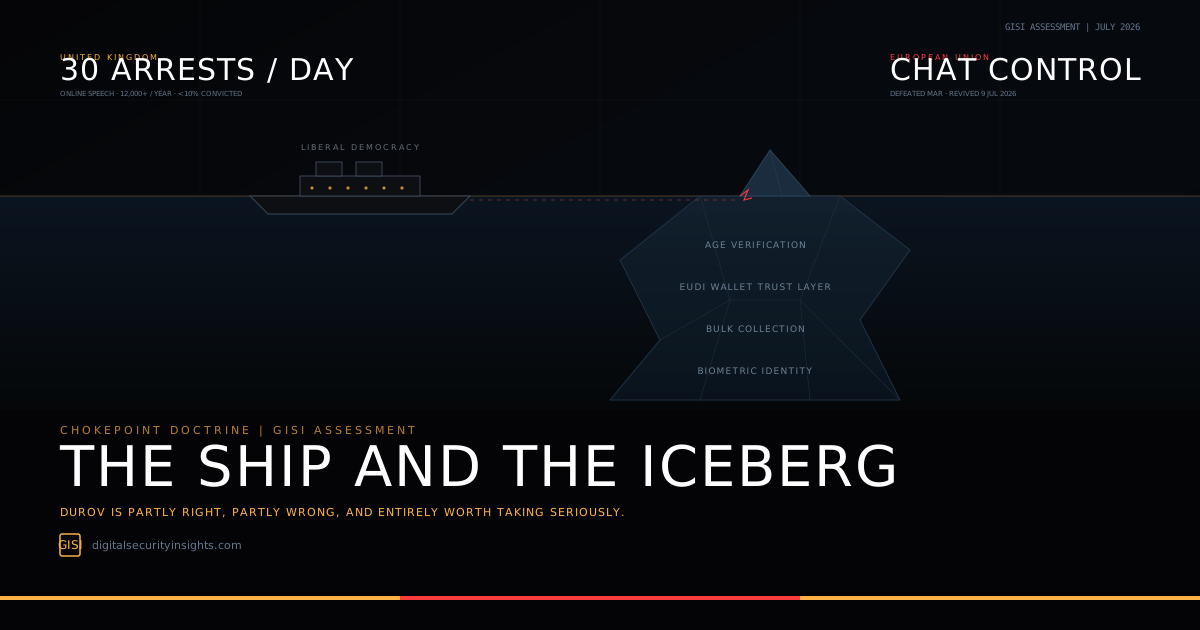
Pavel Durov says the ship of our personal freedoms has hit the iceberg and is sinking without us realising it. He is partly right, partly wrong, and entirely worth taking seriously. This GISI assessment evaluates his argument against the evidence: the UK's 30 online-speech arrests a day, Germany's platform-fining model, France's crypto-kidnapping wave, the EU's Chat Control revival on 9 July 2026, and the online-safety regimes of Australia and New Zealand. What is accurate survives scrutiny. What is exaggerated — the collapse of the distinction between Western democracies and Russia, China, and Iran — does not. The right question is not whether the West is becoming authoritarian. It is whether the architecture being built in the name of safety — age verification, identity wallets, bulk collection, biometric mandates — creates the conditions under which essential liberty becomes, in practice, optional, regardless of who governs it. The series has been asking that question. The answer, so far, is not consistently yes.
Pavel Durov is partly right, partly wrong, and entirely worth taking seriously — a GISI assessment of the global architecture of speech suppression.
Start With the Man, Then Leave Him Behind
Pavel Durov is not a disinterested observer of the surveillance state. He is the founder of Telegram, a platform that has been used to organise terrorist attacks, distribute child sexual abuse material, coordinate genocide, and run criminal markets at scale — alongside the entirely legitimate political speech, journalism, and private communication that makes it genuinely valuable to hundreds of millions of people. He is a man who was arrested in France in August 2024 and placed under formal investigation for offences relating to Telegram's moderation failures. He has a material interest in arguing that governments should have less ability to regulate communications platforms, because his platform is regulated by those governments.
None of that makes him wrong. But it means his argument needs to be evaluated against the evidence rather than accepted on the authority of the person making it — which is, in any case, how the Chokepoint Doctrine series evaluates every argument.
So let us evaluate it against the evidence. And let us do so with the same analytical standard the series has applied to Iran's cable toll demands, to the EU's age verification architecture, to the EUDI Wallet's missing security standard, and to the US government's export control on frontier AI: state what is accurate, state what is exaggerated, and state what the accurate part means for anyone trying to understand the world they actually inhabit.
What Is Accurate
The United Kingdom is arresting more than 30 people per day for online speech. This is not a Durov fabrication. It is confirmed by The Times' April 2025 Freedom of Information investigation across 35 of England and Wales's 43 territorial police forces, corroborated by parliamentary debate in both the House of Commons and the House of Lords, and acknowledged without dispute by the government's own ministers. Police make more than 12,000 arrests a year under section 1 of the Malicious Communications Act 1988 and section 127 of the Communications Act 2003. Every police force in the UK has a dedicated team monitoring social media.
The qualifications matter. Most of these arrests do not result in conviction — less than one tenth resulted in sentencing in 2023. An arrest is not a conviction. The laws being applied do require, under CPS guidance, that communications cross the bar from offensive to grossly offensive, and prosecutors are required to weigh Article 10 ECHR rights in every charging decision. The bar for prosecution is stated to be high. The ex-Royal Marine held for 17 days for posting a video ranting about immigration was acquitted in 17 minutes by a jury.
But the qualifications do not resolve the underlying concern they are offered to dismiss. An arrest that does not result in conviction is not without consequence. Devices are seized. Employment is disrupted. Social standing is damaged. The experience of being investigated by police for an online post, regardless of outcome, is the deterrent that functions independently of whether a conviction follows. A Yorkshire man arrested after posting a photo from a Florida holiday holding a legal shotgun — deemed potentially menacing — endured four months on bail before release without charge. The arrest was the punishment. Freedom House's 2025 assessment of the United Kingdom noted a score decline specifically because of "the proliferation of criminal charges, arrests, and convictions concerning online speech, including speech protected under international human rights standards." Freedom House does not make that assessment carelessly.
The chilling effect is documented rather than speculated. In UK parliamentary debate, the phrase "scared to speak out about important topics in case they face criminal prosecution" appears in evidence given by legal practitioners defending clients. This is the self-censorship that Durov names — people who do not know whether their post crosses the threshold, concluding that the safest course is not to post. The chilling effect of a law that is vaguely defined and inconsistently enforced is not primarily measured in arrests. It is measured in the speech that does not happen.
Germany's Netzdurchsetzungsgesetz — the Network Enforcement Act — operates differently from the UK model but produces similar concerns. Germany primarily fines platforms rather than prosecuting individuals, which means the enforcement pressure falls on platforms to remove content rather than on users to refrain from posting. The effect is content removal without individual prosecution. The outcome for speech is similar: content disappears, but the mechanism is commercial rather than criminal.
France's crypto kidnapping wave, which Durov specifically names, is real and verified. Just in the first three months of 2026, you have over 40 victims of kidnappings targeting cryptocurrency holders whose financial data was exposed. The French tax official breach that preceded it is documented. These are not fabrications.
The EU's Chat Control trajectory is documented by this series across multiple articles with primary source citations. The pattern of rejected proposals returning in narrowed form, using procedural mechanisms to circumvent democratic votes, is confirmed by MEP statements on the record, by parliamentary procedure documentation, and by the vote results themselves. Chat Control 1.0 was defeated in March 2026 by one vote, legally expired on April 3, and passed through a procedurally controversial revival on July 9, 2026, with the vote timed for the last day before summer recess.
The selective enforcement concern that Durov names — "first you overburden an industry with excessive, contradictory regulation. As a result, you make compliance impossible. Now you can treat every entrepreneur, every CEO, every business owner as a criminal" — is the most analytically sophisticated element of his argument, and the one with the most direct connection to the Chokepoint Doctrine series' own work. The TPRM series documented exactly this dynamic at the organisational level. Every enterprise of meaningful scale is simultaneously in violation of some subset of the overlapping, contradictory, and mutually exclusive compliance requirements imposed by NIS2, GDPR, DORA, the EU AI Act, the CRA, national implementation variations, and sector-specific regulatory overlays. The organisation that is fully compliant with all of them does not exist. Selective enforcement — choosing which violations to pursue based on criteria that are not publicly stated — is not a hypothetical risk. It is the operational reality of every regulatory regime that cannot possibly be universally enforced.
What Is Exaggerated or Missing Context
Durov's Titanic analogy is emotionally compelling and analytically imprecise in a way that matters. The ship has hit the iceberg, he says. We are sinking without realising it.
The analogy works if the trajectory is linear and the destination is certain. It fails if the systems being described are contested rather than determined — if the outcome depends on choices being made now rather than physics already in motion.
The UK is making 30 arrests a day for online speech. It is also debating those arrests in the House of Lords, publishing freedom of information investigations about them in The Times, declining to convict in more than 90% of cases, and conducting a 2026 government review of the laws producing them. The arrestees who are not convicted have legal recourse, and some are winning it. The jury that acquitted the ex-Royal Marine in 17 minutes was exercising exactly the democratic check that the system provides. That check is imperfect, costly, and unequally distributed. It is also operating.
This analysis is published. Your decision isn't.
We run the same cross-domain, scenario-based foresight on the decision in front of you — a deal, a market entry, a supplier dependency. Board-ready in five days, with a foresight indicator watchlist.