
Africa & Emerging Markets
Nigerian fintech, NIMC, pan-African rails — digital infrastructure and risk across emerging markets.
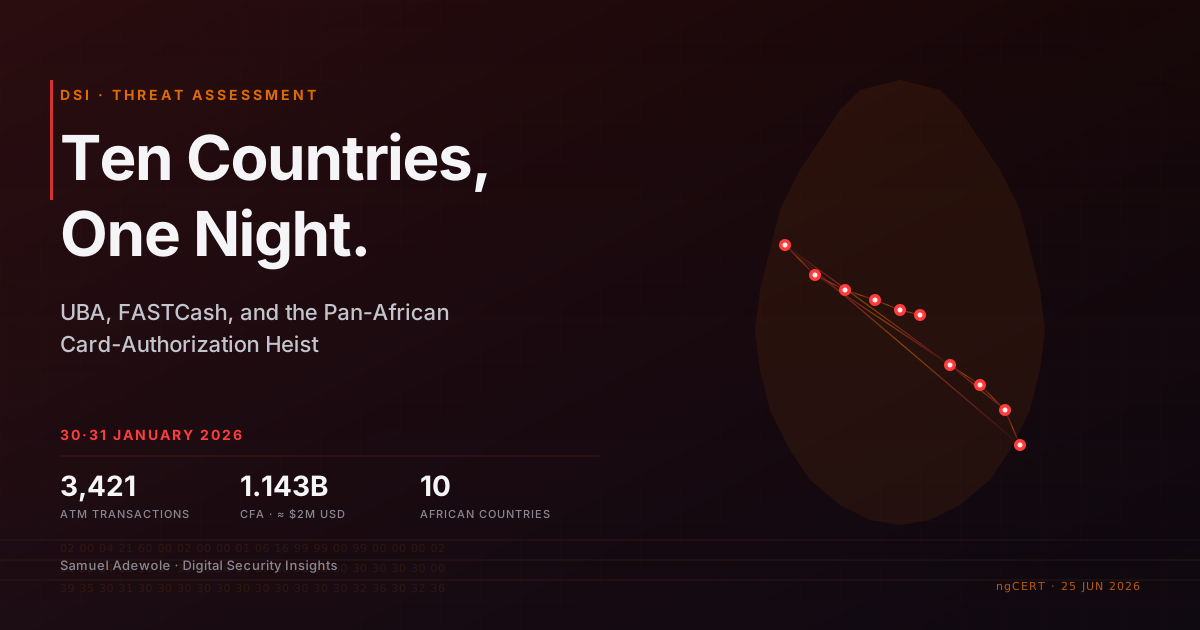
On the night of January 30, 2026, 3,421 ATM withdrawals against the United Bank for Africa drained 1.143 billion CFA francs from 91 customer accounts. The transactions happened in three Senegalese cities — Dakar, Thiès, Kaolack — and were mirrored simultaneously against UBA subsidiaries in nine other African countries. The attackers had what they always have in this pattern: privileged access to the card-authorization infrastructure. FASTCash, the eight-year-old North Korean cash-out playbook, has landed in West Africa at pan-African banking scale — and ngCERT's advisory came five months after the night the money walked.

In June 2024, Paradigm Initiative proved the largest data leak in Nigerian history by buying it: for 100 naira a record, rogue sites were selling the NIN, BVN, passport, and phone number of 104 million Nigerians from NIMC's database, including the slips of the digital-economy minister and the national data regulator. On 27 June 2026, President Tinubu signed the NIMC Act 2026, replacing a 19-year-old law, and named that same commission the Root Certification Authority for Nigeria's national PKI. My assessment: the Act hardens the cryptography, but the 2024 breach was never cryptographic. It leaked through custody and access, third-party agents with legitimate credentials, the exact layer a certificate hierarchy does not fix. The new 14-agency board (INEC, DSS, EFCC, CBN, the population commission, the national security adviser) concentrates the state's coercive machinery around one dataset. For every Nigerian fintech, identity verification now chains to a single sovereign root you cannot switch away from, held by a custodian with a demonstrated breach history. The law is overdue and much of it is sound. But a root of trust is the one credential that cannot be reissued, and it now sits on the custody layer that already failed once, at the scale of a nation. What to watch: the secondary regulations, the data regulator's enforcement teeth, the access-governance layer, and whether any redress ever reaches the 104 million.

At 5:21pm ET on Friday 12 June 2026, a US government letter directed Anthropic to suspend Fable 5 and Mythos 5 for any foreign national, anywhere in the world, including its own non-US employees. Anthropic complied within hours, in full, worldwide — while publicly dissenting from the action and stating that the underlying capability is freely available from competing models without restriction. Sixteen days earlier, the European Commission had published the Tech Sovereignty Package built for exactly this scenario. The letter is the first operational use of Export Control Classification Number 4E091, finalised in the BIS Framework for AI Diffusion on 15 January 2025 to cover frontier model weights trained on more than 10^26 computational operations. The pattern it completes — CLOUD Act 2018, Schrems II 2020, the chip rules 2022, the AI weight rule 2025, the ICC sanctions, the Solvinity block, the EU package, now this — is the ladder of US extraterritorial reach this series has been mapping. The new layer is cognition itself. With the eight-rung extraterritoriality timeline, the seven-region cognitive-dependency map, and the strategic read for EU, UK, India, China, Japan, Korea, Middle East, and Africa.

Two Doctrines, One Coastline named the coalition chokepoint. This piece names what the United Arab Emirates is actually doing inside that coalition. The federation flew Israeli targeting packages out of Al Dhafra against Iranian targets it has held a constitutional grievance with since 1971. The Abu Dhabi capital base has been welded into the American artificial intelligence stack at the chip, model, and platform level — through MGX, OpenAI, Anthropic, the Stargate project, BlackRock, and Microsoft — in commitments that cannot be unwound without vaporising approximately eighty billion dollars of Emirati positioning. The federation will survive the war structurally. The brand promise the survival depended on will not.

Berlin, January 2022. Hackers took the IT systems of Oiltanking and Mabanaft offline. Tank-loading scheduling went dark for two weeks. The OT held — but the IT system that scheduled the loading did not. That is the incident pattern now migrating into the Nigerian operational reality. This briefing examines what the global oil and gas pattern is telling operators in the post-PIA Nigerian context — and why single-operator defence has reached its structural ceiling.

A Tier 1 Nigerian bank lost billions on a Friday evening. The institution did not report the breach to its peers. Within 48 hours, two other banks were compromised by the same group. This briefing examines what the 2026 incident pattern is telling CISOs in the Nigerian banking sector — and why individual-bank defence has stopped working.

On 16 May 2026, a joint US-Nigerian precision strike in Mitile killed Abu-Bilal al-Minuki, the second-in-command of the Islamic State. The same year, Nigeria recorded the highest Belt and Road Initiative construction volume on earth — $24.6 billion in Chinese contracts, up from $1.8 billion the year before. Tinubu's government is splitting its great-power dependencies by domain: the United States for intelligence and counterterrorism; China for railways, telecoms, and oil. The arrangement is being studied as the multipolar playbook for the Global South. The complication: the ghost the Eagle is hunting in Lake Chad is one the Eagle helped to birth — through CPA Order 2 in 2003, Camp Bucca, and the August 2012 DIA memo that predicted exactly the outcome it became.

On 12 February 2012, Jake Sullivan — Hillary Clinton's deputy chief of staff at State, later Obama's deputy national security advisor, now Biden's national security advisor — sent his principal an email containing six words that explain four decades of American foreign policy more completely than any classified briefing: 'AQ is on our side in Syria.' This piece names the doctrine the architects have testified to without acknowledging: the strategic instrumentation of Sunni jihadism across four phases — Afghanistan 1979, Iraq 2003, Syria 2012, the Sahel 2015. Operation Cyclone, CPA Order 2, Camp Bucca, the August 2012 DIA memo, Operation Timber Sycamore, Biden at Harvard, Clinton on Qatar and Saudi Arabia, the 28 pages, Tulsi Gabbard's Stop Arming Terrorists Act. The on-record testimony from the architects is the doctrine. The Lake Chad piece named the symptom. This piece names the disease.

The organisations learning this the hard way all share the same story: they invested in advanced tools before they had stable foundations. AI can amplify maturity. It cannot create maturity. Why DSI has formalised a partnership with SecPoint to solve foundational visibility across Sweden, Nigeria, and Kenya.

On April 9, Finance Minister Smotrich described territorial expansion as state policy in two words. Ten days later, Argentina signed over water infrastructure to the expanding state's national utility. The pattern is not hidden. It does not need to be.

On December 30, 2025, a Chinese entity filed for 193,428 satellites. Washington called it spectrum hoarding. Three weeks later, SpaceX filed for one million. The orbital commons is being enclosed by every power that has the launch capacity to participate. The only question is who wrote the filing system.

Three institutions in three weeks. The Corporate Affairs Commission, Remita Payment Services, and Sterling Bank — a systematic campaign against Nigeria's digital infrastructure is draining the trust that a digital economy cannot function without.

Larry Fink controls $14 trillion. He told the world the Iran war ends in one of two extremes: $40 oil and growth, or $150 oil and global recession. Both outcomes end with BlackRock building the tokenised financial system. The Strait of Hormuz is now a toll booth charging in yuan and crypto. The fertiliser chain is collapsing toward a food crisis affecting 363 million people. The welfare loss in Zambia is 20 times larger than in the United States. And the man who prices the war just bought both ends of the Panama Canal. This is predictive intelligence on chokepoint economics, de-dollarisation, and who profits when the world burns.

Iran produced a broadcast-quality rap video mocking the Secretary of War within twenty-four hours of Trump's Easter Sunday threat to destroy civilian infrastructure. The videos do not rely on deception. They point out moral incongruities that already exist — endless wars, Gaza atrocities, political corruption, billionaire island — and weaponise the truth in a format designed to go viral. The cost-exchange ratio is even more devastating than the $35,000 drone against the $4 million interceptor. A Lego video costs thousands. The political damage is incalculable. And the US dismantled its own counter-disinformation infrastructure in December 2024. The information domain is the war the empire cannot win — because the weapon is the truth, and the truth is something the empire cannot manufacture a defence against.

The ceasefire lasted less than twelve hours. Israel launched Operation Eternal Darkness — fifty jets, one hundred and sixty bombs, two hundred and fifty-four killed in ten minutes in central Beirut. Iran reclosed the Strait of Hormuz. The IRGC struck Kuwait, Saudi Arabia, and the UAE after the ceasefire was announced. Oil hit $126. LNG capacity was destroyed for years. And the interceptor stockpiles that were supposed to protect the empire are one-third depleted with no replacements for three to eight years. The ice that formed over boiling water has shattered. This is what the world looks like when the cover breaks.

Ninety minutes after announcing a ceasefire he did not want and did not dictate, the President of the United States named Nigeria as the source of fake news designed to humiliate him. He named no outlet. He provided no evidence. He did not need to. The word 'Nigeria' did the work on its own. Part 1 of The Empire Looks South.

The US spent $2 billion a day for the first six days of a war it started. Iran spent $35,000 on a drone. The interceptor missile cost $4 million. The drone destroyed a $485 million radar. The national debt crossed $39 trillion. The interest payments now exceed the defence budget. And the empire just drew a line at the equator and declared half of Africa its security perimeter. Part 3 of The Empire Looks South.

On March 5, 2026, the US Secretary of War stood before a map and declared every nation north of the equator part of America's 'immediate security perimeter.' Half of Africa — the half with the oil, the minerals, and the people — fell inside the line. The Greater North America doctrine has an older twin. Part 2 of The Empire Looks South.

On April 1, 2026, the NDPC launched an investigation into a data exposure incident involving Remita and Sterling Bank — alone. One day later, Nigeria announced a Cybersecurity Coordination Council. This is the gap between the governance we have written down and the coordination we have never built.

The most-cited energy analyst in the world told you the global economy could collapse by May if Hormuz stays closed. He is right about the timeline. He is wrong about why. The crisis is not barrels — it is that every barrel now moves through infrastructure that is simultaneously physical and digital, kinetic and networked. And the invisible half is under attack.

The EU AI Act demands conformity assessments. Nigeria's AI bill requires mandatory registration. Kenya just forced Worldcoin to delete all biometric data. India chose no risk classification at all. For organisations deploying AI across African markets, the regulatory fracture is not a governance challenge — it is a barrier to existence.

"Ohun ti a ba gbin la o ka a" — what one plants is what one reaps. Iran presented five conditions for peace. One of them was a bill. Through a 21-mile strait, a $2M yuan toll, and reparations demanded in non-dollar currencies, a financially isolated nation used every weapon except the ones America expected.

Europe did not break its energy dependency. It rotated it. US LNG now supplies 60% of EU imports. Norway is maxed out. Qatar got bombed. Russia is still earning $501 million a day. And 85% of Europe's cloud runs on American servers. The leash changed hands. The collar did not come off.

A cyberattack on Intoxalock stranded thousands of drivers across 46 US states. Smart beds overheat during AWS outages. Solar panels in Africa go dark when payment servers fail. 20 billion IoT devices, 75% without update mechanisms, attacked 820,000 times per day. The EU's Cyber Resilience Act is Europe's answer — but the deadline is December 2027.

Africa is finally learning to leverage what it's always possessed. When African leaders sit at tables where Western voices are just one among many, rather than the presumed authority, the entire dynamic shifts.