

Nigerian Oil and Gas at the Cyber-Physical Frontier: What the 2026 Pattern Tells Operators
Berlin, January 2022. Hackers took the IT systems of Oiltanking and Mabanaft offline. Tank-loading scheduling went dark for two weeks. The OT held — but the IT system that scheduled the loading did not. That is the incident pattern now migrating into the Nigerian operational reality. This briefing examines what the global oil and gas pattern is telling operators in the post-PIA Nigerian context — and why single-operator defence has reached its structural ceiling.
Executive Summary
The Nigerian oil and gas sector now sits in the same architectural position the banking sector occupied two years ago: regulator-pressed, peer-silent, structurally unprepared for the next confirmed adversary campaign. The Petroleum Industry Act 2021 created two new regulators (NUPRC and NMDPRA). The Nigeria Data Protection Act 2023 and the General Application and Implementation Directive 2025 imposed 72-hour breach reporting. The Office of the National Security Adviser has formally designated the sector as Critical National Information Infrastructure. None of those structural changes has produced sector-wide telemetry that would catch a coordinated campaign before the second victim.
This briefing examines the incident pattern visible across global and African oil and gas operators, anchors it in the Nigerian regulatory and operating context, and argues that the cyber-physical boundary is the consequential frontier. Banks lose money in breaches. Energy operators lose molecules, lose process safety, lose national supply reliability. The architecture has to recognise the difference.
This is Part 1 of a series. The architecture work and the operational implementation will be published by cmdev in subsequent briefings.
Stakeholder action map
| Stakeholder | Priority signal | Action this quarter |
|---|---|---|
| Operator CISO / CIO | NMDPRA framework approaching; banks had three weeks for CSAT | Stand up the evidence pipeline now; baseline IT/OT segmentation against ransomware conditions, not normal operations |
| Operator board | Production target depends on uptime; one cyber-physical event impairs the headline KPI | Treat cyber-physical resilience as a production KPI, not an IT cost line. Demand quarterly evidence, not assurance memos |
| NMDPRA / NUPRC | Regulatory inflection underway; sector framework expected 2026 H2 / 2027 Q1 | Move audit cadence to evidence-grade, not attestation. Federate detection across operators before a coordinated campaign forces it |
| JV / off-take counter-party | Counter-party assurance cycles tightening across European and Asian buyers | Require evidence-grade controls from Nigerian counter-parties; underwrite supplier-side capacity-building where the gap is structural |
| ONSA / National CERT | CNII designation active; operational mechanism for sector-wide telemetry missing | Sponsor the federation layer — a shared sovereign platform that warns every operator the moment an adversary surfaces at any participating site |
The Berlin Refuelling Incident
Berlin, January 2022. Hackers hit the IT systems of Oiltanking and Mabanaft, two German oil logistics companies. Tank-loading systems went offline. For roughly two weeks, 233 fuel stations across northern Germany could not reliably reload supply through normal automated channels. The breach was contained at the IT layer — the OT systems holding the molecule never went down. But the IT system that scheduled the loading did. The molecule could not move on its own; the operational coupling between IT and OT was too tight for the IT outage to be tolerated.
That is the incident pattern now migrating into the Nigerian operational reality. Adversaries do not need to defeat a SCADA control loop to disrupt the sector. They need to defeat the IT layer that schedules, bills, allocates, and audits the flow. The operational coupling between IT and OT in Nigerian downstream and midstream is at least as tight as Oiltanking's, and the redundancy is, in many cases, thinner.
The Berlin event was contained because the operators preserved a meaningful manual fallback — paper-based scheduling, walked supply to retail, OT integrity at the terminal. Nigerian operators rebuilding for the post-PIA era are choosing how much of that fallback to keep. The decisions being made now — about automation depth, about cloud back-office, about vendor remote-access architecture — will define what is recoverable in the next event.
Takeaway. An adversary does not need to defeat SCADA to disrupt the sector. Defeating the IT layer that schedules, bills, and allocates the flow is sufficient — and the IT layer is the under-defended one.
The Pattern: Seven Incidents, One Frontier
The Berlin incident is one node in a recurring pattern. Across roughly a decade, the same shape repeats — at different operators, in different jurisdictions, against different control systems, all converging on a single architectural lesson.
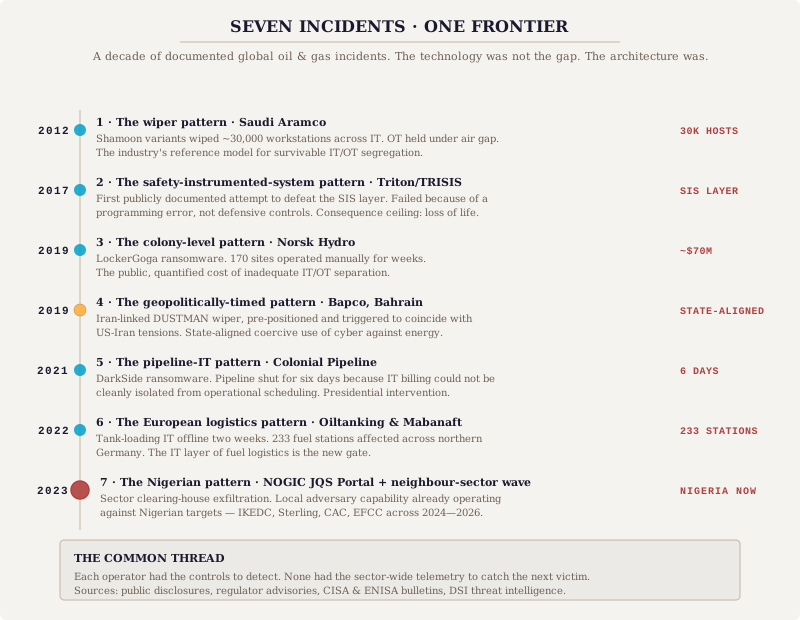
1. The wiper pattern. Saudi Aramco, August 2012 and 2018. Shamoon variants wiped approximately 30,000 workstations across the IT estate. Recovery took weeks. The OT held — separated by an air gap that has since become the industry's reference model. The lesson: IT/OT segregation is not a luxury. It is a precondition for survivability under destructive attack.
2. The safety-instrumented-system pattern. Triton/TRISIS, August 2017, against a Saudi petrochemical facility. An adversary group later attributed to a Russian state-affiliated research institute attempted to manipulate the safety-instrumented system — the layer of last resort, designed to prevent loss of life when process control fails. The attack failed because of a programming error, not because of defensive controls. The lesson: the safety layer is now a target class, not an oversight category.
3. The pipeline-IT pattern. Colonial Pipeline, May 2021. DarkSide ransomware took the IT estate offline; the company shut the 5,500-mile pipeline for six days because the billing system could not be cleanly isolated from the operational scheduling. East Coast gasoline shortages, presidential intervention, $4.4 million in ransom. The lesson: IT/OT coupling that survives normal operations does not survive ransomware.
4. The European logistics pattern. Oiltanking and Mabanaft, Germany, January 2022. Tank-loading IT offline for two weeks. Bunker-fuel logistics impaired across northern Europe. The lesson: the IT layer of fuel logistics is the new gate, and it is structurally under-defended.
5. The colony-level pattern. Norsk Hydro, March 2019. LockerGoga ransomware. ~$70 million loss. 170 sites operated manually for weeks. The lesson: the cost of inadequate IT/OT separation, measured in cash and operational ceremony, is now public and quantified.
6. The Iranian pattern, geopolitically timed. Bapco (Bahrain Petroleum Company), December 2019. Iran-linked DUSTMAN wiper, pre-positioned and triggered to coincide with US-Iran tensions. The lesson: in this region, in this geopolitical alignment, cyber capability against oil and gas operators is treated as a coercive lever by state-aligned actors. Nigerian operators are not outside that targeting frame.
Need intelligence like this on a decision you're facing?
DSI Advisory Services helps boards, business leaders, defence institutions, and security leaders understand threats before they reach the horizon — where cyber, geopolitics, and business risk converge.