

The Useful Enemy
On 12 February 2012, Jake Sullivan — Hillary Clinton's deputy chief of staff at State, later Obama's deputy national security advisor, now Biden's national security advisor — sent his principal an email containing six words that explain four decades of American foreign policy more completely than any classified briefing: 'AQ is on our side in Syria.' This piece names the doctrine the architects have testified to without acknowledging: the strategic instrumentation of Sunni jihadism across four phases — Afghanistan 1979, Iraq 2003, Syria 2012, the Sahel 2015. Operation Cyclone, CPA Order 2, Camp Bucca, the August 2012 DIA memo, Operation Timber Sycamore, Biden at Harvard, Clinton on Qatar and Saudi Arabia, the 28 pages, Tulsi Gabbard's Stop Arming Terrorists Act. The on-record testimony from the architects is the doctrine. The Lake Chad piece named the symptom. This piece names the disease.
This piece extends the analytical frame opened in The Ghost in Lake Chad, which mapped Nigeria’s position between the American counterterrorism partnership and the Chinese infrastructure surge. That piece identified a structural irony at the heart of the partnership: the Islamic State affiliate the United States is helping Nigeria target descends genealogically from organisations that American foreign policy decisions produced. This piece names the longer pattern. The doctrine has a name now, and its architects have testified.
The Email That Should Have Ended a Career
On 12 February 2012, Jake Sullivan — then deputy chief of staff to Secretary of State Hillary Clinton, later deputy national security advisor to Barack Obama, now national security advisor to Joe Biden — sent an email to his principal that should have ended his career, ended a war, or at minimum ended the polite fiction that has governed Western press coverage of Syrian foreign policy for the past fifteen years. The subject line was administrative. The body contained six words that explain four decades of American foreign policy more completely than any classified briefing has ever managed to.
“AQ is on our side in Syria.”
The email was released through Freedom of Information Act litigation. It is in the public State Department archive. Its authenticity has not been contested. The author has not retracted it, contextualised it, or explained how the statement should be understood except as the literal statement of policy assessment that the text says it is. Al-Qaeda — the organisation that murdered three thousand Americans on 11 September 2001, that the United States declared a generational enemy, that the Authorization for Use of Military Force has been used to justify continuous global military operations against for two decades — was, in February 2012, assessed by the senior policy planning aide to the Secretary of State as a strategic ally in the Syrian theatre.
The Sunni jihadist movement that produced al-Qaeda, the Islamic State of Iraq, the Islamic State of Iraq and the Levant, the Nusra Front, Ansar al-Sharia, Jabhat Fateh al-Sham, the Islamic State’s West African Province operating today in the Lake Chad Basin, the Khorasan affiliate in Afghanistan, and every adjacent franchise from Mali to Mindanao — this entire movement has, across four decades and three Republican and three Democratic administrations, functioned as the most versatile and consistently deployable instrument in the toolkit of American foreign policy. It has been armed in Afghanistan, produced in Iraq, weaponised in Syria, franchised across the Sahel, and targeted only when the political cost of toleration exceeded the strategic benefit of letting the instrument operate against an adversary state. This piece maps the doctrine, locates the on-record testimony from the architects themselves, and argues that the Global South’s acceleration of independent counterterrorism cooperation — the Nigerian doctrine that the prior GISI piece documented — is the rational response of states that have read the doctrine and decided to manage the instrument rather than be managed by it.
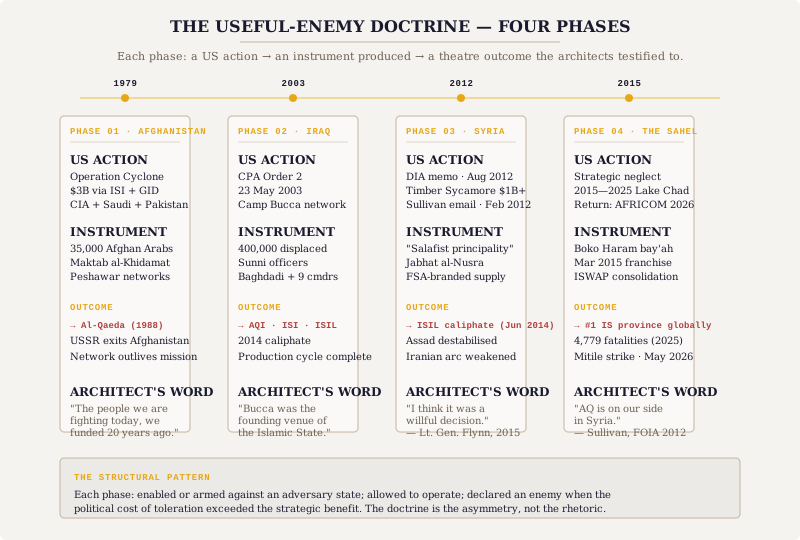
Phase One: Afghanistan, 1979 to 1989 — The Pipeline That Built Al-Qaeda
Operation Cyclone was the longest and most expensive covert action programme in CIA history. Between 1979 and 1989, the United States channelled approximately three billion dollars through the Pakistani Inter-Services Intelligence Directorate and the Saudi General Intelligence Presidency to the Afghan mujahideen, who were fighting the Soviet occupation. Some figures place the total significantly higher when matching-fund commitments from Saudi Arabia and contributions from the United Arab Emirates, Egypt, and the Pakistani national budget are added to the American direct funding. The programme delivered Stinger anti-aircraft missiles, training infrastructure, religious indoctrination materials, and the logistical pipeline that allowed an estimated thirty-five thousand foreign Sunni Muslim fighters — the “Afghan Arabs” — to travel from Saudi Arabia, Egypt, Yemen, Algeria, Sudan, Indonesia, and across the Middle East and North Africa to fight in the Hindu Kush.
The American CIA officers and Pakistani ISI officers who designed and ran Operation Cyclone were aware that the network they were building had ideological characteristics that exceeded the immediate objective of expelling the Soviets. Internal CIA assessments from the period acknowledge that the Afghan Arabs were Salafist in religious orientation, anti-Western in long-term ideological commitment, and unlikely to disband as a coherent network once the proximate Soviet enemy was defeated. The judgement made was that the strategic value of imposing a sustained Soviet military commitment on a peripheral theatre exceeded the projected cost of the network’s eventual non-Soviet operational deployment. The judgement was made repeatedly across the Carter and Reagan administrations. The judgement was correct on the Soviet utility. It was catastrophically incorrect on the cost projection.
The Maktab al-Khidamat, the “Services Bureau” that Osama bin Laden and Abdullah Azzam organised in Peshawar from 1984, was the operational and administrative architecture that received, trained, deployed, and tracked the Afghan Arabs. The Maktab al-Khidamat became al-Qaeda in 1988 through a process of organisational reformulation that did not involve a new fundraising network, a new recruitment channel, a new training infrastructure, or a new ideological framing. It involved the existing Operation Cyclone-financed apparatus continuing to operate under a new internal designation and a slightly modified strategic agenda. The al-Qaeda that declared war on the United States in 1996 and conducted the embassy bombings in 1998, the USS Cole bombing in 2000, and the 11 September attacks in 2001 was the operational continuation of the network the CIA had built between 1979 and 1989.
The 2009 Foreign Affairs interview in which Hillary Clinton, then Secretary of State, said, “The people we are fighting today, we funded twenty years ago” is the on-record acknowledgement of this continuity from the most senior diplomatic official of the United States government. Clinton was not making a controversial historical claim. She was describing the recorded logistical genealogy of the organisation against which the United States had been at war for the preceding eight years. The claim was not contested at the time, has not been contested since, and represents what the State Department, the CIA, and the Department of Defense all internally accept as the documented record of how the organisation came into being.
Phase One established the doctrine. A Sunni jihadist network could be funded, trained, and weaponised against a strategic adversary, operated to the point of accomplishing the primary objective, and then declared an enemy when the primary objective was complete and the secondary consequences became politically intolerable. The cost of the secondary consequences — three thousand dead Americans, twenty years of war, eight trillion dollars of cumulative direct and indirect spending — was paid. The doctrine continued.
This analysis is published. Your decision isn't.
We run the same cross-domain, scenario-based foresight on the decision in front of you — a deal, a market entry, a supplier dependency. Board-ready in five days, with a foresight indicator watchlist.