

The Nigerian Banking Sector Under Siege: What the 2026 Incident Pattern Tells Security Leaders
A Tier 1 Nigerian bank lost billions on a Friday evening. The institution did not report the breach to its peers. Within 48 hours, two other banks were compromised by the same group. This briefing examines what the 2026 incident pattern is telling CISOs in the Nigerian banking sector — and why individual-bank defence has stopped working.
Executive Summary
The Nigerian banking sector is under sustained, coordinated, increasingly sophisticated cyber attack. The CBN's mandatory cybersecurity self-assessment directive of 30 March 2026 — which required all Deposit Money Banks to submit posture evidence within three weeks — was not a regulatory whim. It was a signal that the regulator has lost patience with what it sees from the sector's defensive posture.
This briefing examines the incident pattern hitting the sector in 2026, traces it back through six documented attacks across the continent, and argues that the structural inadequacy is no longer at the technology layer. It is at the coordination layer. Banks defending themselves individually against organised, AI-enhanced adversaries who share intelligence across operations is a losing proposition. The implication for security leaders is uncomfortable: the architecture of sector-wide defence has to change, and the change is overdue.
This is Part 1 of a three-part series. Parts 2 and 3 — published by cmdev — cover the architecture that addresses this threat picture and the operational implementation that delivers it.
The Friday-Evening Incident
A Tier 1 Nigerian bank, early 2026. Friday evening. Billions of naira moved out of the institution before the night was over.
The bank did not report the breach to its peers. Within 48 hours, two other banks in the sector were compromised by the same operators — actors with infrastructure linked to U.S.-based hosting, exhibiting the tooling and tradecraft of a financially-motivated group that had spent meaningful time reconnaissance-mapping the Nigerian sector before acting.
The silence was the failure, not the breach. Had the first victim shared the indicators of compromise — the network signatures, the credential patterns, the lateral movement traces — the second and third banks would have had operational intelligence to act on. They did not. They learned about the campaign the same way the first bank did: by discovering it on their own systems, after the money had moved.
This is not a one-off failure of disclosure protocol. It is the predictable outcome of a sector architecture in which each bank treats its security posture as a competitive secret. The institution that just lost billions of naira has every commercial incentive to keep the incident quiet — reputational damage, customer flight, regulatory exposure — and no peer-pressure mechanism to overcome that incentive.
The Pattern: Six Incidents, One Lesson
The Friday-evening incident is not isolated. It is the most recent expression of a pattern that has been visible across the African banking sector for the better part of a decade. The shape:
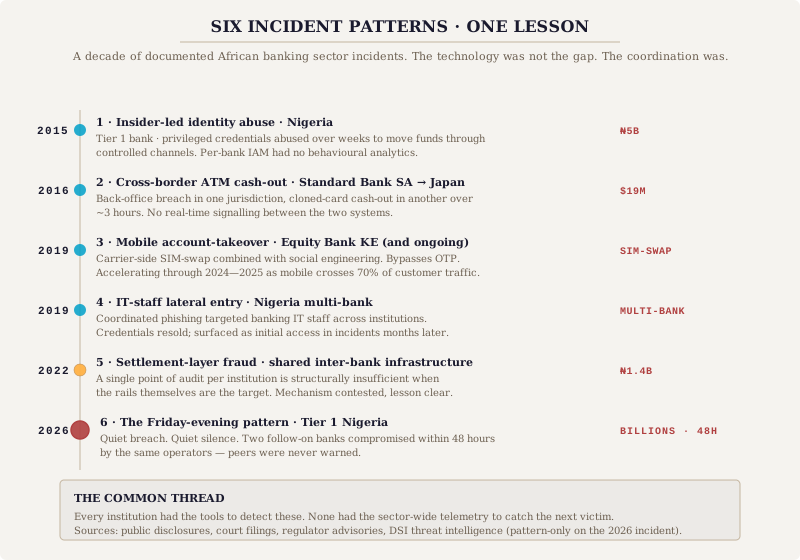
1. The insider-led, identity-abuse pattern. A Tier 1 Nigerian bank, mid-2010s. A ₦5B-class insider fraud unfolded over weeks. Privileged credentials were abused to move funds through controlled channels. The institution's per-bank IAM stack had no behavioural analytics that would have surfaced the pattern early.
2. The cross-border cash-out pattern. Standard Bank South Africa, 2016. Operators extracted approximately $19 million from Japanese ATMs over the course of roughly three hours using cloned cards generated from a compromised back-office system. The attack was successful because the back-office breach happened in one jurisdiction and the cash-out happened in another, with no real-time signalling between them.
3. The mobile account-takeover pattern. Ongoing across Nigerian and Kenyan banks. Carrier-side SIM-swap compromises combined with social engineering to bypass OTP-based authentication. The Equity Bank Kenya mobile-app compromise of 2019 is the often-cited public case. The pattern has accelerated through 2024 and 2025 as mobile banking adoption has crossed 70% of customer traffic across major institutions.
4. The IT-staff lateral-entry pattern. A coordinated phishing campaign in 2019 targeted banking IT staff across multiple Nigerian institutions. Credentials harvested in the campaign were resold and used as the initial access vector for incidents that surfaced months later. Per-bank email defence has a structural ceiling — the better the bank, the higher the social engineering ROI for the specific employees who can grant privileged access.
5. The settlement-layer pattern. Public allegations in 2022 against shared inter-bank infrastructure described a ₦1.4B-class fraud at the settlement rail. The technical mechanism was contested, but the architectural lesson was not: a single point of audit per institution is structurally insufficient when the rails themselves are the target.
6. The Friday-evening pattern. The most recent pattern, and the one we opened with. Quiet breach. Quiet silence. Coordinated follow-on attacks against peers who were never warned.
What every one of these incidents shares: the institutions involved had the tools required to detect them. What they did not have was the sector-wide telemetry that would have caught the pattern before the next victim. The technology was not the gap. The coordination was.
The CBN CSAT Directive: The Regulatory Inflection Point
The Central Bank of Nigeria's mandatory Cybersecurity Self-Assessment Tool directive of 30 March 2026 marked a discontinuity in how the regulator approaches sector cybersecurity posture. The directive required all Deposit Money Banks to submit a comprehensive self-assessment of their cybersecurity controls within three weeks — an aggressive timeline that signalled the regulator's view of where the urgency now sits.
What the CSAT framework asks for, in operational terms:
- Demonstrable control coverage against a defined framework (mapped to NIST CSF, ISO 27001 A.9, and CBN-specific operational controls)
- Auditable evidence that the controls actually function — not just attestations that they exist
- Breach notification readiness within timeframes that align with NDPA 2023 (most banks read this as 72 hours, though the operational reality is hours, not days)
- Third-party risk assessment covering the vendor ecosystem that supports banking operations — increasingly the actual attack surface
The pattern we see across our engagements: most institutions can attest that controls exist. Far fewer can produce evidence that they work. The difference is the difference between a control framework and an operational security posture, and it is the difference the regulator now cares about.
The institutions that pass CSAT cleanly are not necessarily the institutions with the most security tools. They are the institutions with the most queryable, audit-grade evidence — the ones that can answer the examiner's question in minutes, with data, not slides.
Why Individual-Bank Defence Has Stopped Working
The structural argument is straightforward: an attacker who has invested in understanding the Nigerian banking sector — its core banking platforms, its NIBSS integration patterns, its mobile authentication stacks, its third-party vendor ecosystem — has done that investment work once. The institutions defending against that attacker have done their defensive investment work twenty-plus times, in parallel, without sharing the results.
The economics favour the attacker. Each new victim is incremental work for them — the playbook is already developed. Each new defender is full-cost investment, duplicating the security stack and SOC capacity that the institution next door has also built.
Need intelligence like this on a decision you're facing?
DSI Advisory Services helps boards, business leaders, defence institutions, and security leaders understand threats before they reach the horizon — where cyber, geopolitics, and business risk converge.