
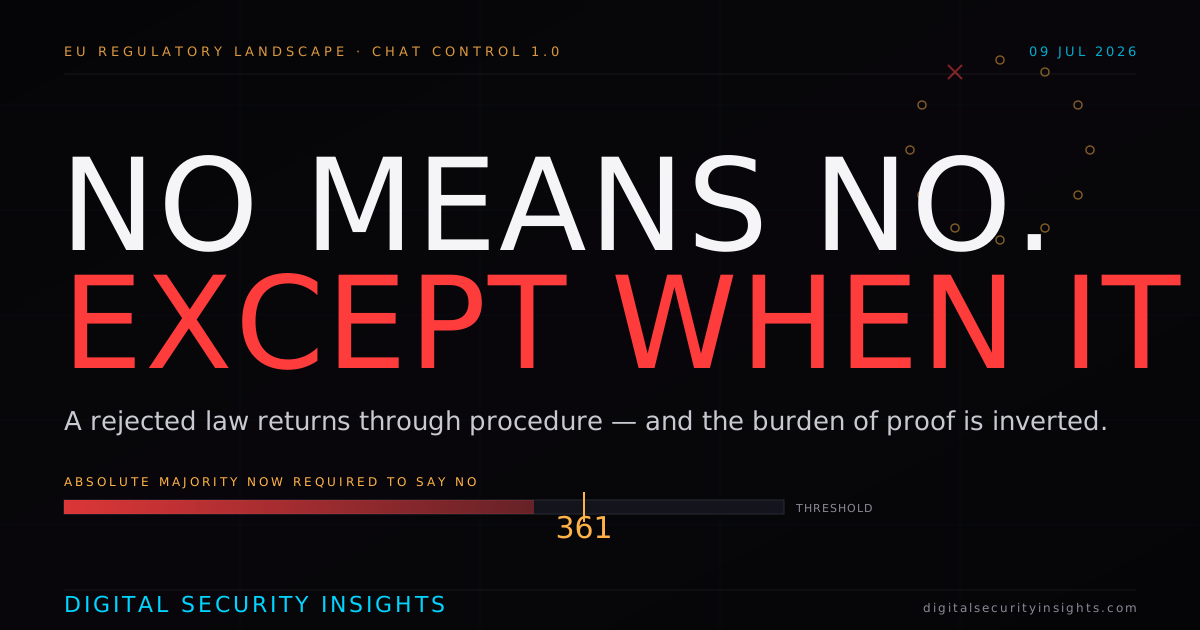
No Means No. Except When It Does.
On 9 July 2026 the European Parliament revived Chat Control 1.0 — three months after rejecting it. A majority of MEPs still voted against (314 to 276, 17 abstentions), but under the second-reading procedure the EPP engineered, blocking it required an absolute majority of 361. Opponents fell 47 short. The vote count is not the story. The procedure that inverted the burden of proof — timed for the last day before recess — is.
The Trap Was Set on Tuesday
The European Parliament voted again on Thursday, July 9, 2026, on extending the private message monitoring rules known as Chat Control 1.0. In March 2026, the extension of the proposal allowing the voluntary scanning of messaging services was rejected by 311 votes to 228, with 92 abstentions — not, as widely reported, by a single vote. This series set out the mechanics of its return days before the vote: how it comes back matters more than whether it passes.
That rejection was real. It was democratic. A majority of the elected representatives of 450 million European citizens voted no. The derogation expired on April 3. Google, Meta, Microsoft and Snap continued their indiscriminate and warrantless scanning of private messages regardless. Users could complain to their data protection authority about this violation of the secrecy of communications. The platforms now did without authorisation what they had previously done with it.
Then on Tuesday July 7, something happened that MEP Markéta Gregorová called unprecedented and that deserves to be examined with the precision it requires — because what happened on Tuesday determined the outcome on Thursday before Thursday's vote was cast.
Tuesday's vote used an "urgent procedure" and passed narrowly: 331 votes in favour, 304 against, and 11 abstentions. The urgent procedure is not merely an administrative shortcut. It is a procedural mechanism that changes the voting threshold for the substantive vote that follows it. Gregorová said: "Because this is a second reading, rejecting or amending the proposal will now require an absolute majority of Members of the European Parliament — 361 votes."
Read that sequence carefully. In March, a decisive majority of 311 voted no, and the law expired. In July, the EPP used an urgent procedure that required 361 votes — an absolute majority of the entire Parliament — to achieve the same outcome. The burden of proof was inverted by a procedural motion that passed by 27 votes on a Tuesday. The Thursday vote was not a fair contest between yes and no. It was a contest between yes and a qualified supermajority that opponents needed to assemble in the last week before summer recess, with MEPs already travelling to their holidays.
When the substantive vote came, a majority of MEPs did vote against it — 314 against, 276 in favour, 17 abstentions. But 314 was 47 votes short of the 361 that an absolute majority required. The law passed because the rules, not the minds, had changed. Mass scanning is now permitted again until 2028.
That is the trap. The democratic result of March was reversed not by changing minds but by changing the rules under which minds were counted.
What Passed and What It Actually Does
Before the democratic-process critique can be made with full credibility, what was voted on needs to be stated precisely — because the viral framing of Chat Control as mandatory mass surveillance of all private messages is not an accurate description of Chat Control 1.0.
Commonly called Chat Control 1.0, this European law allowed tech giants to voluntarily analyse communications. More concretely, this legal framework authorised messaging platforms to detect child abuse content.
Voluntary. Not mandatory. Chat Control 1.0 is a time-limited derogation that permits platforms like WhatsApp and Messenger to voluntarily scan for CSAM. It expires and needs renewing. The platforms that used it were unencrypted US communication services such as Gmail, Facebook and Instagram Messenger, Skype, Snapchat, iCloud Mail, and Xbox. Signal did not use it. Truly end-to-end encrypted services did not use it. The scanning this law permitted was of unencrypted messages on platforms that were already, by commercial design, not providing genuine privacy.
This matters analytically because conflating Chat Control 1.0 with Chat Control 2.0 — the permanent regulation still in trilogue, which does raise the encryption and mass-surveillance concerns in their full form — produces a critique that is emotionally powerful and technically imprecise. The law that passed on July 9 is the voluntary derogation. The law that would mandate scanning of encrypted communications is still being negotiated under the Irish presidency and has not passed.
The distinction does not make the democratic-process question go away. It makes it more precise. The question is not "did the EU mandate mass surveillance of all private messages." It did not. The question is "did the EU Parliament reverse a democratic vote through a procedural mechanism that changed the voting rules, timed for the last day before summer recess, to restore legal cover for voluntary scanning by US tech companies that were doing it without authorisation anyway." It did.
The Procedural Architecture of How This Happened
The European People's Party, the largest group in the Parliament, revived the temporary extension through a rarely used legislative procedure. EPP MEPs largely voted against it in March, because of amendments to the original text introduced by the Socialist rapporteur Birgit Sippel and other left-wing lawmakers, aimed at restricting the scope of the scanning. EPP leader Manfred Weber has been pushing for the extension to be adopted without any changes and found a way to make it happen. According to people familiar with the matter, on 17 June the EPP requested that the Parliament's President Roberta Metsola push forward with the interim file, and no other group objected. The day after, Metsola urged EU leaders to "move on" with the legislation during her intervention at the EU summit, and member states subsequently agreed to reinstate the interim measure.
The procedural sequence is now fully documented. EPP requests Metsola to act. Metsola urges EU leaders to act. EU leaders agree. Council adopts a position on July 2. EPP triggers the urgent procedure on July 7. Parliament votes on the substance on July 9 — the last day before summer recess — under rules requiring 361 to block, a threshold opponents could not reach.
"Usually, when the Parliament rejects a text, the Council stops working on it and the Commission eventually withdraws it. Now, we are forced into a second vote that questions the essence of democracy," Gregorová told Euronews, blaming the EPP for imposing their priorities through an unusual move.
Gregorová further accused the European People's Party of "abusing its position as the largest political group to bring back a proposal that Parliament had already rejected." She added: "This is unprecedented. This is no longer just about protecting privacy, it is about protecting our democracy. No means no."
The MEP who said no means no was correct about the democratic principle and was overridden by the procedural mechanism. That is not a paradox. It is a description of how institutional power operates when the formal democratic process produces an outcome that the institutional majority did not want.
The EPP was not alone in pushing for the vote. According to media reports, four European Commissioners wrote to MEPs on the Monday, urging them to back the proposal. "Disrupting detection seriously weakens our collective ability to identify abuse, support victims, and stop offenders," they wrote. Commissioners lobbying MEPs on a vote concerning a Commission proposal is not illegal. It is normal executive pressure on a legislature, practised in every democratic system. What is abnormal is that the Commission was lobbying to restore a law that the legislature had already rejected — decisively, three months earlier — through a procedural route that the legislature's own president had facilitated against her chamber's stated position.
The Great Wall Analogy — And Why It Is Historically Instructive
Who will tell them that this only leads to descent, and to ever more creative techniques to bypass their controls? The historical record on this question is unambiguous, and it predates the internet by centuries.
Need intelligence like this on a decision you're facing?
DSI Advisory Services helps boards, business leaders, defence institutions, and security leaders understand threats before they reach the horizon — where cyber, geopolitics, and business risk converge.