
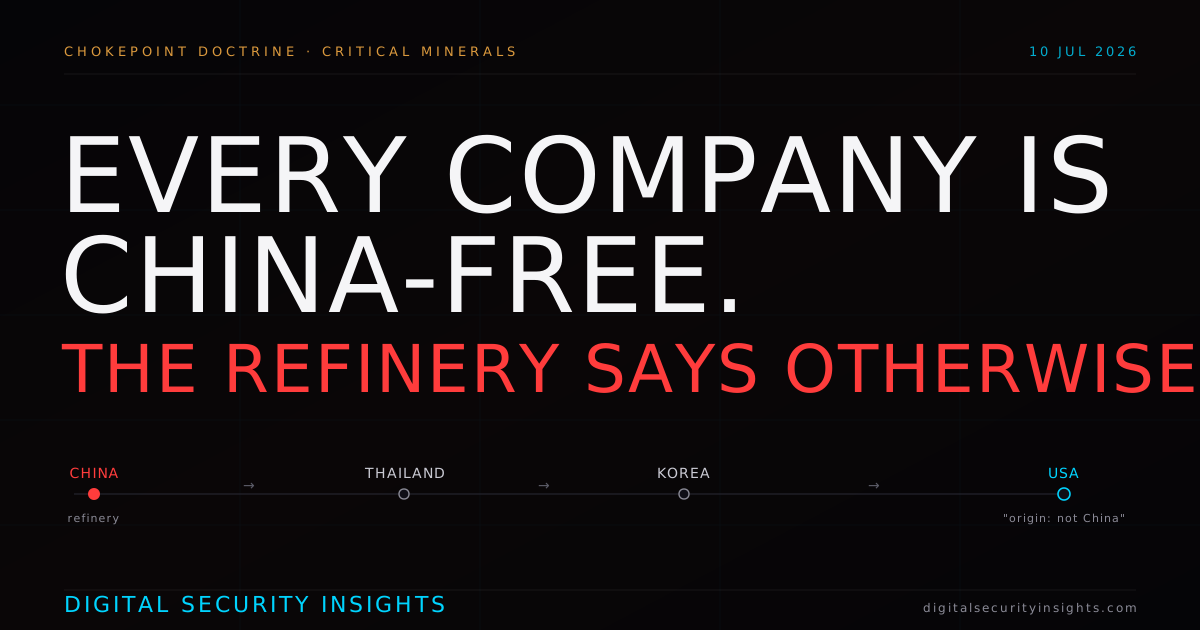
Every Company Is China-Free. The Refinery Says Otherwise.
Bloom Energy's CEO said it for years: no China supply chain. A short-seller says otherwise — but Bloom is a symptom, not the story. Concealing Chinese origin is now an industrial practice ($549M in aluminium as 'pallets'; tungsten laundered through Taiwan; Chinese magnets in the F-16, the F-18 and the F-35 three times over), because 'China-free' is worth a fortune and origin is structurally unverifiable. The deeper move: China controls these inputs by export licence, not ban — and every licence forces disclosure of the end user. Beijing holds a more accurate map of American critical dependencies than America's own regulators do. My assessment of the real risk, and where it goes in a Taiwan crisis.
The Denial Was the Product
"The one notable country that you're not sourcing from is China." The CEO of Bloom Energy did not hedge. Asked when he made the decision to avoid Chinese suppliers, he named a year: 2005. He said it on earnings calls. He said it on podcasts. "There is no China supply chain for us." "We never coupled ourselves to the China supply chain, which in hindsight today means that we don't have to decouple from something." For a company whose stock had climbed from roughly three dollars to over three hundred on the promise of powering America's AI data centres, being China-free was not a footnote. It was the product.
On 8 July 2026 the short-seller Hunterbrook Media published trade records, satellite images, and a photograph of the supplier logo wall from Bloom's own May summit — and counted three Chinese scandium suppliers. It alleged that Bloom's scandium, a rare metal at the heart of its fuel-cell patents, moves out of China and through Thailand, Japan and Korea before reaching the United States, disguising its origin along the way.
Let me deal with the messenger first, because it matters. Hunterbrook holds a short position in Bloom; it profits if the stock falls. Every forensic claim it makes should be read as advocacy and tested, not accepted. Bloom, for its part, calls the report false and points to its "diversified, multi-country supply chain" and "proprietary materials-recovery technology." That dispute will be settled by customs records and corporate registries, not by me.
But you do not need Hunterbrook's forensics for the story to hold. The structural facts are independently verifiable, and they are larger than one company's denial. Scandium is never mined as a primary product anywhere on Earth — it is a byproduct of titanium, nickel and uranium processing. The entire global market is roughly sixty tons a year. And China controls somewhere north of ninety per cent of the world's refined scandium. On 4 April 2025, Beijing placed scandium, by name, on its rare-earth export-licence list. A genuinely China-free scandium supply chain, at the scale Bloom has promised Wall Street, is not improbable. It is close to arithmetically impossible.
Bloom Is a Symptom, Not an Anomaly
The instinct is to treat this as one company caught in one lie. That instinct is wrong, and the enforcement record proves it. Concealing Chinese origin is not an aberration. It is an industrial practice, and the United States government is now surfacing it case by case.
In May 2026, Perfectus Aluminum settled for $549.5 million — the largest trade-fraud recovery in American history — for declaring Chinese aluminium extrusions as "pallets" to dodge duties. In December 2025, Ceratizit paid $54.4 million for routing Chinese tungsten carbide through Taiwan and declaring it Taiwanese — the identical playbook now alleged against Bloom. Executives of Quadrant Magnetics pleaded guilty to concealing that rare-earth magnets sold into the F-16 and F-18 supply chains were smelted and magnetised in China. A medical supplier once physically peeled "Made in China" labels off body bags, applied US-flag stickers, and shipped them to the Department of Veterans Affairs and the Pentagon.
The most instructive case is the one that never made the news, because it was resolved quietly, three times. Between 2022 and 2024, the F-35 programme discovered Chinese-made magnets embedded in its own supply chain on three separate occasions. Each time, the response was the same: not removal, but a National Security Waiver signed so the jets could keep flying. The Government Accountability Office noted that without the contractor's voluntary self-disclosure, "DOD may not have known that the magnets were made in China." The most surveilled weapons programme on the planet could not see its own dependency until someone chose to tell it.
And in case the pattern seems accidental, one of Bloom's other suppliers wrote the strategy down. In a Chinese securities filing, a firm supplying Bloom with temperature sensors disclosed that Bloom had instructed it to route shipments through Taiwan and India first, in order to — in the filing's own words — "gradually reduce direct exports to the US and dodge tariffs." The playbook is not inferred. It is filed with a regulator, in writing.
Why the Concealment Is Manufactured, Not Merely Committed
Here is where the analysis has to go past the fraud. These companies are not lying in a vacuum. They are responding to a structure that all but requires the lie. Three forces lock together.
The first is that "China-free" has become a priced premium and a contract precondition. When the Pentagon took a stake in the rare-earth miner MP Materials in July 2025, it wrote a price floor of $110 per kilogram of neodymium-praseodymium into the contract — roughly double the Chinese market price. Being China-free earns a subsidy. Being China-linked is punished: the day the Defence Department designated a batch of Chinese firms under its military-companies list, Tencent lost some $35 billion in market value in a single session. The label is worth a fortune.
The second force is that genuine independence is, for many inputs, nearly unattainable. China's leverage is not in the mines it owns but in the refineries it controls. It processes nineteen of the twenty energy-critical minerals the International Energy Agency tracks, at an average share near seventy per cent. It runs an estimated ninety-nine per cent of the world's heavy-rare-earth separation and ninety-four per cent of its finished magnets. You can open a mine in Australia or Nevada; you still send the ore to China to be turned into something usable.
The third force is the one almost no one names: origin is structurally unverifiable. It fails at four layers at once. Legally, "country of origin" turns on a subjective, case-by-case test that a US trade judge has called a source of "absurd results" — routing goods through a third country to rewrite their origin is a recognised compliance strategy, not merely a crime. At the customs layer, the declaration is written by the party with the incentive to shade it. At the supply layer, the buyer cannot see the seller's seller: the Pentagon holds country-of-origin data on less than ten per cent of the F-35's thirty thousand parts. And at the material layer, rare earths are processed as a single commingled basket of sixteen elements — origin physically dissolves at the refinery, and no commercial system to trace it back exists.
Combine the three. The label is worth thirty-five billion dollars in market capitalisation, and it is unfalsifiable. My assessment is that under those conditions concealment is not a moral failure of a few executives. It is the predictable output of the system. When the truth is both enormously valuable and impossible to check, the comfortable version gets printed.
The License Is a Panopticon
Now the part that turns a supply-chain story into an intelligence one — and the reason this matters more than any single fraud.
China does not control these minerals through blunt bans. It controls them through licences. Almost every restriction imposed since 2023 is a case-by-case approval regime, and to obtain a licence the applicant must disclose the end user and the end use — who ultimately receives the material, and what they will build with it. Military end-users are routinely refused. Every intermediate and ultimate destination must be declared.
Read that mechanism carefully, because it does something no tariff can. It hands Beijing a live, self-updating census of exactly which Western companies depend on which inputs, in what volume, for which downstream weapon or data centre or fuel cell. The political scientists Henry Farrell and Abraham Newman gave this its name: weaponised interdependence, the ability of whoever sits at the centre of a network to do two things at once — deny access, and watch the flows. China's licence regime is that theory in its purest physical form. It is a chokepoint and a panopticon fused into a single document.
This analysis is published. Your decision isn't.
We run the same cross-domain, scenario-based foresight on the decision in front of you — a deal, a market entry, a supplier dependency. Board-ready in five days, with a foresight indicator watchlist.