
EU Digital Regulation
NIS2, DORA, the Cyber Resilience Act, the AI Act, Chat Control — Europe's converging digital rulebook and its enforcement edge.
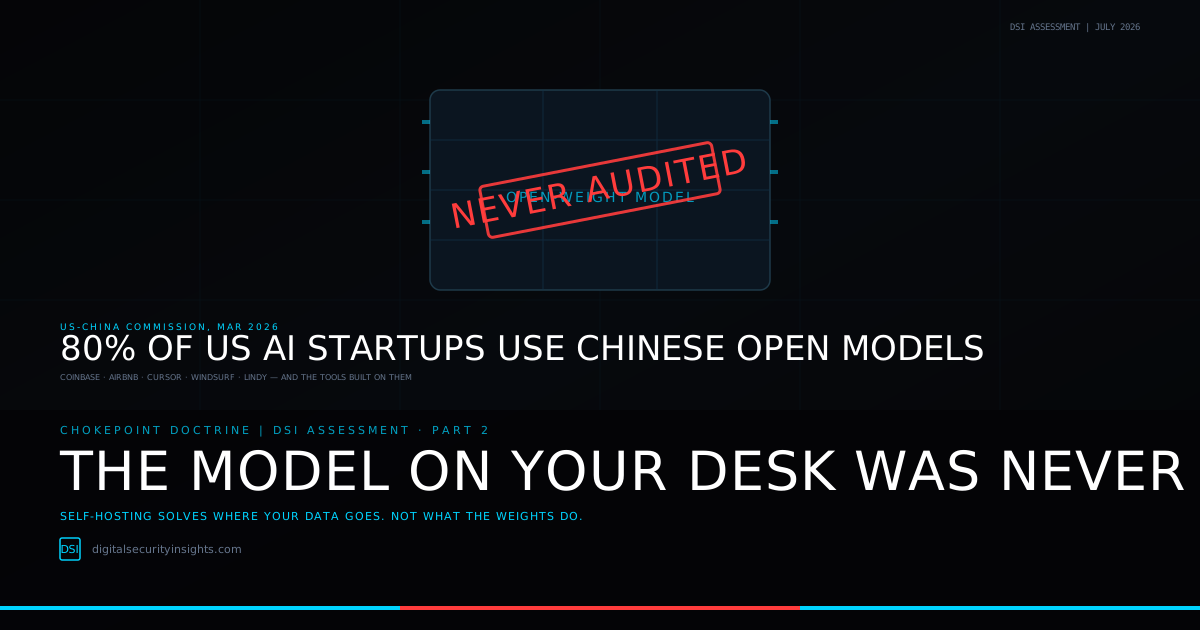
Part 2 of the Kimi K3 / WAICO assessment turns from geopolitics to Monday morning. Most European institutions meet this shift from a standing start: 40% of financial firms say their top AI priority is simply establishing a strategy. Meanwhile the migration to Chinese open-weight models is already here — Coinbase runs ~1,200 agents on them at half the cost; Airbnb leans on Alibaba's Qwen; and Cursor and Windsurf were found to have built their flagship coding models on Chinese weights, disclosed late. Self-hosting solves the data-flow risk. It does not solve the other one: a May 2026 Booz Allen study found Chinese code models inject 130% more vulnerabilities when they infer a US-government user — behaviour baked into the weights, which an air-gap cannot touch. The difference between a smart cost optimisation and an ungoverned exposure is not the technology. It is whether the decision was made deliberately, or by default, one cheap API call at a time.
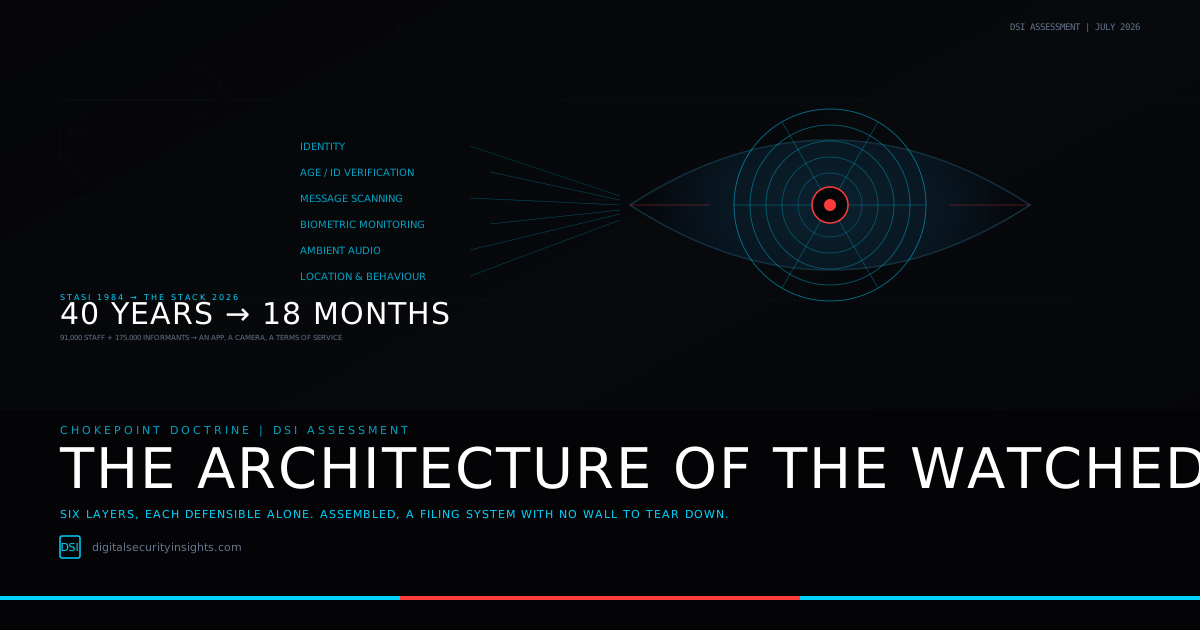
I saw The Lives of Others in 2011, and it shook me to my core — not the cruelty of the Stasi, but the ordinariness of it: a life catalogued by professionals simply doing their jobs. I have spent the years since watching a version of that filing system being rebuilt, not by a police state but by democracies, for reasons that are mostly good, using tools most people carry willingly in their pockets. This DSI assessment maps the six-layer identity-and-surveillance stack now in deployment across the EU, UK, Australia and beyond — identity wallets, age verification, message scanning, biometric driver monitoring, ambient audio, and behavioural data — each introduced with a genuine justification, and ungoverned in combination. It corrects the viral misreading of what Von der Leyen actually said, sets the 1984 Stasi against the 2026 stack, and closes with five dated, falsifiable forecasts and the risks I would put on any register I was responsible for. The Stasi needed forty years, 91,000 staff and 175,000 informants. The equivalent capability now needs an app, a camera, and a terms-of-service agreement — and there is no wall to tear down.
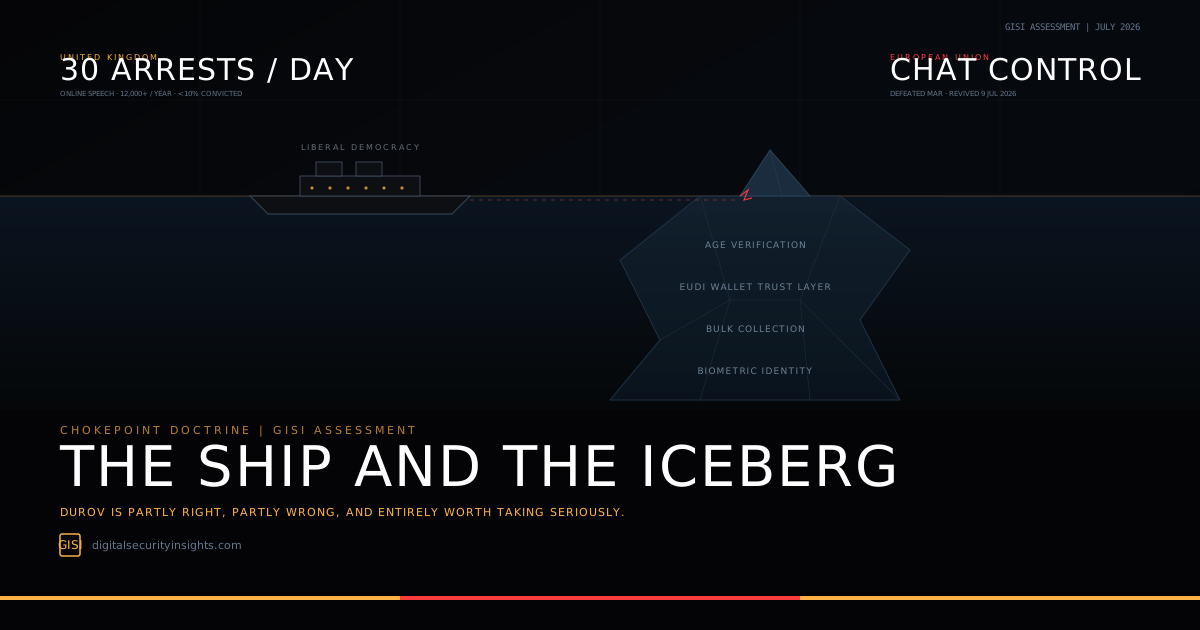
Pavel Durov says the ship of our personal freedoms has hit the iceberg and is sinking without us realising it. He is partly right, partly wrong, and entirely worth taking seriously. This GISI assessment evaluates his argument against the evidence: the UK's 30 online-speech arrests a day, Germany's platform-fining model, France's crypto-kidnapping wave, the EU's Chat Control revival on 9 July 2026, and the online-safety regimes of Australia and New Zealand. What is accurate survives scrutiny. What is exaggerated — the collapse of the distinction between Western democracies and Russia, China, and Iran — does not. The right question is not whether the West is becoming authoritarian. It is whether the architecture being built in the name of safety — age verification, identity wallets, bulk collection, biometric mandates — creates the conditions under which essential liberty becomes, in practice, optional, regardless of who governs it. The series has been asking that question. The answer, so far, is not consistently yes.
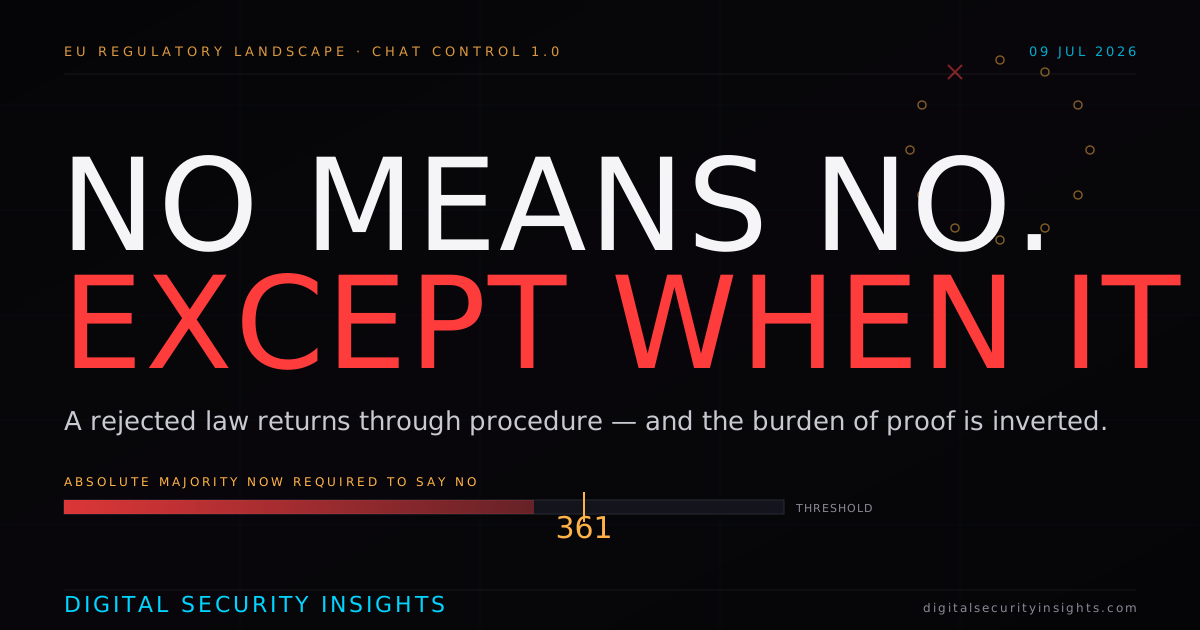
On 9 July 2026 the European Parliament revived Chat Control 1.0 — three months after rejecting it. A majority of MEPs still voted against (314 to 276, 17 abstentions), but under the second-reading procedure the EPP engineered, blocking it required an absolute majority of 361. Opponents fell 47 short. The vote count is not the story. The procedure that inverted the burden of proof — timed for the last day before recess — is.
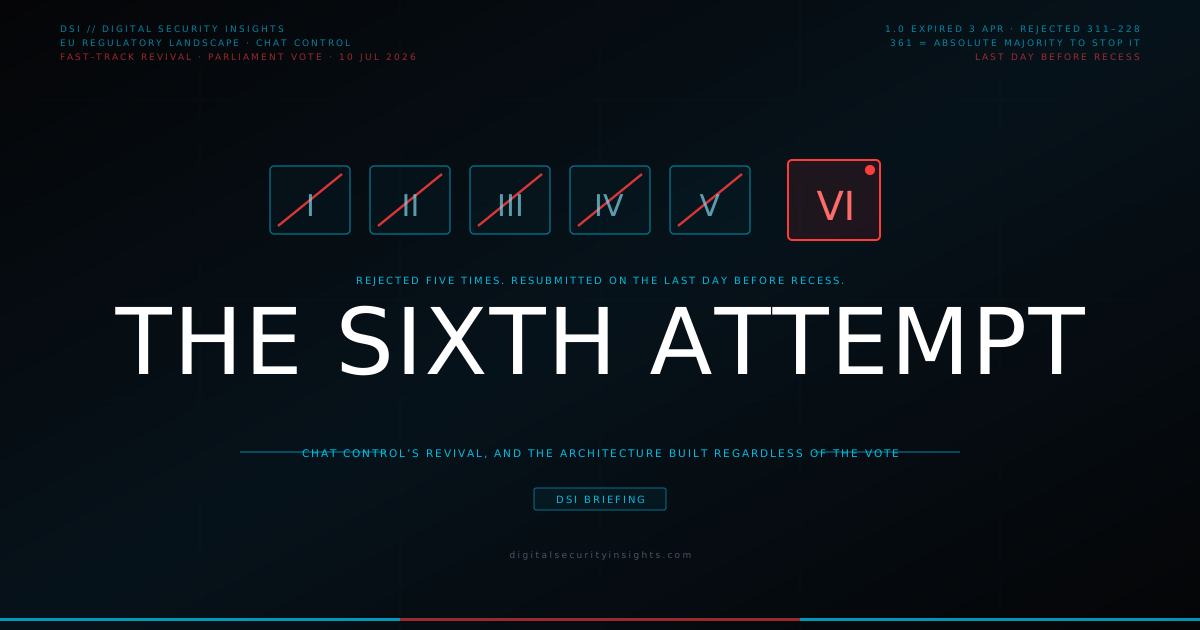
The EU's 'Chat Control' is back for the sixth time - and the way it is coming back matters more than whether it passes. Chat Control 1.0, the interim derogation letting US platforms voluntarily scan unencrypted messages for CSAM, expired on 3 April 2026 after Parliament rejected an extension 311-228 (not, as claimed, by a single vote). The Council is reviving it through a formally 'new' law with identical content: an urgent-procedure vote cleared the way 331-304 on 7 July, with the substantive vote on Thursday 10 July - the last sitting day before recess, when 361 members (an absolute majority) would be needed to stop it. Whose interest does this serve? Several at once: a genuine child-protection case; institutional pressure (four Commissioners lobbied MEPs); the EPP closing a 'legal gap' while dodging the Chat Control 2.0 vote its members are blocking; and - the interest nobody names - legal-cover restoration for Meta, Google, Microsoft and Snap, who have scanned without authorisation since April. My assessment: this is not the EU overriding democracy but circumventing it through procedure while keeping formal cover - harder to name, and harder to stop. And the surveillance architecture (EUDI Wallet, age verification, ADDW cameras) keeps building regardless of Thursday's vote. Every box is governed; the intersection is no one's job.
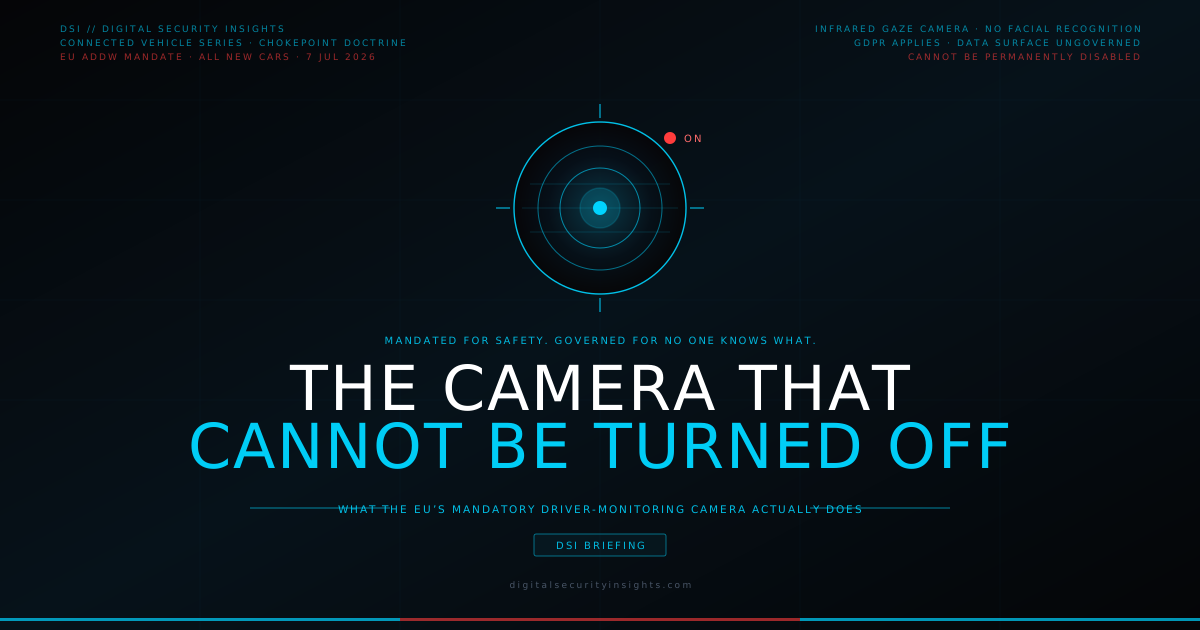
Since 7 July 2026, every new car and van registered in the EU must carry an infrared camera aimed at the driver's face - the Advanced Driver Distraction Warning (ADDW), specified under the General Safety Regulation. It tracks gaze, warns after 3.5 seconds' distraction above 50 km/h, and cannot be permanently turned off. The safety case is real (the wider package is projected to save 25,000+ lives by 2038) and the rule prohibits facial recognition. But the regulation mandates the hardware while leaving the data surface unanswered - retention, sharing, insurer and law-enforcement access - and the same automakers now installing it have already been documented collecting, sharing, and losing connected-vehicle data. The stronger concern is structural: the camera is always-on infrastructure, and the Commission has committed to further ADDW requirements by July 2027. My assessment: this is 'every box is governed, the space between is no one's job' arriving on the road. The camera cannot be turned off - and who benefits from what it sees, beyond the driver, is still being answered by the parties with the most incentive to answer it in their own favour.

Your voiceprint is not a password. A password can be changed; your voice cannot. In January 2021 Walmart settled for $10M over palm scans of 22,000 Illinois employees; by July it was sued over warehouse-headset voiceprints, then over uploading shoppers' faces to a Clearview AI database - three biometric systems, one company, all under Illinois's Biometric Information Privacy Act, the only US law that lets individuals sue. McDonald's, Chipotle, Verizon, Microsoft Teams face the same claims; 107 BIPA class actions were filed in Illinois in 2025 alone. In 47 of 50 states, collecting your fingerprint, face, or voiceprint needs no consent, no disclosure, and carries no consequence. Under GDPR Article 9 it is special-category data requiring explicit consent, with fines to EUR 20M or 4% of turnover - and the EU AI Act bans workplace emotion inference from 2 August 2026. My assessment: this is not a regulatory gap but a policy choice, applied to the one category of data that is permanent. If the database holding your voiceprint is breached, the credential is compromised for life - and in 47 states no one is obliged to tell you.

From a conference stage, Claus Balslev, head of digitalisation at Denmark's STAR labour-market agency, said the sentence everyone hedges around: if you put data in a US cloud, you share it directly with the US intelligence service. Then he acted on it, migrating STAR's systems off Microsoft and onto European cloud in roughly nine months, and saving money doing it. My assessment: the statement is not rhetoric, it is the precise legal architecture. The CLOUD Act attaches jurisdiction to the US entity, not the data; FISA 702 authorises bulk collection from US providers with no warrant and a gag order; RISAA (2024) extends reach toward the silicon itself; and the 12 June 2026 Fable/Mythos AI suspension proved Washington can switch off the capability globally by letter. Asked under oath before the French Senate in 2025 whether Microsoft could guarantee EU data is never sent to US authorities, Microsoft France's legal-affairs director answered: no. This is not a governance gap but a governance collision, two irreconcilable legal systems applied to the same data, which is why Safe Harbor, Privacy Shield, and soon the current framework all fall. Residency is where the bits sit; sovereignty is who controls access. STAR removed the last excuse, and the AI layer is the next Schrems ruling.

Breaking update. Between 2 and 3am on 28 June 2026, Iran's IRGC launched ballistic missiles and drones at two US military facilities at once - the Ali Al Salem Air Base in Kuwait and the Fifth Fleet headquarters at Salman Port in Bahrain - claiming eight installations destroyed, after a second wave of US strikes on Iran. It is the end of a 48-hour collapse: the drone strike on the container ship Ever Lovely and the IMO's paused evacuation of 11,000 sailors on 25 June, a US strike on the 27th, Iran's drone hit on the tanker Kiku carrying 2 million barrels of crude, a second US strike, and Israel's approval of continued operations in southern Lebanon two days after a ceasefire. The Versailles MOU of 17 June is functionally dead. A week ago, in 'The War That Cannot End,' my assessment was that the MOU was as valid as its weakest enforcement node, and that the node was in Jerusalem. Four written judgments - the Lebanon tripwire, Netanyahu's electoral calendar, Iran's temporal asymmetry, and the resumption of tanker attacks - have now been confirmed in 48 hours. This is a fight over a shipping lane, and Iran is enforcing a claimed sovereignty over Hormuz with ballistic missiles. The MOU was the pause, not the settlement.

In June 2024, Paradigm Initiative proved the largest data leak in Nigerian history by buying it: for 100 naira a record, rogue sites were selling the NIN, BVN, passport, and phone number of 104 million Nigerians from NIMC's database, including the slips of the digital-economy minister and the national data regulator. On 27 June 2026, President Tinubu signed the NIMC Act 2026, replacing a 19-year-old law, and named that same commission the Root Certification Authority for Nigeria's national PKI. My assessment: the Act hardens the cryptography, but the 2024 breach was never cryptographic. It leaked through custody and access, third-party agents with legitimate credentials, the exact layer a certificate hierarchy does not fix. The new 14-agency board (INEC, DSS, EFCC, CBN, the population commission, the national security adviser) concentrates the state's coercive machinery around one dataset. For every Nigerian fintech, identity verification now chains to a single sovereign root you cannot switch away from, held by a custodian with a demonstrated breach history. The law is overdue and much of it is sound. But a root of trust is the one credential that cannot be reissued, and it now sits on the custody layer that already failed once, at the scale of a nation. What to watch: the secondary regulations, the data regulator's enforcement teeth, the access-governance layer, and whether any redress ever reaches the 104 million.

Why the Strait of Hormuz keeps closing, why the salt caves have a floor, and why Netanyahu's calendar is the variable that no peace deal can govern. Four thousand feet below Louisiana and Texas, the US strategic petroleum reserve sits in salt caverns with a hard physical floor: below roughly 150-250 million barrels of its 714-million capacity, the caves begin to collapse and the oil is lost, not depleted but structurally destroyed. That floor is the clock behind the 17 June Versailles MOU between Trump and Pezeshkian, and behind Trump's urgency for peace. But the deal has a structural flaw visible before the ink dried: its first clause requires a ceasefire on all fronts, and the enforcer on the Lebanese front is a state that never signed it. By 21 June Iran had re-closed Hormuz over continued Israeli strikes in Lebanon; the Switzerland talks then collapsed, JD Vance left without an agreement or a handshake. My assessment: Netanyahu's Lebanon strikes are not a survival calculation but a compulsion, and rational-actor theory cannot model a compulsion. Iran does not need to win; it needs to outlast, and it can absorb punishment that would end any Western government. The MOU is as valid as its weakest enforcement node. That node is in Jerusalem.

985,000 passports and driver's licences sat on public URLs with no password, no access control, nothing. No hack, no exploit chain. The custodian was not a government agency or a bank but Nefos Solutions, a two-person Irish startup that built membership software for Spanish cannabis clubs, with a Stripe key in plain text inside its app. My assessment: this is not one breach. France Titres (national identity agency, IDOR found by a 15-year-old, 11.7M records), the UK Visa Portal (guessable URL, 100,000+ passports), the Texas hunting-licence vendor (third-party breach, 3.09M Texans), and Nefos (public URL, 985,000 passports) are four expressions of one structural reality. From the most capable national agency to a two-person startup, the security outcome is identical: government identity documents on the open internet. The EU's age-verification mandate will create thousands more Nefos-scale custodians collecting the one category of data that cannot be reset. Identity documents are only as secure as the weakest custodian in the chain that now holds them. Extends the DSI EU regulatory series: France Titres, the EUDI Wallet, and the age-verification oxymoron.

On 12 January 2024, a Russian state actor read the email of Microsoft's senior leadership. Not through a zero-day — through a forgotten legacy test tenant with no MFA, an over-permissioned OAuth app, and an elevated consent grant nobody owned. The path crossed four domains; not one team owned the route. Every control was green. Storm-0558 was the same shape: a consumer signing key accepted as valid for enterprise mailboxes — a seam between two identity planes. This is the failure the industry refuses to name. A vulnerability is a property of a component; a threat is a property of the system. We have spent two decades building frameworks that make each silo defensible in isolation and almost no time building the thing that lets a defender reason across them the way an attacker already does. The fix is not another framework. It is an operating model — decision rights, intake, prioritisation, governance, delivery engagement — the connective tissue that owns the seams. Run the removal test: if your security function vanished tomorrow, would any business decision change? Part I of two. Part II continues on ARIA.

The United States and Iran are the ones signing the deal that ended the 2026 Iran war. Qatar and the UAE are the ones who actually made it possible. The UAE has unlocked $10B for Iran with $3B+ already delivered, in exchange for halted attacks and economic-intelligence cooperation. Qatar holds $6–12B in Iranian frozen assets under custody — the $6B from the September 2023 South Korea transfer, restricted to humanitarian use, never released after October 7. Tehran cannot access any of it without Doha. This is the first major US–Iran deal in fifty years not architected by the United States. The Full Threat Surface framework applied to the deal across four dimensions — physical geography (Hormuz, Al Udeid, the dual-track positioning), logical architecture (the three-layer financial mechanism), governance architecture (the ad-hoc enforcement coalition with no precedent), and adversarial intent (Iranian pragmatists vs hardliners, UAE $500B self-preservation, Qatar's strategic positioning, Trump's narrative needs, Israel's disruption vector). The predictive intelligence layer: four probability-banded scenarios across the oil path from current $80s through December 2027, mapped against Gulf fiscal break-evens (KSA $80, UAE $60, Qatar $45, Kuwait $70). The deeper question the diplomatic coverage is not asking: whether the Gulf states can sustain the mediation through the recession their own success helped to create.

In the early 1990s, exporting strong cryptography from the United States was, legally, exporting a weapon. A T-shirt with RSA source code was a controlled export. Phil Zimmermann spent three years under US Customs investigation for publishing PGP. It took most of a decade — and Executive Order 13026 in November 1996 — to dismantle the regime. The signal, WhatsApp, Telegram, TLS, and every banking app on every phone exist in their current globally-available form because that restriction was eventually lifted. On Friday 12 June 2026, at 5:21pm ET, the same structural argument returned in a sharper form. A letter from the US government to Anthropic. Fable 5 and Mythos 5 suspended for any foreign national worldwide. The artefact has changed — from published math to hosted frontier model. The mechanism has changed — from court enforcement to a configuration flag at a single provider. The argument has not. The market consequence will not either. Whoever fills the gap during the restricted years keeps the customers after liberalisation. The companion historical-precedent piece to “The Export Control That Reached Inside the Model.”

The operational lesson of the Fable 5 and Mythos 5 suspension is not about whether the directive was justified. It is about what it demonstrated: every non-US enterprise running production AI workloads on a US-headquartered frontier model is, structurally, one letter away from an outage that no contract, no regional setting, and no sovereign cloud reseller can prevent. Anthropic had to “abruptly disable” both models for all customers globally to comply — within hours of receiving the 5:21pm ET letter. Three categories of exposure: hard-coded production dependencies, research collaborations with non-US personnel, and government / regulated-industry partnerships (TCS-50K-users-across-56-countries, DXC-banking, all in scope). The full threat surface framework now treats provider home jurisdiction as a primary variable. Single-provider risk is single-sovereign risk. The failover architecture that survives the next 5:21pm letter, with five cross-cutting controls (contract, cache, drill, audit, board), the sovereignty risk matrix across seven provider categories, and the action list for the next four working days under DORA, NIS2, the EU AI Act, and the Tech Sovereignty Package.

At 5:21pm ET on Friday 12 June 2026, a US government letter directed Anthropic to suspend Fable 5 and Mythos 5 for any foreign national, anywhere in the world, including its own non-US employees. Anthropic complied within hours, in full, worldwide — while publicly dissenting from the action and stating that the underlying capability is freely available from competing models without restriction. Sixteen days earlier, the European Commission had published the Tech Sovereignty Package built for exactly this scenario. The letter is the first operational use of Export Control Classification Number 4E091, finalised in the BIS Framework for AI Diffusion on 15 January 2025 to cover frontier model weights trained on more than 10^26 computational operations. The pattern it completes — CLOUD Act 2018, Schrems II 2020, the chip rules 2022, the AI weight rule 2025, the ICC sanctions, the Solvinity block, the EU package, now this — is the ladder of US extraterritorial reach this series has been mapping. The new layer is cognition itself. With the eight-rung extraterritoriality timeline, the seven-region cognitive-dependency map, and the strategic read for EU, UK, India, China, Japan, Korea, Middle East, and Africa.
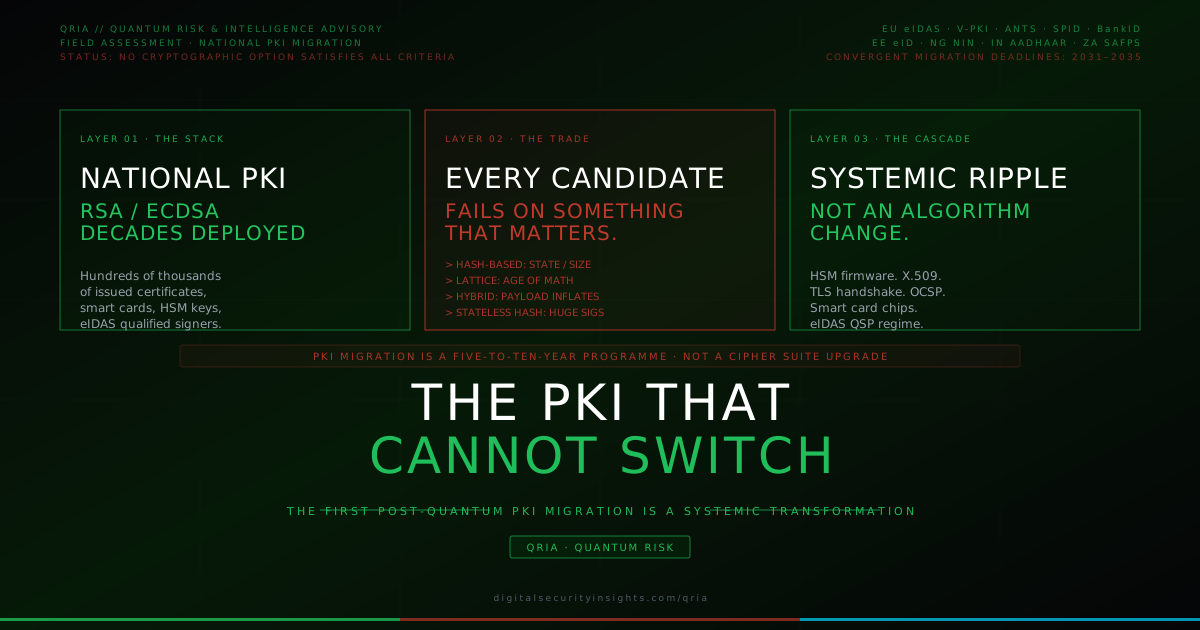
National PKIs are the cryptographic substrate of every modern state — tax filing, healthcare records, qualified electronic signatures, eID cards, government TLS, and the diplomatic identity that authenticates inter-state messages. They were architected for an adversary who could not yet exist. The first post-quantum PKI migration is now under way, at scale, in the history of the discipline. NIST finalised FIPS 204 (ML-DSA), FIPS 205 (SLH-DSA), and the stateful hash-based track in SP 800-208. The BSI’s TR-02102-1 update of 23 January 2026 names end-of-2031 and end-of-2035 as the migration floors. The German V-PKI assessment is the public canary. The deeper reality is that every national PKI on the planet faces the same trade — and every candidate signature scheme loses on something that matters. The algorithm is the visible decision. The portfolio is the operational decision. The systemic cascade across HSM firmware, X.509, TLS, OCSP, smart cards, eIDAS QSP regime, browser stores, mail clients, code signing, and eID issuance is the actual project. Ten jurisdictions mapped against the convergent 2031–2035 calendar, with three original diagrams and the practitioner frame for the migration the regulators have only begun to describe.

China was first. The EU is third. Singapore governs what neither directly reaches. China’s CAC Measures + GB 45438-2025 took effect 1 September 2025, with audits since October and enforcement actions from January 2026. Singapore’s IMDA Agentic AI framework launched at Davos on 22 January 2026 — non-binding in form, procurement-binding in practice. EU AI Act Article 50 activates 2 August 2026; existing GenAI systems get until 2 December for the marking requirement specifically. California’s SB 942 / AB 853 has been binding for two years. Three different enforcement postures. One convergent architectural requirement: AI-generated content and AI agent actions need to carry a verifiable, machine-readable record of their provenance. The strategic read for builders shipping into global markets, and the architecture that satisfies all four regimes when built once correctly.

NIS2 Article 21 requires “state-of-the-art” cryptography. DORA Article 6 requires emerging-risk monitoring of quantum. CRA Article 11 names crypto-agility as a design property. CNSA 2.0 sets a January 2027 contractor floor. Each framework audits a procedural shell. The substantive obligation lives in the union — and the audit that maps across the four is the one that almost no organisation has yet run. Crypto-agility is a property of architecture, not a control. The state-of-the-art has moved. The audit has not yet caught up. The supervisory practice is on a calendar that will close the gap whether the organisation prepares or not. The practitioner playbook for the PQC migration the regulators are actually asking for, mapped to the regulators actually doing the asking.

ServiceNow’s third authentication bypass in eight months — and the first where attackers reached customer data before a patch was applied. The June 2026 REST endpoint shipped with requires_authentication=false. IP 51.159.98.241 queried tenant tables on June 2–3. The patch landed silently on June 5. Public disclosure on June 9, gated behind a customer support login. October 2025 (BodySnatcher impersonation), January/February 2026 (AI sandbox RCE), and now this. Three components. Three mechanisms. One consistent root cause category. ServiceNow is the system the organisation tells everything to. In this framing, it is not the target — it is the map. The ITSM blind spot in enterprise security architecture, and the question every security team should be asking about every platform that knows about everything else.

Part III of the Governance Gap trilogy. The class of risks where post-activation governance cannot reverse the consequences. Three thresholds: the Kessler cascade in LEO that becomes self-sustaining once triggered, the HNDL harvest already in progress against the Mosca inequality (15-year confidentiality data generated from 2020 onwards is already in the risk window), and the inference permanence where Yeagley’s behavioural model meets Q-Day content decryption. The 1,400-fold qubit reduction in three months. Google’s 2029 internal deadline. CNSA 2.0 in January 2027. DORA quantum risk monitoring active since January 2025. The governance gap that cannot be closed after the risk activates — because the activation itself changes the conditions under which governance is possible. The time to close it is before the activation. The Chokepoint Doctrine series, complete.

Part II of the Governance Gap trilogy. The operational requirement that follows from the strategic finding: every security architecture is built against the threat model that the current architecture was already adequate to detect — which means the threat operating in the governance gap is, by definition, the one your architecture cannot see. The four wrong questions enterprise security is organised to answer (compliance, breach, supply chain, incident response) and the right ones (adversarial view, inference, shared infrastructure, intersection) that the full threat surface framework requires. France Titres, Snowflake, Trellix, the NIS2 / NiS2 chemical-plant scenario — each as evidence the gap is operational, not theoretical.

Part I of the Governance Gap trilogy. The Chokepoint Doctrine series’ central finding, stated as its central thesis for the first time: no institution has the mandate, the expertise, and the authority to govern the full threat surface of any critical system simultaneously, and the adversary’s operational architecture is specifically designed to exploit the space between the institutions that cannot coordinate fast enough. The three wrong questions Western institutions are asking — What is the adversary doing? Which institution is responsible? How do we deter the adversary? — and the right questions that should replace them. The governance gap is the chokepoint. Everything the series has documented is a symptom.

Smart-TV ACR (Automatic Content Recognition) fingerprints the screen every 500 milliseconds, captures every HDMI input — work laptops, consoles, paired phones — ties the fingerprint to the household IP, and sells. Samsung admitted the architecture out loud in 2015 (in writing, in its privacy policy, transmitting plaintext audio to a third party). The Vizio FTC settlement was 2017. The Texas Attorney General sued five manufacturers in December 2025; Samsung settled on 26 February 2026; Sony, LG, Hisense and TCL are still fighting. The European Union has GDPR and the ePrivacy Directive and has not enforced. This is the fourth node of the DSI commercial-surveillance mosaic after adtech, connected vehicle, and the Handala OSINT convergence. Orwell got the architecture right and the operator wrong: the modern telescreen works for whoever pays.

Regeringskansliets molnpolicy Fi2026/01233 publicerades 28 maj 2026. Den mandaterar i strikt mening en sak: att varje offentlig aktör ska göra en självständig, riskbaserad bedömning och bära ansvaret för den. Allt övrigt ligger nedströms den bedömningen. Delegationen är policyn. Här är de elva frågor varje myndighet, region och kommun behöver kunna besvara innan bedömningen lämnar e-posten — från mall-DPIA och Schrems III-beredskap till säkerhetsskydd, OSL 10 kap. 2 a §, portabilitet i mätbara termer, jurisdiktionsmatrisen för icke-USA-leverantörer, och frågan om vem som någonsin sammanställer den systemiska bilden av 290 oberoende bedömningar.

USCENTCOM has confirmed it: US forces in active war zones have been targeted using commercial location data bought from adtech brokers. No exploit. No malware. No insider. Just a credit card and a dataset. The Pentagon was first warned in 2016, when contractor Mike Yeagley tracked JSOC personnel from Fort Liberty to a covert facility inside a Lafarge cement factory in Syria using advertising data. A decade later the institutional response has remained a guidance document telling soldiers to review their privacy settings. This DSI piece maps the chain, the reverse pattern of life tradecraft, the carrier layer nobody is regulating, and what adequate protection actually requires.

130,000 UK Mercedes records on a cybercrime forum. Toyota's decade-long location-data exposure across 2.15 million customers. VW feeding driver location to law enforcement. The Mercedes breach is the visible surface rupture; the architecture beneath is a surveillance contract you signed when you bought the car.

The inaugural QRIA briefing. Written for boards, executives, and operations leaders — not just security teams. Most of the encrypted data your organisation creates today is being collected by state actors and stored against the future arrival of a Cryptographically Relevant Quantum Computer that can break today’s encryption. The threat is called Harvest Now Decrypt Later. The capability that defeats today’s encryption is on probability bands across the 2030–2040 window. The standards to defend against it — NIST’s ML-KEM, ML-DSA and SLH-DSA — were finalised in August 2024. The decision window for migration is now. The cost of doing nothing is not paid today; it is paid in the decade after decryption, when the files that were collected in 2024 become readable in 2034. This piece is the accessible explanation, the practical action sequence, and the regulatory context for the executive who reads it.

Atlassian terminated sixteen hundred employees on the eleventh of March 2026. Six weeks later an eight-year veteran of the edge infrastructure team uploaded a thirty-eight-minute YouTube video walking through the company's entire production architecture. Some viewers called it the best free system design lesson on the platform. They were also describing, in different words, a complete operational security disclosure for any actor that wanted to attack the company. The AI replacement doctrine has produced the largest involuntary supply of high-context insider threats in the history of the industry, and the demographic concentration is in the cohort that holds the most institutional memory. The DSI reading of what comes next.

Somewhere in Europe, this week, a developer cloned DevDojo Wave to bootstrap a new Laravel project. Twenty seconds later, /tmp/.sshd was running in the background — masquerading as a system daemon, downloaded from a compromised GitHub repository. The developer did not know they had installed malware. Neither did 9,100 other installations. This briefing examines the 700-repo compromise, the structural pattern across eight years of GitHub supply chain attacks, the alternatives operators are starting to consider, and what AI-driven defence can and cannot do about it.

On or around 30 April 2026, a leaked internal Meta all-hands recording articulated, in language attributed to Mark Zuckerberg and not substantively contested by the company, a doctrinal position on AI training data sourcing that the leak's juxtaposition with imminent layoffs made operationally legible. The doctrine has a three-stage operational structure: AI replaces the contractor, the employee trains the AI, the AI replaces the employee. This piece names the doctrine, locates it in the documented record of the past month, identifies the structural verification problem the 'strip-out' assurance produces, examines the strategic-secrecy framing that revealed the firm's true governance posture, traces the compounding economics that make the doctrine irresistible without governance discipline, and proposes the augmentation alternative — opt-in compensated training data contribution, shared productivity gains, verifiable disclosure, explicit board-level doctrinal commitment — that workforce-productive AI architecture actually requires. AI should make organisations productive, not redundant. The claim is a doctrinal position with operational, legal, and competitive consequences. The choice is on every board's desk.

Air gaps. No budget. Asset inventory first. One template across sectors. Information as the crown jewel. The five widely held OT security misconceptions share a common origin in the unconscious inheritance of IT security defaults by environments where the threat model is structurally inverted. In IT, information is the asset. In OT, information is the threat vector — and the operational integrity of the physical process is the crown jewel. The FrostyGoop incident of January 2024 took the heating off six hundred apartment buildings in Lviv during subzero wartime conditions because the OT environment was defended on IT defaults that the documented incident record had already invalidated. This piece walks the five misconceptions, names the inversion, and proposes the threat-driven architecture that NIS2 supervisory authorities have started to indicate produces the better enforcement outcomes — and the better operational ones.

Every business continuity plan contains assumptions so foundational they are never written down. GPS works. Satellites are up. The timing signal is accurate. The Iran war moved all four assumptions from the constants column to the variables column. This piece is the operational framework for the GPS timing audit your organisation has almost certainly never done, the Starlink paradox where your resilience measure becomes your single point of failure, the commercial earth observation dependency nobody has classified as critical, and the satellite ground station supply chain whose cybersecurity floor your continuity plan inherits without auditing.

France’s national identity agency — the system managing every passport, ID card, and driver’s licence in the country — was breached by a 15-year-old exploiting an IDOR vulnerability so basic the attacker called it “really stupid.” 11.7 million records confirmed exposed. France was one of six EU member states rated “high preparedness” for the EUDI Wallet. The wallet that 450 million Europeans will use from December 2026 depends on these same government identity APIs for its initial provisioning. The certification standard does not yet exist. Part 4 of the EU Regulatory Landscape series.

You type NIS2 into your regulatory database. It returns two results: the EU cybersecurity directive that just took effect in Sweden, and nickel disulfide — a Group 1 human carcinogen. If you work in Swedish chemical manufacturing, both are now your problem simultaneously, governed by three different regulators with no coordination between them. This is the governance gap where the incident happens.

The organisations learning this the hard way all share the same story: they invested in advanced tools before they had stable foundations. AI can amplify maturity. It cannot create maturity. Why DSI has formalised a partnership with SecPoint to solve foundational visibility across Sweden, Nigeria, and Kenya.

The United States is demanding access to European biometric data under threat of revoking visa-free travel for 450 million EU citizens. HIPAA protects American health data from any foreign government. The GDPR was supposed to do the same for Europeans. The asymmetry of this arrangement is the question nobody in Brussels is answering.

ENISA has confirmed in writing that no security standard for the EU Digital Identity Wallet is available or foreseen to be available by the deployment deadline. The first generation of wallets will be certified against national schemes of varying robustness, not a unified European standard. The weakest wallet in the EU becomes the entry point for every service provider required to accept it.

The EU's mass surveillance proposal has failed four times in four years -- under Belgium, Hungary, Denmark, and the European Parliament. Each failure produced a narrower, more legally sophisticated successor. DSI maps the pattern, names the three catalysts, and predicts when the fifth attempt succeeds.

When CRA, NIS2, and GDPR converge on the same product manufacturer, the compliance gap becomes an existential threat. DSI maps the regulatory timelines, the readiness data, and the incidents that prove the gap is widening.

Jaguar Land Rover shut down for five weeks. Nucor halted steel production. Both made the same calculation: when you cannot prove IT/OT segmentation holds, you stop everything. An $18 billion monitoring industry can tell you what's on your network — but not whether it passes IEC 62443. This special report maps the gap between 160,000 newly regulated EU entities and the 33 certifications issued last year.

Within twenty days in March and April 2026, the EU rejected mass surveillance of private messages by a single vote and launched a government age verification app built on the same infrastructure as the EU Digital Identity Wallet. The two decisions are not contradictory in intent. They are contradictory in architecture. This is Part 1 of the DSI EU Regulatory Landscape series.

OpenAI products are used by 72 percent of enterprises working with AI globally. The AI layer is structurally more dangerous than software dependency because AI processes the most sensitive information in the organisation, creates cognitive lock-in that is harder to reverse than software migration, and embeds invisible dependencies across business processes. ARIA maps three scenarios for European AI sovereignty.

Two legal systems govern Europe's digital infrastructure. The CLOUD Act follows provider control, not data location. GDPR Article 48 prohibits foreign data demands without international agreement. Every time a US agency serves a CLOUD Act warrant on data stored in Europe, the provider faces a binary choice: comply with US law and violate EU law, or vice versa. There is no middle ground.

In February 2025, the Trump administration sanctioned the ICC's Chief Prosecutor. Microsoft blocked his email. Nine hundred staff were banned from the US. By October, the ICC had replaced Microsoft with a German open-source alternative. The question European governments are now asking is not whether this could happen to them. The ICC proved it can.

On April 7, six US agencies confirmed Iranian APT actors had disrupted PLCs across water, energy, and government systems. Over 700 flights experienced GPS spoofing. 1,100 vessels lost navigation in 24 hours. The EU's NIS2 framework is still being transposed. CISA has been cut by $707 million. Three crises. One structural failure.

Larry Fink controls $14 trillion. He told the world the Iran war ends in one of two extremes: $40 oil and growth, or $150 oil and global recession. Both outcomes end with BlackRock building the tokenised financial system. The Strait of Hormuz is now a toll booth charging in yuan and crypto. The fertiliser chain is collapsing toward a food crisis affecting 363 million people. The welfare loss in Zambia is 20 times larger than in the United States. And the man who prices the war just bought both ends of the Panama Canal. This is predictive intelligence on chokepoint economics, de-dollarisation, and who profits when the world burns.

The EU AI Act demands conformity assessments. Nigeria's AI bill requires mandatory registration. Kenya just forced Worldcoin to delete all biometric data. India chose no risk classification at all. For organisations deploying AI across African markets, the regulatory fracture is not a governance challenge — it is a barrier to existence.

Iranian drones struck three AWS data centres in the UAE and Bahrain on March 1, 2026 — the first known physical attacks on data centres in history. The demonstrated 3,800km strike on Diego Garcia has placed every European data centre within a threat envelope that no risk model had previously contemplated. Europe built the sovereign cloud without building the sovereign defence around it.

Only four of twenty-seven member states met the NIS2 transposition deadline. Eighteen months later, ransomware attacks are up 52%, the EU faces a 299,000-person cybersecurity talent gap, and not a single NIS2-specific fine has been levied. This is the story of the gap between continental ambition and operational reality.

A cyberattack on Intoxalock stranded thousands of drivers across 46 US states. Smart beds overheat during AWS outages. Solar panels in Africa go dark when payment servers fail. 20 billion IoT devices, 75% without update mechanisms, attacked 820,000 times per day. The EU's Cyber Resilience Act is Europe's answer — but the deadline is December 2027.