
The Architecture of the Watched World
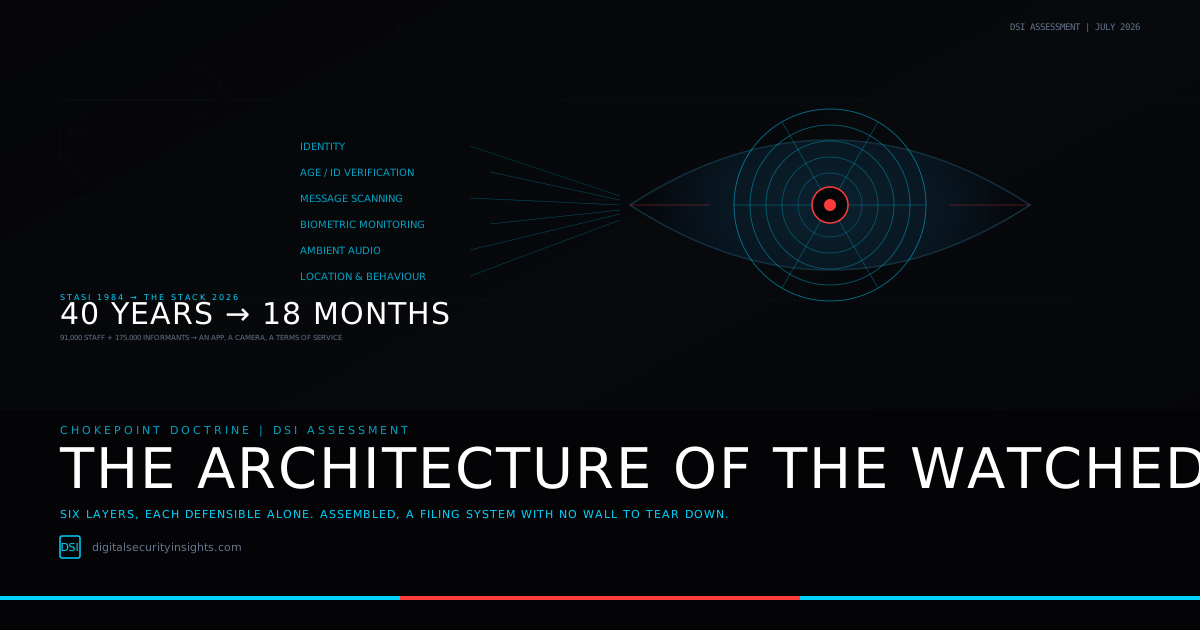
I saw The Lives of Others in 2011, and it shook me to my core — not the cruelty of the Stasi, but the ordinariness of it: a life catalogued by professionals simply doing their jobs. I have spent the years since watching a version of that filing system being rebuilt, not by a police state but by democracies, for reasons that are mostly good, using tools most people carry willingly in their pockets. This DSI assessment maps the six-layer identity-and-surveillance stack now in deployment across the EU, UK, Australia and beyond — identity wallets, age verification, message scanning, biometric driver monitoring, ambient audio, and behavioural data — each introduced with a genuine justification, and ungoverned in combination. It corrects the viral misreading of what Von der Leyen actually said, sets the 1984 Stasi against the 2026 stack, and closes with five dated, falsifiable forecasts and the risks I would put on any register I was responsible for. The Stasi needed forty years, 91,000 staff and 175,000 informants. The equivalent capability now needs an app, a camera, and a terms-of-service agreement — and there is no wall to tear down.
A Film, a File, and a Warning
I saw The Lives of Others in 2011, and it shook me to my core.
I have carried it ever since. Not the plot — plots fade — but the feeling the film leaves in you, which is harder to name and slower to leave. The German film won the Academy Award for Best Foreign Language Film in 2006; it is set in East Berlin in 1984, and its subject is Hauptmann Gerd Wiesler of the Stasi — the Ministerium für Staatssicherheit — assigned to surveil a playwright suspected of insufficient loyalty to the Party. Wiesler sits in an attic with headphones on, and below him another man loves, argues, writes, despairs, and never once suspects that his most private hours are being transcribed into a file by a stranger who will decide what they mean. You watch it happen. You know something he does not. And somewhere in the gap between what the watcher knows and what the watched cannot even imagine, the film locates a very specific kind of dread — not the loud dread of violence, but the quiet dread of exposure. Of being fully known by a power you cannot see, cannot address, and cannot appeal to.
What shook me was not the cruelty. The Stasi's cruelty is historical fact; I expected it. What I did not expect was the ordinariness. The surveillance in the film is not carried out by sadists. It is carried out by professionals — men in grey rooms filling in forms, managing equipment, meeting quotas, doing their jobs competently and without malice. The horror is bureaucratic. It is procedural. It is a career. And that, I think, is why it lodged in me and would not leave: cruelty you can see coming, but a filing system you cannot. A filing system simply grows, one defensible entry at a time, until it contains you.
I did not know, in 2011, that I would spend the years that followed watching a version of that filing system being rebuilt — not by a police state, but by democracies, for reasons that are mostly good, using tools most people carry willingly in their pockets. But the feeling the film gave me then is the same feeling I have now, reading the week's announcements. And I have learned to trust that feeling as an analyst, because it is usually the first thing to notice what the argument has not yet caught up to.
The Stasi at its peak employed approximately 91,000 full-time staff and 175,000 unofficial informants in a country of 16 million people. One informant for every 63 citizens. It held files on an estimated 6 million people — more than a third of the entire East German population. Those files documented not just political dissent but relationships, daily routines, sexual behaviour, medical conditions, family tensions, and the small dishonesties of ordinary life that could be assembled, on demand, into a case against anyone the state needed a case against.
The wall came down in November 1989. The files were opened. The scale of what had been built became visible. Germany has spent thirty-five years processing what it means to have lived inside that machine.
I want you to hold that image — the microphone in the apartment, the file in the cabinet, the informant on the street — while I describe what I watch being built today. Not because the comparison is exact. It is not. But because the question the comparison raises is the one I have circled for eighteen months without asking directly.
The Stasi needed 91,000 employees and 175,000 informants to surveil a third of its population. I keep asking myself what the equivalent capability requires now. Not employees. Not informants. An app. A camera. A terms-of-service agreement. A child-safety justification. And a population that accepted each component separately, because each component arrived with a reason that was true.
What Von der Leyen Actually Said — and What I Checked First
When the clips started circulating, I did what I always do before I draft: I went and found what was actually said. The viral version — that Ursula von der Leyen had "confirmed every EU citizen must use an EU identity app before they can post on social media" — was too consequential to repeat without checking. It turns out to be wrong in one direction and, more quietly, understated in another.
On 13 July 2026, the European Commission President received the report of the Special Panel on Child Safety Online at EU headquarters in Brussels. The panel had met three times between March and June 2026 and produced 14 policy recommendations.
Von der Leyen said what any reasonable person would say, in language that is hard to argue with on its own terms. Children under 3 should have no screen exposure. Children under 13 should access social media only under adult supervision and for limited periods. Access should be phased and gradual across age ranges. Social media is not a toy. The burden of proof should sit with providers, not with regulators, parents, and children. Car manufacturers must make their vehicles safe; we do not expect children to design their own seatbelts. She announced a proposal for member states after the summer, and named the EU's age-verification app — already in development, already interoperable with the EUDI Wallet — as one tool for implementing age-appropriate access.
So the viral framing is inaccurate as a description of what she said. She said children's access should be age-gated. She did not say adults must verify identity before posting.
But here is why I do not find that correction reassuring, and why I think it actually understates the problem. Months ago, when I mapped the age-verification architecture, I concluded that the distinction between "children must verify age" and "everyone must verify identity" is thinner than it looks — because you cannot verify age without verifying identity. That is not a political opinion. It is an engineering fact: if anyone, at any point, has to check a person's ID for a service to prove they are an adult, privacy is gone; if no one does, the system proves nothing. Every serious engineer who has looked at age verification arrives at the same wall.
I want to be careful here, because this is where I feel the pull of the argument on the other side, and I do not want to pretend I don't. I have no interest in being the person who waves away child safety to protect an abstraction. The child-safety justification is genuine. Children are genuinely harmed by algorithmic social media at scale. The Panel's own evidence — 60% of young children reporting emotional or psychosocial problems online, four to six hours a day on screens — is real and documented. If I had to look a parent in the eye, I would not tell them the harm is imaginary. My assessment is narrower, and I hold it precisely because the harm is real: the policy response under consideration is architecturally identical, in its infrastructure requirements, to a universal digital-identity mandate for internet access. The justification and the architecture are not the same thing. Conflating them in either direction is where the analysis fails — and where, I think, most of the public conversation currently sits.
The Stack, Layer by Layer
I have spent eighteen months documenting the individual components of the surveillance architecture democratic governments are assembling. Here I want to put them in one place, because I have come to believe the danger is not in any single layer. It is in the stack.
This analysis is published. Your decision isn't.
We run the same cross-domain, scenario-based foresight on the decision in front of you — a deal, a market entry, a supplier dependency. Board-ready in five days, with a foresight indicator watchlist.