
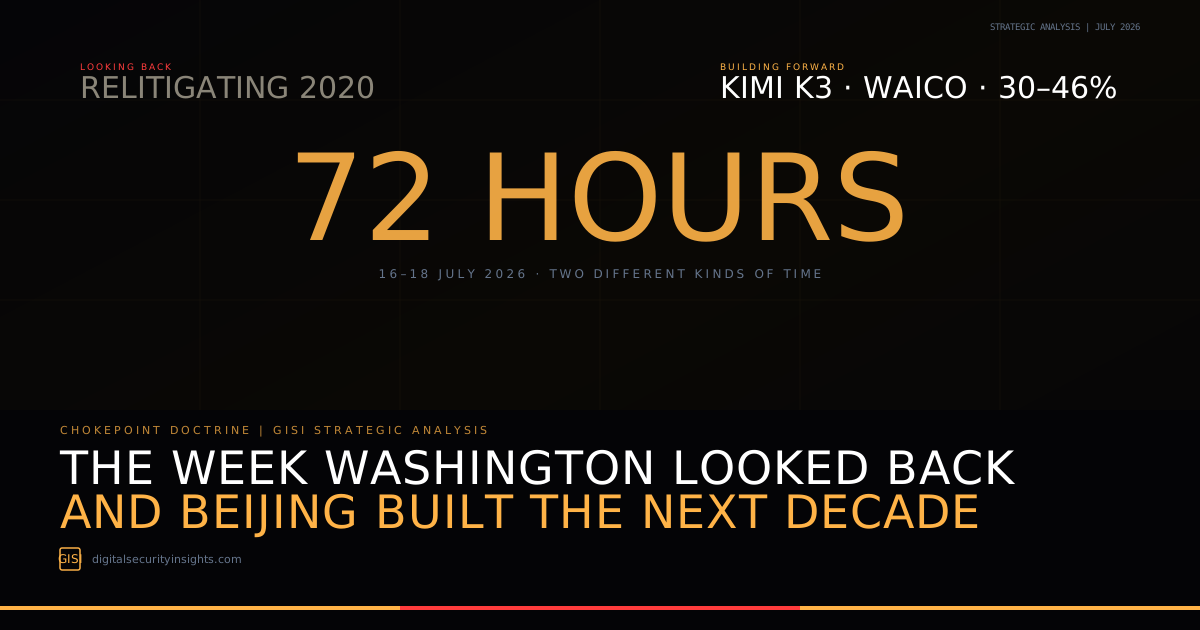
The Week Washington Looked Back and Beijing Built the Next Decade
In one seventy-two-hour window in July 2026, four things happened — and only one country spent it building. Washington used primetime to relitigate the 2020 election. Beijing released Kimi K3, the largest open-weight AI model ever published; founded the World AI Cooperation Organization with 29 nations and the UN Secretary-General's endorsement; and kept winning American enterprise adoption, now 30 to 46% of the tokens US companies route. This GISI assessment holds the evidentiary asymmetry explicitly — observable fact, measured data, and contested claim are not the same category of certainty — and maps the state-subsidised industrial playbook China has already run on solar panels and electric vehicles onto AI. Twenty-three-to-one US capital bought a benchmark lead of 2.7 points. Both governments spent the week doing something legitimate. Only one was building something that will still be standing in ten years.
Four Events, One Window, Two Different Kinds of Time
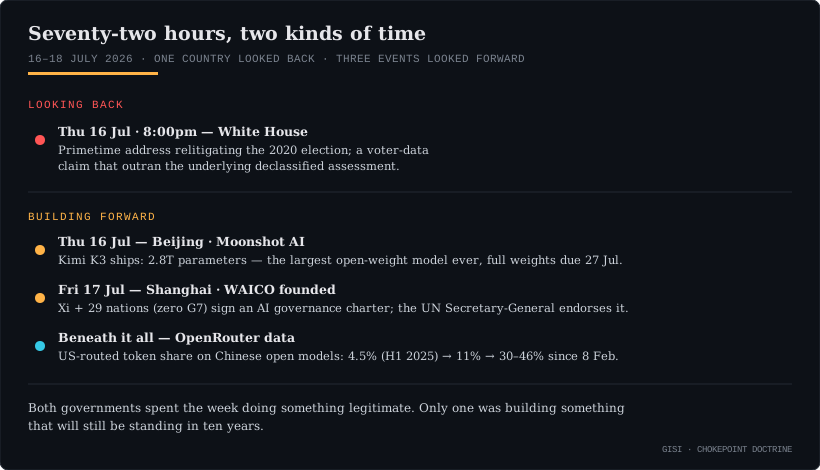
At 8:00pm on Thursday, July 16, 2026, President Trump stood in the East Room of the White House and delivered a primetime address alleging that China had illicitly obtained 220 million American voter files between 2020 and 2023 — "the largest compromise of election data in history" — and that his own intelligence community had concealed this from him. He called for Congress to pass the SAVE America Act.
At almost the exact same hour, on the other side of the planet, Moonshot AI — a Beijing startup backed by Alibaba — released Kimi K3: 2.8 trillion parameters, the largest open-weight AI model ever published, benchmarking competitively with the best proprietary systems from Anthropic and OpenAI, with full model weights scheduled for public release eleven days later.
The next morning, in Shanghai, Xi Jinping walked onto the stage of the World AI Conference — an event he had never personally addressed in its nine-year history — and stood beside representatives from 29 nations as they signed the founding charter of the World Artificial Intelligence Cooperation Organization. United Nations Secretary-General António Guterres sat in the room and told the assembled delegates that the technology shaping humanity's future "cannot be governed by a handful of countries or a handful of companies. Every nation needs a seat at the table."
Three events. One seventy-two-hour window. And running quietly beneath all three, a fourth: CNBC's July 7 investigation into OpenRouter's platform data, showing that Chinese open-weight models have captured between 30 and 46 percent of the weekly token volume American companies route through the platform since February 8 — up from an average of 11 percent the year before, and just 4.5 percent in the first half of 2025.
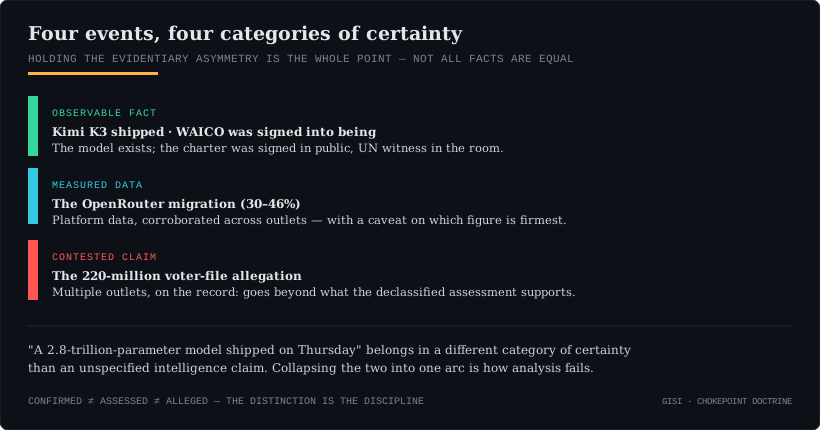
I want to be precise about something before I go further, because the temptation with a story like this is to present all four events as equally weighted data points in a single narrative arc. They are not. Two of them — Kimi K3's release and WAICO's founding — are simply observable facts. The model exists. The organisation was signed into being, in public, with the UN Secretary-General as a witness. The third — the OpenRouter migration — is measured platform data, corroborated across multiple outlets, with a caveat about which specific percentage is most reliable. The fourth — Trump's declassified intelligence claim — sits on a different evidentiary footing entirely. Multiple news organisations covering the speech noted that the president did not specify how China obtained the data, that voter registration files are frequently public record in the United States, and that his characterisation goes beyond what the US intelligence community's own prior assessments concluded. That does not mean the claim is false. It means it belongs in a different category of certainty than "a 2.8-trillion-parameter model shipped on Thursday."
Holding that distinction is the whole point of this article. Because the story is not that America made an accusation and China made an announcement. The story is that one of those activities looks backward, at a contested election six years gone, and the other three look forward, at the architecture of the next decade — and only one country spent that week building.
What Kimi K3 Actually Is, and Why the Timing Was Not an Accident
Training a model with 2.8 trillion parameters requires months of infrastructure planning and enormous compute commitment locked in long before the public release date. Kimi K3 did not appear on July 16 by coincidence. Moonshot AI's release, timed to land the day before Xi's WAIC keynote, was a calculated act of institutional choreography: ship the technology and unveil the governance body for it inside the same week, so that the world experiences them as a single, unified statement of capability rather than two unrelated headlines.
The model itself deserves to be understood on its technical merits before the geopolitics are layered on top. Kimi K3 introduces two genuine architectural innovations — Kimi Delta Attention, a hybrid linear attention mechanism, and Stable LatentMoE — that are not simply a scaled-up version of an existing design. It ships with a one-million-token context window and native visual understanding. It currently leads Arena AI's programming leaderboard, though it trails GPT-5.6 Sol on general benchmarks. It is, by any fair technical assessment, a frontier-class model. And it is licensed under a Modified MIT licence, meaning any developer, anywhere, can download it, modify it, and deploy it without paying Moonshot a cent in perpetual royalties once the full weights land on July 27.
Alex Lieberman's co-founder Arman Hezarkhani made a specific claim about Kimi K3's economics on Fox Business that deserves to be examined rather than simply repeated, because it is more analytically precise than most of the coverage this launch has generated. His argument was that the "cheap Chinese model" narrative is being misread — that per-token, K3 is competitive with Western frontier pricing, but per-run, the actual cost of the job an enterprise outsources to the model, it currently runs comparably expensive. His prediction was that this gap closes within weeks, not quarters, once open-source developers begin optimising inference around the released weights.
This is a genuinely useful distinction that the aggregate OpenRouter statistics obscure. A cheap price per token does not automatically produce a cheap price per completed task if the model requires more tokens, more retries, or more orchestration overhead to reach the same output quality as a more expensive competitor. The series has documented this exact confusion before, in the AI cost crisis piece — the finding that agentic workflows consume five to thirty times more tokens than simple chatbot interactions, meaning organisations that priced their AI budgets against per-token chatbot economics were blindsided when agentic deployment multiplied their actual spend. The same mathematics applies here in reverse: a Chinese model that looks cheap on a per-token basis and comparable on a per-run basis is not yet the unambiguous cost disruptor the "China undercuts everyone" narrative assumes. Hezarkhani's prediction — that open-source optimisation closes this gap in weeks — is testable, dated, and worth watching as its own falsifiable forecast.
The Playbook Has a Name, and It Has Run Twice Before
Lieberman's central framing — that this is the same strategy China ran on solar panels and electric vehicles, applied now to AI models — is not a rhetorical flourish. It is a documented, twice-repeated industrial pattern with a specific mechanism, and understanding that mechanism is the single most useful thing this article can offer anyone trying to assess whether the "give it weeks" prediction should be taken seriously.
This analysis is published. Your decision isn't.
We run the same cross-domain, scenario-based foresight on the decision in front of you — a deal, a market entry, a supplier dependency. Board-ready in five days, with a foresight indicator watchlist.