
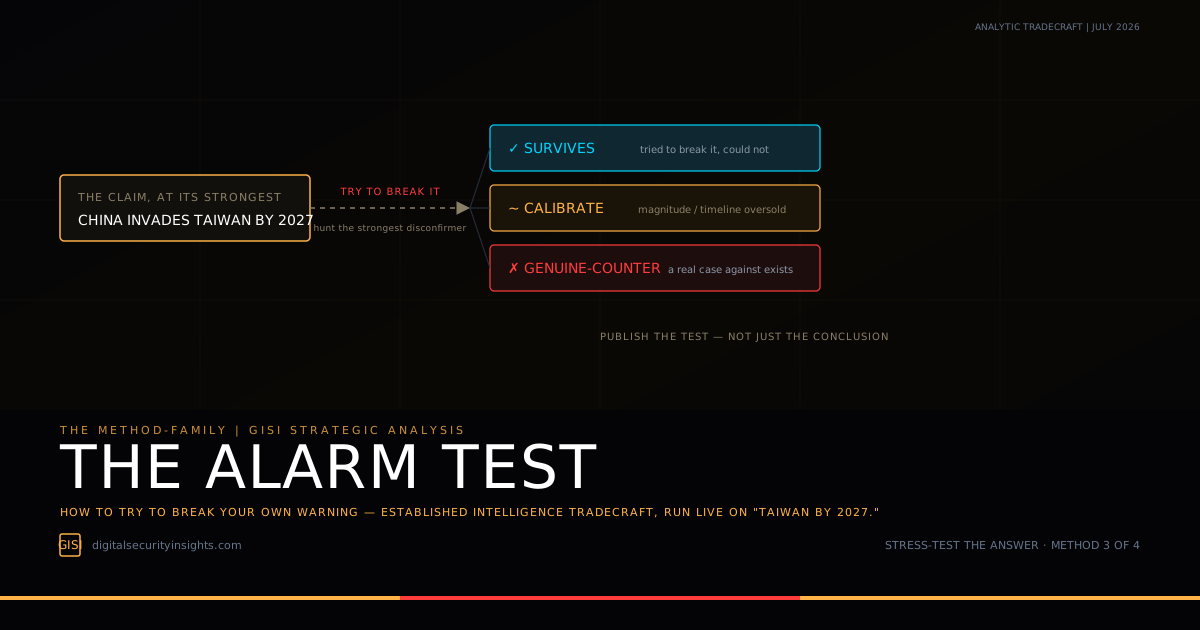
The Alarm Test: How to Try to Break Your Own Warning
Every analyst can find a warning. The discipline is knowing which ones survive a genuine attempt to break them. Here is the method — run live on the most repeated date in geopolitics: the claim that China will invade Taiwan by 2027. Stated at its strongest, tested against its own sources (Admiral Davidson's 2021 capability window; CIA Director Burns's “ready by 2027” that is not a decision to invade), it returns a CALIBRATE verdict — the structural risk survives, the scheduled-invasion date does not. The first piece in the Method-Family series: the discipline that separates intelligence from advocacy, applied to our own claims first.
Repeat a date often enough and it stops sounding like an estimate and starts sounding like a schedule. In the analyst community, and increasingly in the boardrooms that depend on it, that date is 2027 — the year, we are told with rising confidence, that China will invade Taiwan. It appears in risk registers, in supply-chain contingency decks, in the opening slide of more briefings than I can count. It has the two qualities a claim needs to spread: it is specific, and it is frightening.
It is also, in the form most people repeat it, not what the original sources said. That gap — between a warning and what actually stands behind it — is where an intelligence analyst is supposed to earn their keep. So let me use the most repeated alarm in geopolitics to demonstrate the single most useful piece of tradecraft I know, and one that almost nobody performs in public: the deliberate attempt to break your own warning before you sound it.
The move, and why it is rare
Most security and geopolitical commentary sounds every alarm it finds. Intelligence analysis does the opposite: it tests each alarm and reports the ones that hold. I call the disciplined version of this the Alarm Test, and it is not a new science — it is established intelligence tradecraft, turned on our own field's warnings rather than only on the adversary. The lineage, and the shoulders it stands on, are set out in full on our methodology page. What is worth teaching here is the discipline of running it, in four steps, in the open.
Step one: state the claim at its strongest
An honest test needs an honest target, so I will not caricature the alarm. Stated in its sharpest, most falsifiable form, it is this: the People's Republic of China will launch a military invasion of Taiwan on or before the end of 2027. Not "tensions will rise." Not "a crisis is possible." An invasion, a date, a claim that can be proven wrong. If I am going to try to break it, I owe it the strongest version.
Step two: assign it a genuine adversary
Now I argue against my own alarm as hard as I can, and the first place to look is the alarm's own pedigree. Where does 2027 come from? Trace it back and it converges on two public statements, both of which say something narrower than the claim they now underwrite.
The first is Admiral Philip Davidson, then head of US Indo-Pacific Command, testifying to the Senate Armed Services Committee in March 2021. He warned that the threat to Taiwan "could be manifest during this decade, in fact in the next six years." Six years from 2021 is 2027. But read the sentence again: it describes a window in which the risk could materialise, an assessment of the trend line, not a forecast that an invasion will occur. It is a statement about danger, not a statement about intent.
The second is CIA Director William Burns, in early 2023, who said that Chinese intelligence indicated Xi Jinping had instructed the People's Liberation Army to be ready to invade Taiwan by 2027. This is the sharper-sounding source, and it is routinely quoted as the smoking gun. But Burns did not stop there. He added, in the same breath, that this "does not mean that he has decided to conduct an invasion in 2027, or any other year." The Director of the CIA, delivering the very intelligence that anchors the alarm, drew the exact distinction the alarm erases: readiness is a capability, not a decision.
This analysis is published. Your decision isn't.
We run the same cross-domain, scenario-based foresight on the decision in front of you — a deal, a market entry, a supplier dependency. Board-ready in five days, with a foresight indicator watchlist.