

The Method Beneath the Map
Methodology reference for the Chokepoint Doctrine series. How GISI assigns probability bands, why the numbers carry analytical weight, the Tetlock-style decomposition that produces them, the rerate-trigger discipline that keeps them honest, and the three categories of question where we refuse to forecast at all. Show the work or the work does not count. The work is the band, the decomposition, the trigger, the limit, and the refusal to forecast where the forecast would not survive its own publication.
The methodology reference piece for the Chokepoint Doctrine series. How GISI assigns probability, why the numbers carry weight, and what discipline distinguishes a forecast from a guess.
Why Most Security Analysis Lies About Uncertainty
A reader of the Chokepoint Doctrine series asked the question that the discipline of strategic analysis is structured to avoid. The Two Doctrines, One Coastline piece assigned forty percent probability to one scenario, thirty percent to another, twenty-five percent to a third, and five percent to a tail risk. How were those numbers actually derived? The question is correct. The honest answer is that those numbers are structured professional judgments calibrated against historical base rates and updated by specific 2026 evidence. They are not the output of a Monte Carlo simulation. They are not the output of a forecasting tournament. They are the output of a discipline that the security analysis community uses constantly and rarely shows its work on, and the failure to show the work is the reason most security analysis is correctly distrusted by the operators who have to act on it.
The Chokepoint Doctrine series exists because the operators — CISOs, finance directors, energy traders, sanctions desks, ministry advisors — need forecasts they can act on. A forecast they can act on requires three properties the conventional security commentariat usually does not deliver. It requires a number that decomposes into something the reader can interrogate. It requires named triggers that, when they occur, force the number to update. And it requires an honest articulation of the conditions under which the forecast does not apply at all. This piece is the permanent reference for how GISI delivers those three properties, why the discipline behind them is the discipline of forecasting under deep uncertainty, and what the reader is meant to do with the output.
The Base-Rate Discipline
The foundational move in any honest forecast is what Daniel Kahneman, in Thinking, Fast and Slow, called the outside view. The outside view asks what the base rate is. How often does the class of event the forecaster is being asked to predict actually occur, across the historical record of similar events, regardless of the specific features of the current case? The outside view is the discipline that prevents the most common forecasting error, which is overweighting the specific features of the current case at the expense of the empirical reality of how often that class of case actually resolves in the direction the forecaster has been asked to predict.
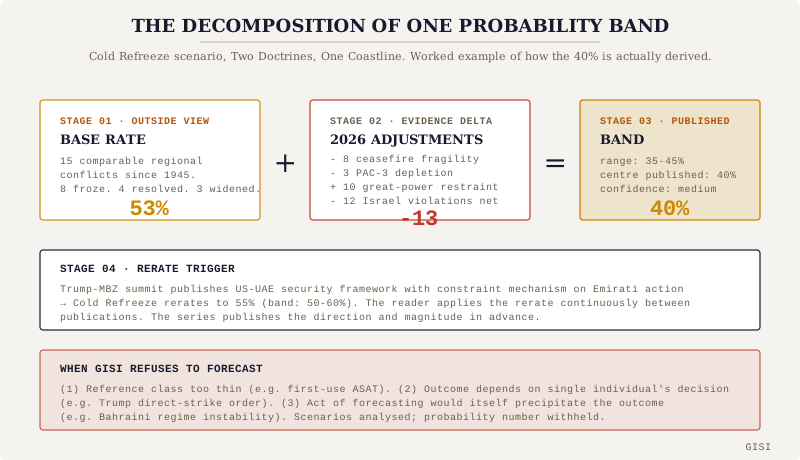
The Two Doctrines, One Coastline piece assigned forty percent probability to a Cold Refreeze scenario in the 2026 Iran war — the path where the April ceasefire holds in stuttering form, Iran rebuilds drone production, the Emirates is constrained, and Brent settles in an eighty-five-to-ninety-five-dollar range. Where does forty percent come from? The outside view: of fifteen comparable regional conflicts since 1945 in which no great power had both the capability and the political will to force decisive termination, approximately eight resolved into long frozen standoffs, four ended in decisive resolution, and three escalated wider. Eight out of fifteen is fifty-three percent. That fifty-three percent is the base rate. The forecast rerated it to forty percent because the specific evidence of 2026 — the documented fragility of the April ceasefire framework, the Israeli day-one violation of the Lebanon clause, the Patriot interceptor depletion curve — all push downward on the probability of a clean frozen-standoff resolution. The base rate is the anchor. The adjustment is the analytical work. The number the reader sees is the base rate plus the adjustment, with the analytical work documented for inspection.
The Tetlock Decomposition
Philip Tetlock’s twenty-year work on forecasting accuracy, summarised most accessibly in his book Superforecasting, established that forecasters who outperform expert panels do so primarily through three behavioural disciplines. They begin with the outside view and update incrementally as new information arrives. They decompose questions into smaller sub-questions whose answers compose into the larger forecast. And they assign probabilities in fine-grained bands rather than the coarse buckets — likely, possible, unlikely — that natural language defaults to. The Good Judgment Project, the multi-year forecasting tournament Tetlock co-led, validated these disciplines against the predictions of intelligence analysts with classified access, and the superforecasters using these disciplines from open sources alone outperformed the intelligence community analysts by margins that the intelligence community itself eventually adopted into its own training curriculum.
The Chokepoint Doctrine series operates inside the same discipline. Every probability band the series assigns is the output of a decomposition. The forty percent assigned to Cold Refreeze decomposes into the base rate (fifty-three percent), the downward adjustment for ceasefire fragility (negative eight points), the downward adjustment for Patriot depletion (negative three points), the upward adjustment for great-power restraint architecture (positive ten points net, after subtracting the Israeli factor), and the residual confidence interval that accounts for the analyst’s own uncertainty about the adjustments. The number forty percent is the centre of a band that runs from thirty-five to forty-five. The series publishes the centre because the centre is what the reader can compute with, but the discipline behind the centre is the band.
The same decomposition applies to the thirty percent assigned to Israeli Veto Holds, the twenty-five percent to Iranian Asymmetric Escalation, and the five percent to Wider Coalition War. Each carries its own base rate from a different reference class, its own deltas from the specific evidence of 2026, and its own residual band. The series publishes all four centres because they sum to one hundred percent in a way that reader can evaluate, but the disciplined reader reads each one as a band.
The Rerate-Trigger Discipline
A forecast that does not specify the conditions under which it would update is not a forecast. It is an opinion. The distinguishing feature of an actionable forecast is the named trigger event whose occurrence would force the assigned probability to rerate, in a specified direction, by a specified magnitude. The intelligence community calls these triggers indicators and warnings. The forecasting community calls them rerate criteria. The Chokepoint Doctrine series calls them inflection events and publishes a calendar of them for every scenario the series assigns.
This analysis is published. Your decision isn't.
We run the same cross-domain, scenario-based foresight on the decision in front of you — a deal, a market entry, a supplier dependency. Board-ready in five days, with a foresight indicator watchlist.