
INTELLIGENCE FEED
Every DSI, GISI, and ARIA briefing in one chronological feed. Filter by publication, follow the thread, and act before the rest of the world catches up.
No Means No. Except When It Does.
On 9 July 2026 the European Parliament revived Chat Control 1.0 — three months after rejecting it. A majority of MEPs still voted against (314 to 276, 17 abstentions), but under the second-reading procedure the EPP engineered, blocking it required an absolute majority of 361. Opponents fell 47 short. The vote count is not the story. The procedure that inverted the burden of proof — timed for the last day before recess — is.
The Sixth Attempt
The EU's 'Chat Control' is back for the sixth time - and the way it is coming back matters more than whether it passes. Chat Control 1.0, the interim derogation letting US platforms voluntarily scan unencrypted messages for CSAM, expired on 3 April 2026 after Parliament rejected an extension 311-228 (not, as claimed, by a single vote). The Council is reviving it through a formally 'new' law with identical content: an urgent-procedure vote cleared the way 331-304 on 7 July, with the substantive vote on Thursday 10 July - the last sitting day before recess, when 361 members (an absolute majority) would be needed to stop it. Whose interest does this serve? Several at once: a genuine child-protection case; institutional pressure (four Commissioners lobbied MEPs); the EPP closing a 'legal gap' while dodging the Chat Control 2.0 vote its members are blocking; and - the interest nobody names - legal-cover restoration for Meta, Google, Microsoft and Snap, who have scanned without authorisation since April. My assessment: this is not the EU overriding democracy but circumventing it through procedure while keeping formal cover - harder to name, and harder to stop. And the surveillance architecture (EUDI Wallet, age verification, ADDW cameras) keeps building regardless of Thursday's vote. Every box is governed; the intersection is no one's job.
The Shadow of the Future — Q2 2026 Special Report
Our Q2 2026 Special Report. Robert Axelrod showed cooperation among rivals survives only where four conditions hold - a long shadow of the future, clear signals, enforceable reciprocity, and legible reputation. Across every domain we cover - chokepoints, ransomware, cyber attribution, the AI race, the quantum transition, digital identity, and the dollar itself - the security environment is systematically destroying those four conditions. The report scores seven games on one board, asks whose game we are actually in (China's Go, Russia's reflexive control, the West's chess), names the Defection Premium as the largest unpriced liability on the balance sheet, and grades our own Q2 forecasts in the open. Read the interactive report or download the 67-page PDF.
The Camera That Cannot Be Turned Off
Since 7 July 2026, every new car and van registered in the EU must carry an infrared camera aimed at the driver's face - the Advanced Driver Distraction Warning (ADDW), specified under the General Safety Regulation. It tracks gaze, warns after 3.5 seconds' distraction above 50 km/h, and cannot be permanently turned off. The safety case is real (the wider package is projected to save 25,000+ lives by 2038) and the rule prohibits facial recognition. But the regulation mandates the hardware while leaving the data surface unanswered - retention, sharing, insurer and law-enforcement access - and the same automakers now installing it have already been documented collecting, sharing, and losing connected-vehicle data. The stronger concern is structural: the camera is always-on infrastructure, and the Commission has committed to further ADDW requirements by July 2027. My assessment: this is 'every box is governed, the space between is no one's job' arriving on the road. The camera cannot be turned off - and who benefits from what it sees, beyond the driver, is still being answered by the parties with the most incentive to answer it in their own favour.

The Credential You Can't Change
Your voiceprint is not a password. A password can be changed; your voice cannot. In January 2021 Walmart settled for $10M over palm scans of 22,000 Illinois employees; by July it was sued over warehouse-headset voiceprints, then over uploading shoppers' faces to a Clearview AI database - three biometric systems, one company, all under Illinois's Biometric Information Privacy Act, the only US law that lets individuals sue. McDonald's, Chipotle, Verizon, Microsoft Teams face the same claims; 107 BIPA class actions were filed in Illinois in 2025 alone. In 47 of 50 states, collecting your fingerprint, face, or voiceprint needs no consent, no disclosure, and carries no consequence. Under GDPR Article 9 it is special-category data requiring explicit consent, with fines to EUR 20M or 4% of turnover - and the EU AI Act bans workplace emotion inference from 2 August 2026. My assessment: this is not a regulatory gap but a policy choice, applied to the one category of data that is permanent. If the database holding your voiceprint is breached, the credential is compromised for life - and in 47 states no one is obliged to tell you.

Two Straits, One Funeral, and What Medvedev Just Said Out Loud
Flying back from Ayatollah Khamenei's state funeral in Tehran, Russia's Dmitry Medvedev said the Strait of Hormuz has become a weapon 'no weaker than a nuclear weapon' for Iran - and that Iran holds 'a thermonuclear weapon in reserve, the Bab el-Mandeb Strait.' Medvedev does not speak carelessly. This piece puts his claim under scrutiny: Hormuz carries a fifth of world oil and works as a deterrent whose power derives from the threat, not the use; Bab el-Mandeb carries roughly a tenth of global trade by volume and, as the Houthi campaign proved, can be disrupted by a non-state actor without physical control. The nuclear analogy names the energy market; the thermonuclear analogy names the entire container-shipping architecture. Delivered at a funeral no Western government attended, as France and the UK signal naval deployment to Hormuz and Iran answers with a sovereignty claim, the statement reframes the series' four-month chokepoint map: what this series read as vulnerabilities, Moscow is naming as weapons. The thermonuclear weapon has not been used - which is the most important fact in the statement, and the reason he said it out loud.

Every Box Is Governed. The Space Between Is No One's Job.
Is there an industry ShinyHunters has not breached lately? Food distribution, healthcare, higher education, entertainment, telecoms, finance, the Council of Europe. Sysco: 61 million Salesforce records claimed on 16 June, published after the 18 June deadline, 2,691,852 confirmed on HaveIBeenPwned by 28 June. The question is not who they target. It is whether sector, size, and security budget are all secondary to one variable: whether an unrevoked OAuth token is sitting in your Salesforce connected apps or a 2023 code commit. My assessment: ShinyHunters is not a group you arrest but a brand and a playbook that outlive their operators — one industrialised technique (voice-phish an employee or scan GitHub for forgotten tokens, both bypassing passwords; enumerate the CRM; loop and exfiltrate; extort). The reason the industry keeps being surprised is not sophistication. It is that the monitoring is pointed at the boxes, and the attack happens in the space between them. Every box is governed — identity, exposure, data, software, AI, supply chain, governance. The space between is no one's job. That argument is now a book: The Wrong Map, reading cybersecurity as political economy across Susan Strange's four structures. Contributors welcome — especially the dissenters.

Your Smart TV Is Someone Else's Criminal Infrastructure
On 2 July 2026, the FBI and IRS Criminal Investigation seized NetNut, a residential proxy service run by the NASDAQ-listed Israeli company Alarum Technologies, after Google and partners degraded the Popa botnet — roughly two million consumer devices, including the Android TV box and smart television under millions of ordinary homes, enrolled with little or no consent. A residential proxy routes criminal traffic through real home connections, so when a target checks the source it sees your ISP and your city, not a data centre. In one week of June 2026, Google's Threat Intelligence Group counted 316 distinct threat clusters — criminal and nation-state — using NetNut exit nodes; a comparable network, IPIDEA, carried APT28, Sandworm, and Volt Typhoon. My assessment: the FBI's advice to avoid cheap streaming boxes is correct and insufficient, and this is not a botnet you kill but a market you would have to close, resilient because the same infrastructure serves legitimate ad-verification and nation-state espionage alike. The connected device is the permanent weak point: the risk rides an access path you never chose to open. What to do today: segment your smart devices onto a separate network, and ask what the box under your television does when the television is off.
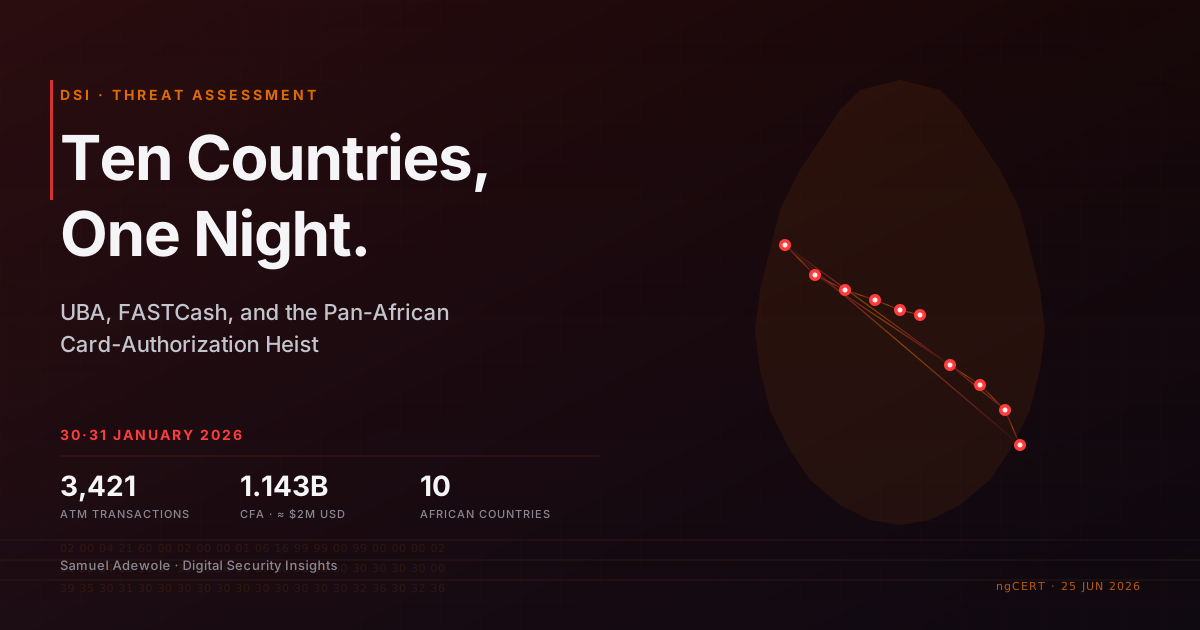
Ten Countries, One Night: UBA, FASTCash, and the Pan-African Card-Authorization Heist
On the night of January 30, 2026, 3,421 ATM withdrawals against the United Bank for Africa drained 1.143 billion CFA francs from 91 customer accounts. The transactions happened in three Senegalese cities — Dakar, Thiès, Kaolack — and were mirrored simultaneously against UBA subsidiaries in nine other African countries. The attackers had what they always have in this pattern: privileged access to the card-authorization infrastructure. FASTCash, the eight-year-old North Korean cash-out playbook, has landed in West Africa at pan-African banking scale — and ngCERT's advisory came five months after the night the money walked.

If You Put Data in a US Cloud, You Share It With US Intelligence
From a conference stage, Claus Balslev, head of digitalisation at Denmark's STAR labour-market agency, said the sentence everyone hedges around: if you put data in a US cloud, you share it directly with the US intelligence service. Then he acted on it, migrating STAR's systems off Microsoft and onto European cloud in roughly nine months, and saving money doing it. My assessment: the statement is not rhetoric, it is the precise legal architecture. The CLOUD Act attaches jurisdiction to the US entity, not the data; FISA 702 authorises bulk collection from US providers with no warrant and a gag order; RISAA (2024) extends reach toward the silicon itself; and the 12 June 2026 Fable/Mythos AI suspension proved Washington can switch off the capability globally by letter. Asked under oath before the French Senate in 2025 whether Microsoft could guarantee EU data is never sent to US authorities, Microsoft France's legal-affairs director answered: no. This is not a governance gap but a governance collision, two irreconcilable legal systems applied to the same data, which is why Safe Harbor, Privacy Shield, and soon the current framework all fall. Residency is where the bits sit; sovereignty is who controls access. STAR removed the last excuse, and the AI layer is the next Schrems ruling.

The MOU Is Dead. The Series Called It.
Breaking update. Between 2 and 3am on 28 June 2026, Iran's IRGC launched ballistic missiles and drones at two US military facilities at once - the Ali Al Salem Air Base in Kuwait and the Fifth Fleet headquarters at Salman Port in Bahrain - claiming eight installations destroyed, after a second wave of US strikes on Iran. It is the end of a 48-hour collapse: the drone strike on the container ship Ever Lovely and the IMO's paused evacuation of 11,000 sailors on 25 June, a US strike on the 27th, Iran's drone hit on the tanker Kiku carrying 2 million barrels of crude, a second US strike, and Israel's approval of continued operations in southern Lebanon two days after a ceasefire. The Versailles MOU of 17 June is functionally dead. A week ago, in 'The War That Cannot End,' my assessment was that the MOU was as valid as its weakest enforcement node, and that the node was in Jerusalem. Four written judgments - the Lebanon tripwire, Netanyahu's electoral calendar, Iran's temporal asymmetry, and the resumption of tanker attacks - have now been confirmed in 48 hours. This is a fight over a shipping lane, and Iran is enforcing a claimed sovereignty over Hormuz with ballistic missiles. The MOU was the pause, not the settlement.

The Root of Trust That Already Leaked
In June 2024, Paradigm Initiative proved the largest data leak in Nigerian history by buying it: for 100 naira a record, rogue sites were selling the NIN, BVN, passport, and phone number of 104 million Nigerians from NIMC's database, including the slips of the digital-economy minister and the national data regulator. On 27 June 2026, President Tinubu signed the NIMC Act 2026, replacing a 19-year-old law, and named that same commission the Root Certification Authority for Nigeria's national PKI. My assessment: the Act hardens the cryptography, but the 2024 breach was never cryptographic. It leaked through custody and access, third-party agents with legitimate credentials, the exact layer a certificate hierarchy does not fix. The new 14-agency board (INEC, DSS, EFCC, CBN, the population commission, the national security adviser) concentrates the state's coercive machinery around one dataset. For every Nigerian fintech, identity verification now chains to a single sovereign root you cannot switch away from, held by a custodian with a demonstrated breach history. The law is overdue and much of it is sound. But a root of trust is the one credential that cannot be reissued, and it now sits on the custody layer that already failed once, at the scale of a nation. What to watch: the secondary regulations, the data regulator's enforcement teeth, the access-governance layer, and whether any redress ever reaches the 104 million.

The Text String That Cost a Decade
In March 2026, FulcrumSec found an Azure Container Registry token in a public JavaScript bundle on a Novo Nordisk subdomain. Two months later it had walked out with 1.3 terabytes: 41,000 drug compounds, 30 trained AI models, and a marketed drug's manufacturing recipe. The pharmaceutical industry's credential problem, mapped globally.

The War That Cannot End
Why the Strait of Hormuz keeps closing, why the salt caves have a floor, and why Netanyahu's calendar is the variable that no peace deal can govern. Four thousand feet below Louisiana and Texas, the US strategic petroleum reserve sits in salt caverns with a hard physical floor: below roughly 150-250 million barrels of its 714-million capacity, the caves begin to collapse and the oil is lost, not depleted but structurally destroyed. That floor is the clock behind the 17 June Versailles MOU between Trump and Pezeshkian, and behind Trump's urgency for peace. But the deal has a structural flaw visible before the ink dried: its first clause requires a ceasefire on all fronts, and the enforcer on the Lebanese front is a state that never signed it. By 21 June Iran had re-closed Hormuz over continued Israeli strikes in Lebanon; the Switzerland talks then collapsed, JD Vance left without an agreement or a handshake. My assessment: Netanyahu's Lebanon strikes are not a survival calculation but a compulsion, and rational-actor theory cannot model a compulsion. Iran does not need to win; it needs to outlast, and it can absorb punishment that would end any Western government. The MOU is as valid as its weakest enforcement node. That node is in Jerusalem.

The Strait Held by Permission
Since the 2026 Iran war opened on 28 February, Iran has pushed at least 11.7 million barrels of crude through the Strait of Hormuz it declared closed — every barrel to China, and on 4 March it made the arrangement explicit: only Chinese vessels may pass. The strait was never closed. It was reserved. Western coverage of the 20 June closure reads the map upside down. Hormuz carries ~20 million barrels a day, close to a third of seaborne crude, and almost 90% sails east — China 5.4 mb/d, India, Japan, and South Korea another slice each. The hostage is not the empire; it is the Global South that buys from the Gulf, led by Iran's own creditor. The weapon points home: ~90% of Iranian crude leaves via Kharg and must transit Hormuz, so a blockade of the strait is mechanically a blockade of Iran — which is why Tehran is quietly loading at Jask, beyond the chokepoint. And the leverage belongs to the buyer: China pre-stocked its reserves, kept Brent near $80 when analysts forecast $200, and now sets the price of any closure. Iran holds the geography. Beijing holds the economy of the geography. This is conditional sovereignty in the energy age — the inherited chokepoint exercisable only on terms set elsewhere. Part II of two; Part I is 'The Architecture Beneath the Signature.'

The Weakest Custodian in the Chain
985,000 passports and driver's licences sat on public URLs with no password, no access control, nothing. No hack, no exploit chain. The custodian was not a government agency or a bank but Nefos Solutions, a two-person Irish startup that built membership software for Spanish cannabis clubs, with a Stripe key in plain text inside its app. My assessment: this is not one breach. France Titres (national identity agency, IDOR found by a 15-year-old, 11.7M records), the UK Visa Portal (guessable URL, 100,000+ passports), the Texas hunting-licence vendor (third-party breach, 3.09M Texans), and Nefos (public URL, 985,000 passports) are four expressions of one structural reality. From the most capable national agency to a two-person startup, the security outcome is identical: government identity documents on the open internet. The EU's age-verification mandate will create thousands more Nefos-scale custodians collecting the one category of data that cannot be reset. Identity documents are only as secure as the weakest custodian in the chain that now holds them. Extends the DSI EU regulatory series: France Titres, the EUDI Wallet, and the age-verification oxymoron.

The Identities Nobody Owns. And Now They Act.
After the October 2023 Okta compromise, Cloudflare rotated more than five thousand credentials. On Thanksgiving Day a nation-state actor walked into its Atlassian environment anyway — through the four machine identities the rotation missed: a Moveworks service token, a Smartsheet account with admin rights to Jira, a Bitbucket account reaching source code, an AWS credential. Every one a non-human identity nobody believed was theirs. This is Part II of the cross-cutting threat analysis: a vulnerability is a property of a component, a threat is a property of the system, and the actors crossing your organisation are now overwhelmingly not human. Machine identities outnumber people by as much as eighty to one, nearly half hold privileged access, and OWASP now publishes a separate Top Ten for them. A service account is a seam with permissions — connective tissue that spans the boundaries human silos are built around, held by an account no team owns. And the seam has begun to act: AI agents are non-human identities that reason, hold credentials across every silo at once, and can be redirected by a planted instruction at machine speed. The fix is the same operating model from Part I, extended to actors that are not people: every machine identity and every agent needs a named owner, a defined scope, an expiry, and a decommissioning trigger. Run the removal test this afternoon — pick any service account or agent and ask who owns it, what it can do, and when it expires.

Security Doesn't Need Another Framework. It Needs an Operating Model.
On 12 January 2024, a Russian state actor read the email of Microsoft's senior leadership. Not through a zero-day — through a forgotten legacy test tenant with no MFA, an over-permissioned OAuth app, and an elevated consent grant nobody owned. The path crossed four domains; not one team owned the route. Every control was green. Storm-0558 was the same shape: a consumer signing key accepted as valid for enterprise mailboxes — a seam between two identity planes. This is the failure the industry refuses to name. A vulnerability is a property of a component; a threat is a property of the system. We have spent two decades building frameworks that make each silo defensible in isolation and almost no time building the thing that lets a defender reason across them the way an attacker already does. The fix is not another framework. It is an operating model — decision rights, intake, prioritisation, governance, delivery engagement — the connective tissue that owns the seams. Run the removal test: if your security function vanished tomorrow, would any business decision change? Part I of two. Part II continues on ARIA.

The Architecture Beneath the Signature
The United States and Iran are the ones signing the deal that ended the 2026 Iran war. Qatar and the UAE are the ones who actually made it possible. The UAE has unlocked $10B for Iran with $3B+ already delivered, in exchange for halted attacks and economic-intelligence cooperation. Qatar holds $6–12B in Iranian frozen assets under custody — the $6B from the September 2023 South Korea transfer, restricted to humanitarian use, never released after October 7. Tehran cannot access any of it without Doha. This is the first major US–Iran deal in fifty years not architected by the United States. The Full Threat Surface framework applied to the deal across four dimensions — physical geography (Hormuz, Al Udeid, the dual-track positioning), logical architecture (the three-layer financial mechanism), governance architecture (the ad-hoc enforcement coalition with no precedent), and adversarial intent (Iranian pragmatists vs hardliners, UAE $500B self-preservation, Qatar's strategic positioning, Trump's narrative needs, Israel's disruption vector). The predictive intelligence layer: four probability-banded scenarios across the oil path from current $80s through December 2027, mapped against Gulf fiscal break-evens (KSA $80, UAE $60, Qatar $45, Kuwait $70). The deeper question the diplomatic coverage is not asking: whether the Gulf states can sustain the mediation through the recession their own success helped to create.

The New Munitions List
In the early 1990s, exporting strong cryptography from the United States was, legally, exporting a weapon. A T-shirt with RSA source code was a controlled export. Phil Zimmermann spent three years under US Customs investigation for publishing PGP. It took most of a decade — and Executive Order 13026 in November 1996 — to dismantle the regime. The signal, WhatsApp, Telegram, TLS, and every banking app on every phone exist in their current globally-available form because that restriction was eventually lifted. On Friday 12 June 2026, at 5:21pm ET, the same structural argument returned in a sharper form. A letter from the US government to Anthropic. Fable 5 and Mythos 5 suspended for any foreign national worldwide. The artefact has changed — from published math to hosted frontier model. The mechanism has changed — from court enforcement to a configuration flag at a single provider. The argument has not. The market consequence will not either. Whoever fills the gap during the restricted years keeps the customers after liberalisation. The companion historical-precedent piece to “The Export Control That Reached Inside the Model.”