
The Questions Doctrine
The security industry asks the right questions about the wrong map. The value is in asking the better question first.
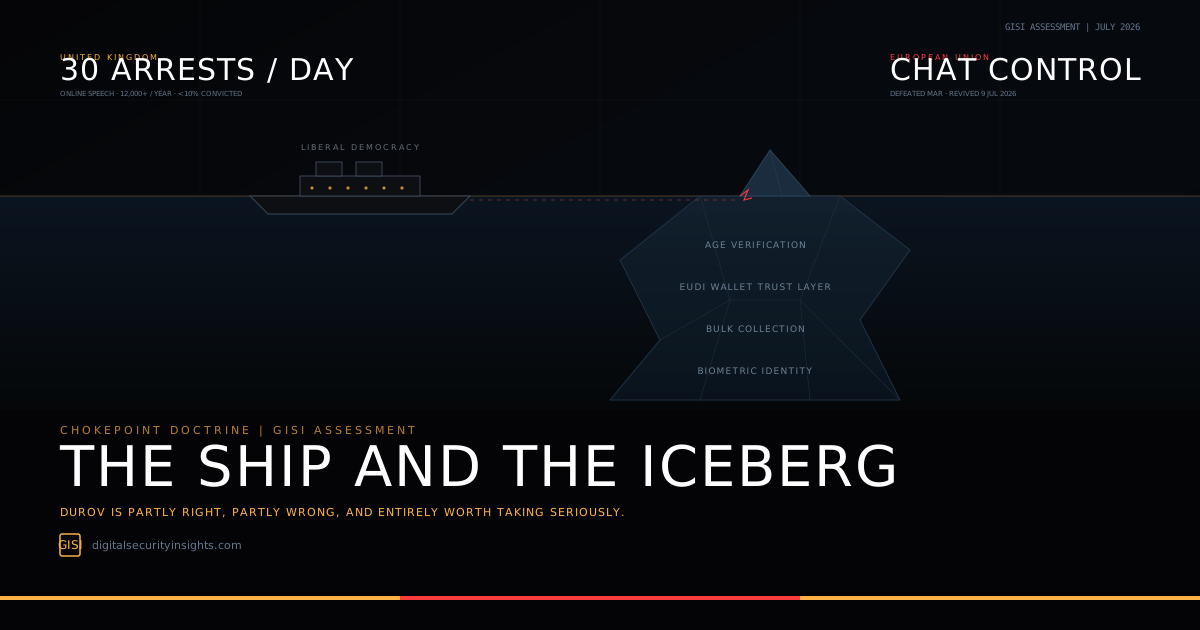
Pavel Durov says the ship of our personal freedoms has hit the iceberg and is sinking without us realising it. He is partly right, partly wrong, and entirely worth taking seriously. This GISI assessment evaluates his argument against the evidence: the UK's 30 online-speech arrests a day, Germany's platform-fining model, France's crypto-kidnapping wave, the EU's Chat Control revival on 9 July 2026, and the online-safety regimes of Australia and New Zealand. What is accurate survives scrutiny. What is exaggerated — the collapse of the distinction between Western democracies and Russia, China, and Iran — does not. The right question is not whether the West is becoming authoritarian. It is whether the architecture being built in the name of safety — age verification, identity wallets, bulk collection, biometric mandates — creates the conditions under which essential liberty becomes, in practice, optional, regardless of who governs it. The series has been asking that question. The answer, so far, is not consistently yes.

Is there an industry ShinyHunters has not breached lately? Food distribution, healthcare, higher education, entertainment, telecoms, finance, the Council of Europe. Sysco: 61 million Salesforce records claimed on 16 June, published after the 18 June deadline, 2,691,852 confirmed on HaveIBeenPwned by 28 June. The question is not who they target. It is whether sector, size, and security budget are all secondary to one variable: whether an unrevoked OAuth token is sitting in your Salesforce connected apps or a 2023 code commit. My assessment: ShinyHunters is not a group you arrest but a brand and a playbook that outlive their operators — one industrialised technique (voice-phish an employee or scan GitHub for forgotten tokens, both bypassing passwords; enumerate the CRM; loop and exfiltrate; extort). The reason the industry keeps being surprised is not sophistication. It is that the monitoring is pointed at the boxes, and the attack happens in the space between them. Every box is governed — identity, exposure, data, software, AI, supply chain, governance. The space between is no one's job. That argument is now a book: The Wrong Map, reading cybersecurity as political economy across Susan Strange's four structures. Contributors welcome — especially the dissenters.

Part II of the Governance Gap trilogy. The operational requirement that follows from the strategic finding: every security architecture is built against the threat model that the current architecture was already adequate to detect — which means the threat operating in the governance gap is, by definition, the one your architecture cannot see. The four wrong questions enterprise security is organised to answer (compliance, breach, supply chain, incident response) and the right ones (adversarial view, inference, shared infrastructure, intersection) that the full threat surface framework requires. France Titres, Snowflake, Trellix, the NIS2 / NiS2 chemical-plant scenario — each as evidence the gap is operational, not theoretical.

Part I of the Governance Gap trilogy. The Chokepoint Doctrine series’ central finding, stated as its central thesis for the first time: no institution has the mandate, the expertise, and the authority to govern the full threat surface of any critical system simultaneously, and the adversary’s operational architecture is specifically designed to exploit the space between the institutions that cannot coordinate fast enough. The three wrong questions Western institutions are asking — What is the adversary doing? Which institution is responsible? How do we deter the adversary? — and the right questions that should replace them. The governance gap is the chokepoint. Everything the series has documented is a symptom.